Freediving vs Scuba Diving: Key Differences Explained
By DivePlnr Editorial Team | Published April 2026 | Updated April 2026
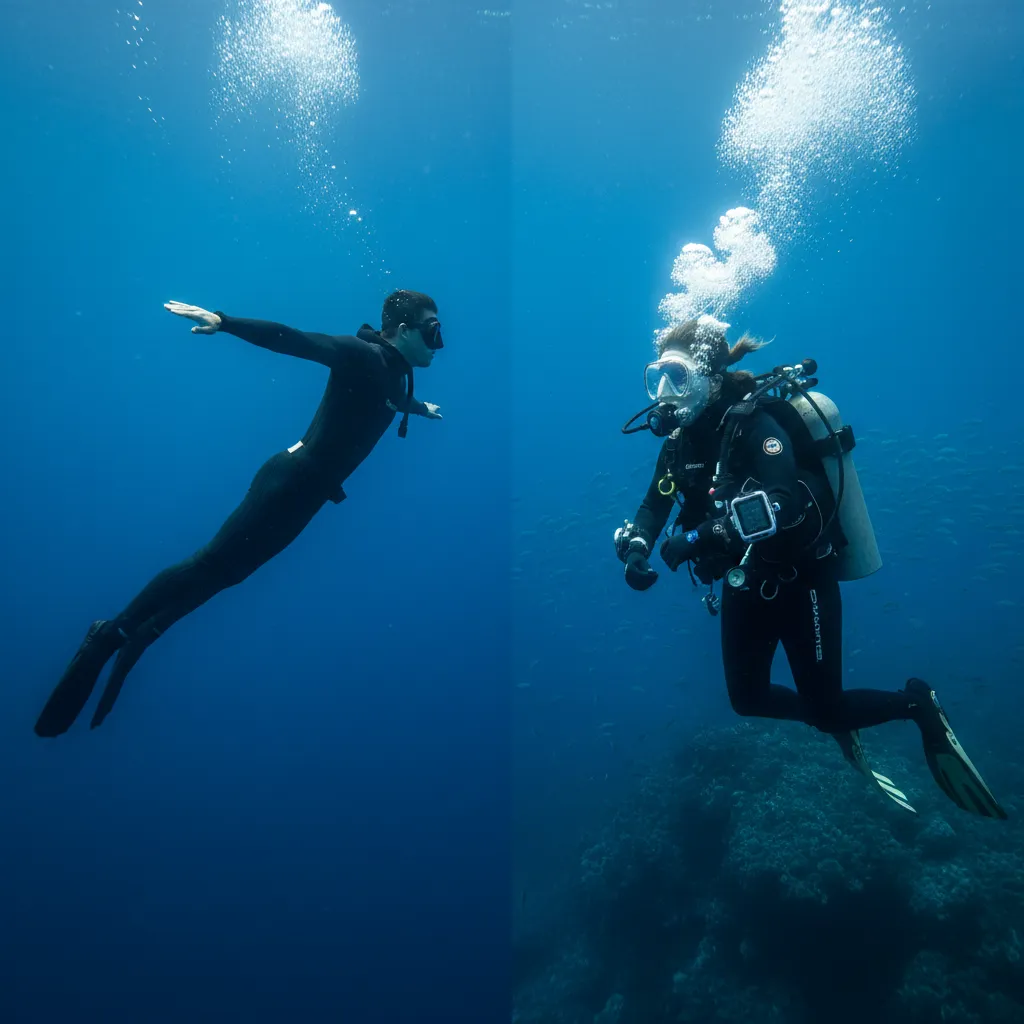
Freediving and scuba diving both take you beneath the surface, but the experience couldn't be more different. One relies on a single breath and inner calm; the other on technology and extended bottom time. Understanding the differences helps you choose your path - or embrace both.
The Fundamental Difference
Scuba diving uses compressed gas (typically air or enriched air nitrox) delivered through a regulator, allowing you to breathe continuously underwater for 45-90 minutes. Freediving relies entirely on a single breath held from the surface. This fundamental distinction shapes everything - the equipment, the training, the risks, and the experience itself.
Equipment Comparison
Scuba Gear
A full scuba setup includes a BCD (buoyancy control device), regulator, tank, wetsuit, mask, fins, weight system, and dive computer. Rental gear for a day of diving typically costs $30-60. Owning a full kit runs $2,000-5,000+. Learn more in our equipment guide.
Freediving Gear
Freedivers need a low-volume mask, long-blade fins, a snorkel, a wetsuit (often open-cell for better flexibility), a weight belt, and a dive watch or freediving computer. The total investment is significantly lower - a complete setup runs $500-1,500.
Certification Paths
Scuba certifications follow a well-established progression: Open Water, Advanced Open Water, Rescue Diver, and Divemaster through agencies like PADI or SSI. An Open Water course takes 3-4 days and costs $300-500.
Freediving has its own certification bodies - AIDA (Association Internationale pour le Developpement de l'Apnee) and SSI Freediving are the most recognised. A Level 1 / Freediver course covers breath-hold techniques, safety protocols, and usually takes 2-3 days at a similar cost to a scuba Open Water course.
Depth and Time Underwater
Recreational scuba divers are limited to 40m (130ft) and can spend 45-90 minutes underwater depending on depth and air consumption. Freediving depth depends on training - beginners typically reach 10-20m, while advanced freedivers regularly exceed 30-40m. However, bottom time per dive is measured in seconds to a few minutes, not the extended exploration that scuba allows.
Physical Requirements
Scuba diving is accessible to almost anyone in reasonable health. The equipment does the breathing work - you need basic swimming ability and comfort in water, but exceptional fitness isn't required.
Freediving demands more from your body. Breath-hold training, diaphragmatic breathing exercises, and cardiovascular fitness directly impact your performance. Yoga and meditation practitioners often take naturally to freediving because of their existing breath control skills.
Safety Considerations
Each discipline has distinct risks. Scuba divers face decompression sickness, air supply management, and equipment failure scenarios. Freedivers face shallow-water blackout (losing consciousness on ascent), hypoxia, and barotrauma from depth changes without continuous air supply. Both require proper training and a buddy system - but the buddy's role differs significantly.
Wildlife Encounters
This is where things get interesting. Many marine animals react differently to scuba divers versus freedivers. The noise and bubbles from scuba regulators can startle shy species. Freedivers - silent and bubble-free - often get closer encounters with whales, dolphins, sharks, and other megafauna. Underwater photographers increasingly prefer freediving for this reason.
Conversely, scuba diving allows you to wait patiently at a cleaning station or on a coral bommie for extended periods, observing behaviours that freedivers simply can't witness in their brief bottom time.
The Growing Crossover Community
Many experienced divers practice both. Freediving improves your air consumption and relaxation when scuba diving. Scuba diving teaches you about marine ecosystems and dive planning. The skills complement each other beautifully. If you're debating which to learn first, scuba diving is more accessible for complete beginners, but both are equally valid starting points.
Cost Comparison
| Factor | Scuba Diving | Freediving |
|---|---|---|
| Entry certification | $300-500 | $300-450 |
| Full personal gear | $2,000-5,000 | $500-1,500 |
| Per-dive cost (guided) | $40-100 | $0 (self-guided after training) |
| Ongoing costs | Tank fills, servicing, boat fees | Minimal - fins and mask |
Key Takeaways
- 1Scuba gives extended bottom time (45-90 min) with equipment; freediving gives brief but intimate encounters on a single breath
- 2Freediving gear costs a fraction of scuba equipment - $500-1,500 vs $2,000-5,000 for a full kit
- 3Marine life often reacts more calmly to freedivers due to the absence of bubbles and regulator noise
- 4Freediving certifications (AIDA, SSI Freediving) are comparable in duration and cost to scuba Open Water
- 5Many divers practice both - the skills are highly complementary
Frequently Asked Questions
Is freediving more dangerous than scuba diving?
Both carry risks, but the risks are different. Scuba's main risks are decompression sickness and air supply issues; freediving's main risk is shallow-water blackout. Statistically, fatality rates are comparable when both are practiced with proper training and a buddy. Never freedive alone - a buddy who can rescue you from a blackout is essential.
Can I try freediving without certification?
Technically yes - anyone can hold their breath and dive. But formal training teaches critical safety protocols, especially recognising and responding to blackout. Even a basic course dramatically reduces your risk and improves your technique. Many dive centres offer introductory freediving experiences similar to Discover Scuba.
Which is better for underwater photography?
It depends on the subject. Freediving is superior for large, skittish marine life (whales, dolphins, mantas) because you're silent and agile. Scuba is better for macro photography, reef portraits, and any subject requiring patience and stability at depth. Serious underwater photographers often hold both certifications.