Jeff’s Edge - Coral Sea

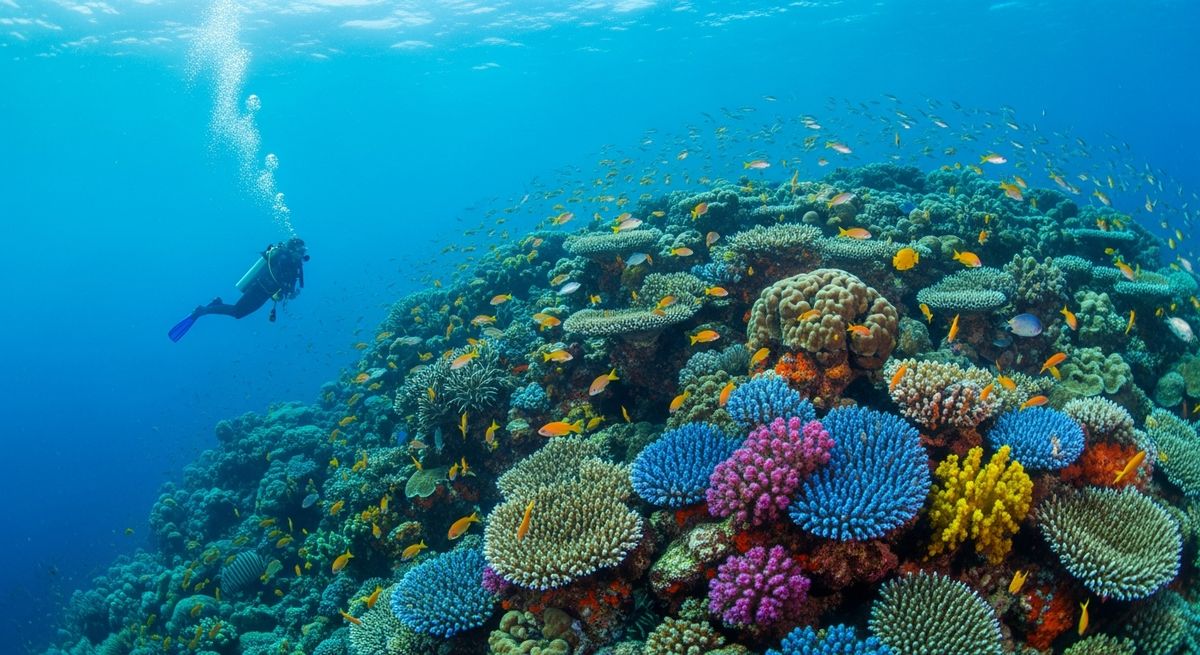
Matavera Point holds a special spot for us, a place where Rarotonga really shows off its stronger currents and bigger fish. We love how this reef plateau, sitting around 20 metres, just pushes out into the blue, creating a visible corner where the water masses collide. Drop down, and you’re on a proper vertical wall, not just a slope, that just keeps going. It’s where you’ll often feel a decent push, which means the pelagics often cruise past – we’ve seen eagle rays ghosting by more than once here. The schools of fusiliers and damsels on the wall are so thick they sometimes make the light ripple, and we often spot several types of wrasse darting in and out, like the colourful pearl-spotted and dusky wrasse. Keep an eye out for Isabel’s hermit crabs scuttling around, and the striking Achilles tang. This spot is definitely one for the more experienced diver who appreciates a bit of current and the potential for larger visitors. The visibility here is usually excellent, often pushing 35 metres, so you get a great sense of the wall’s scale.

Location
Coral Sea, Australia, Australasia
Coordinates
-23.883900, 152.417700
Type
reef

Best Time to Dive in Coral Sea

The warmest water temperatures in Coral Sea occur in March, averaging 28.3°C. The coolest conditions are in August at 21.2°C.

Monthly Water Temperatures

  • January: 27.9°C
  • February: 28.3°C
  • March: 28.3°C
  • April: 27.2°C
  • May: 25.0°C
  • June: 23.0°C
  • July: 21.6°C
  • August: 21.2°C
  • September: 22.3°C
  • October: 24.3°C
  • November: 26.3°C
  • December: 27.7°C

Nearby Dive Sites in Coral Sea

Nearest Dive Centres to Jeff’s Edge

Marine Life in Coral Sea

Home to 120 recorded species including 73 reef fish, 30 hard corals, 8 seagrass & algae, 3 other, 2 sharks & rays, 1 whales & dolphins.

Notable Species

Recommended Packing List for Jeff’s Edge

Based on average water temperature of 25.2°C, currents 5 cm/s.

  • Shorty or Rashguard - warm 25°C water needs minimal exposure protection
  • Mask - essential for every dive
  • Fins
  • BCD - buoyancy compensator
  • Regulator - your most safety-critical piece of gear
  • Dive Computer - tracks depth, time, and NDL
  • Surface Marker Buoy (SMB) - essential for boat pickups
  • Dive Torch - useful for crevices and colour at depth
  • Underwater Camera - capture your diving memories

Frequently Asked Questions

What is the typical depth range for scuba diving at Jeff's Edge?
The maximum depth for scuba diving at Jeff's Edge is 20m. This depth range makes it accessible for divers with various certification levels, allowing for extended bottom times and thorough exploration of the reef.
What marine life and underwater features can divers expect to see at Jeff's Edge?
Divers at Jeff's Edge can expect to explore a vibrant reef environment. The site is particularly known for an impressive array of sharks and rays, including whitetip sharks, blacktip sharks, grey reef sharks, eagle rays, sting rays, and bull rays. Keep an eye out for these magnificent creatures during your dive, as well as other potential encounters.
How challenging is diving at Jeff's Edge, and is it suitable for beginner divers?
Diving at Jeff's Edge is considered intermediate in difficulty due to significant water movement and strong currents. While exhilarating for experienced divers, it is not typically recommended for beginner divers. Divers should be comfortable with drift diving techniques and current conditions to safely enjoy this dynamic site.
What is the best time of year to dive at Jeff's Edge for optimal conditions and marine life sightings?
The provided data does not specify the best time of year to dive at Jeff's Edge for optimal conditions or marine life sightings. We recommend checking local dive operator information or our When to Dive section for seasonal insights specific to the Coral Sea region.
What scuba diving certifications are required or recommended to dive at Jeff's Edge?
Given the intermediate difficulty and strong currents conducive to drift diving at Jeff's Edge, an Advanced Open Water certification or equivalent is highly recommended. Divers should also have experience or specialized training in drift diving. This ensures you can safely and confidently enjoy the dynamic conditions of the site.
What are the typical current conditions at Jeff's Edge, and is it primarily a drift dive site?
Jeff's Edge is renowned for significant water movement and strong currents, making it primarily a drift dive site. Divers can expect to be transported by the current on the outer edge, covering long distances effortlessly. This provides an exhilarating experience, feeling like you're flying underwater.