Wreck Bay
Why dive here
With 154+ marine species recorded in the area - including hammerhead sharks, sea turtles, tiger sharks and napoleon wrasse - Wreck Bay offers some of Great Barrier Reef's richest wreck diving. Water ranges 24-30°C, warmest January, February, March.
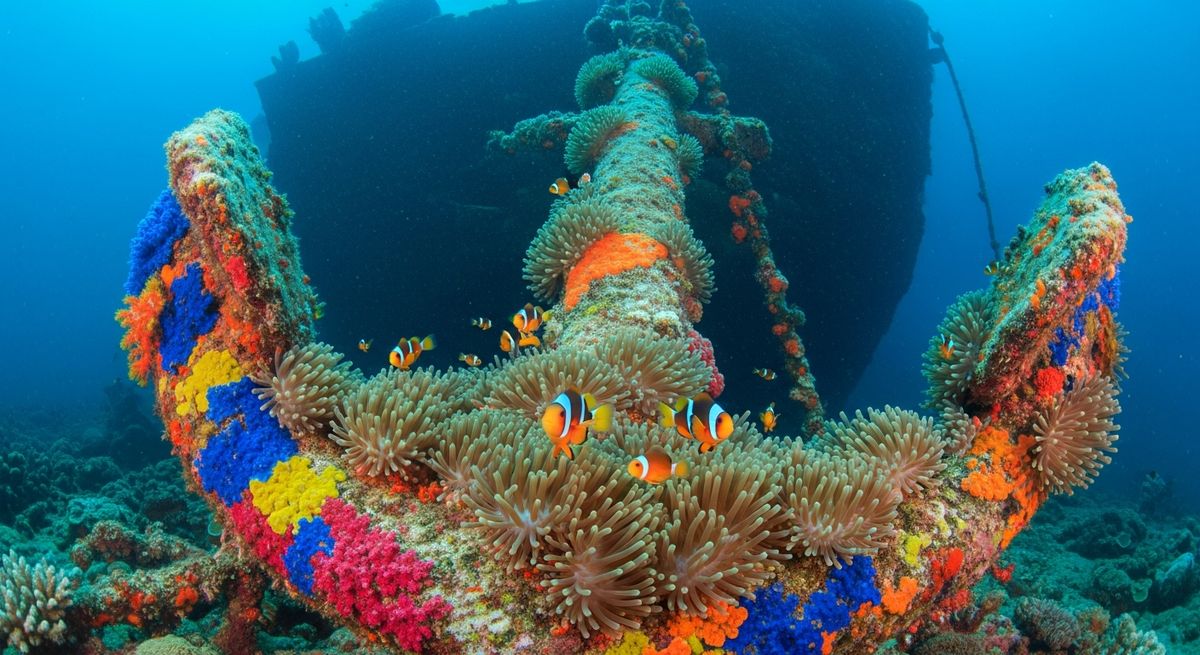
Wreck Bay on the Great Barrier Reef isn't about some grand, intact vessel. Forget the perfectly preserved ships you see in magazines. This is a site where history has been thoroughly reclaimed by the ocean. What you get here is a scatter of metal, ribs, and plates, completely overgrown, making it more like an artificial reef than a traditional wreck. We love how the structure, whatever it once was, has merged so completely with the coral, particularly the staghorn. It's a fantastic spot for bumphead parrotfish, which we’ve often seen cruising over the jumbled metal, casually munching on the coral. Look closely among the nooks and crannies for blue-lined surgeonfish and the dark-fin chromis that flit in dense clouds. It’s a gentle drift, typically, with visibility decent enough to pick out the bigger structures from a distance. Our favourite part? Finding those little surprises – a shy batavian parrotfish tucked into a gap, or a big long-nosed butterflyfish pecking at the encrusting coral. This site suits divers who appreciate the subtle beauty of nature taking over, rather than those hunting for a grand historical statement.
Safety Notes
Wreck site - avoid penetration without wreck diving certification. Watch for sharp metal and entanglement hazards.
Strong currents typical this month (avg 30 cm/s). Good buoyancy control essential.
Wreck Bay Wreck History
Vessel Type
unknown
Cause
unknown
Wreck Bay, located on the Great Barrier Reef, is not a single wreck but a historic graveyard of ships, a testament to the treacherous nature of navigating these beautiful but dangerous waters in centuries past. Over the years, numerous vessels, from early sailing ships to more modern craft, have met their end on the bay's hidden reefs, often during powerful storms. For divers, Wreck Bay offers a unique sense of exploration. Rather than a single intact vessel, the site is a scattered collection of maritime history, with anchors, chains, and hull fragments slowly being reclaimed by the vibrant coral ecosystem. Exploring Wreck Bay is a dive into the GBR's rich maritime past, where every piece of coral-encrusted metal tells a story.
Nearest Dive Centres to Wreck Bay
Dive shops near Wreck Bay
View all dive centres in Great Barrier ReefReviews for Wreck Bay
Conditions
Ocean conditions, forecast and tides for Wreck Bay
Wreck Bay Ocean Conditions
Monthly averages for Wreck Bay, sourced from Open-Meteo marine data + Copernicus Marine (EU) - nearest station: Open-Meteo marine grid (-15.65, 145.72) (5km away)
October Averages
Sea Temperature
26°C
80°F · Range: 24.5–29°C
Current Speed
30.07 cm/s
Direction: S (183.8°)
Chlorophyll-a
0.057 mg/m³
Very clear (oligotrophic)
Salinity
35.08 PSU
Based on 4 years of monitoring data · Data sources: Open-Meteo marine data + Copernicus Marine (EU)
Plan & book
Ways to dive Great Barrier Reef, from day trips to liveaboards.
Day trips & courses
via GetYourGuideGuided dives, courses and snorkel trips with instant booking.
Find dive trips in Great Barrier ReefPlaces to stay
via Booking.comHotels and dive resorts near Great Barrier Reef.
Search stays in Great Barrier ReefDive insurance
Most travel insurance excludes or limits scuba. Check what you need before you go.
Dive insurance explainedPartner links: we may earn a commission if you book, at no extra cost to you. How we make money
Where to Stay near Wreck Bay
Prices from Booking.com. We may earn a commission at no extra cost to you.