Urquharts Bay
Protected Area
Bream Islands
Why dive here
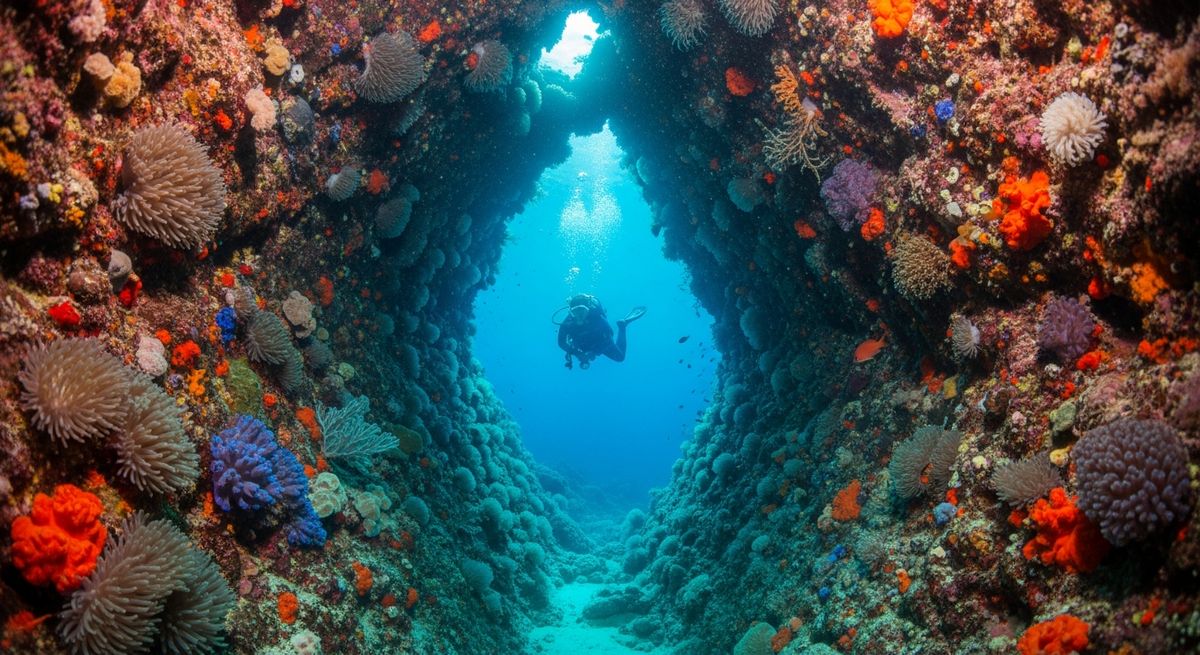
With 79+ marine species recorded in the area - including blue sharks, dolphins, hammerhead sharks, humpback whales and orcas - Urquharts Bay offers some of Poor Knights Islands's richest cave diving. Water ranges 15-22°C, warmest January, February, March.
Okay, Urquharts Bay. Let’s be honest, it’s not the Poor Knights’ showpiece deep dive. But we love it for a completely different reason: it’s a brilliant, easy shore entry, shallow water wonderland, especially if you’re looking for macro life or just a gentle, current-free bimble. The walk in from the carpark, past the toilets and water fountain, is straightforward. But that long, shallow wade out across the bay? It feels like forever on tired legs, and yes, the bottom is notoriously squishy. Our tip: take your time, shuffle your feet, and enjoy the anticipation. Once you hit that 3-4 metre mark, it completely changes. The visibility often sits around 3 metres, which sounds low, but it forces you to slow down and really look. We've had some incredible encounters here: watching a Bulldog Stargazer peek its eyes out of the sand, a Spotted Robust Triplefin darting between rocks, and the rich colours of purple sunset clams. We’ve found octopus lurking around the mooring blocks, and on a good day, the snapper are curious. It’s a site for the patient observer, the photographer, or anyone who wants a relaxed, unhurried poke around without boat schedules or big depths. Forget big pelagics; come here to appreciate the small, the subtle, and the wonderfully weird.
Safety Notes
Overhead environment - never enter without proper cave/cavern training, redundant equipment, and a guideline.
Nearest Dive Centres to Urquharts Bay
Dive shops near Urquharts Bay
DIVE NOW
Moana Futures Ltd
Dive! Tutukaka
Reviews for Urquharts Bay
Conditions
Ocean conditions, forecast and tides for Urquharts Bay
Urquharts Bay Ocean Conditions
Monthly averages for Urquharts Bay, sourced from Open-Meteo marine data + Copernicus Marine (EU) - nearest station: Open-Meteo marine grid (-35.84, 174.61) (14km away)
October Averages
Sea Temperature
16°C
60°F · Range: 14.8–17.1°C
Current Speed
11.4 cm/s
Direction: SE (142.1°)
Chlorophyll-a
0.388 mg/m³
Moderate productivity
Salinity
35.44 PSU
Based on 4 years of monitoring data · Data sources: Open-Meteo marine data + Copernicus Marine (EU)
Plan & book
Ways to dive Poor Knights Islands, from day trips to liveaboards.
Day trips & courses
via GetYourGuideGuided dives, courses and snorkel trips with instant booking.
Find dive trips in Poor Knights IslandsPlaces to stay
via Booking.comHotels and dive resorts near Poor Knights Islands.
Search stays in Poor Knights IslandsDive insurance
Most travel insurance excludes or limits scuba. Check what you need before you go.
Dive insurance explainedPartner links: we may earn a commission if you book, at no extra cost to you. How we make money
Where to Stay near Urquharts Bay
Prices from Booking.com. We may earn a commission at no extra cost to you.