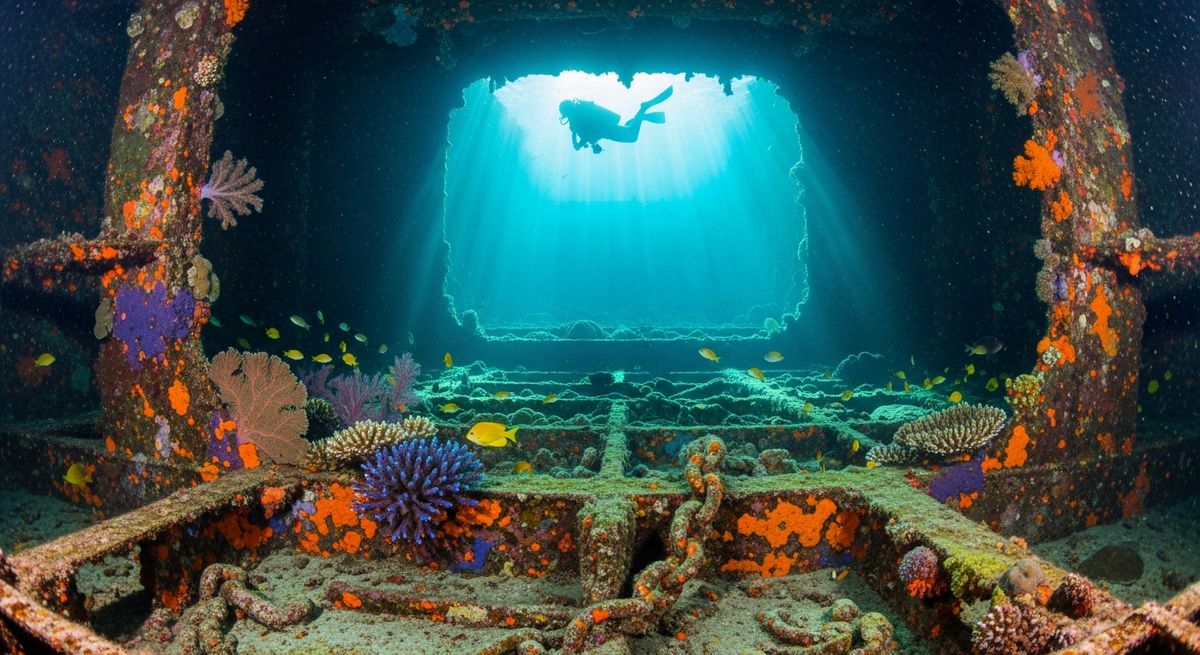
Wonderview
Protected Area
Cape Rodney-Okakari Point
Why dive here
With 79+ marine species recorded in the area - including blue sharks, dolphins, hammerhead sharks, humpback whales and orcas - Wonderview offers some of Poor Knights Islands's richest wreck diving. Water ranges 15-22°C, warmest January, February, March.
Wonderview, for us, is a shallow sanctuary, perfect for when the weather kicks up or you just want to take it slow. The entry can be a scramble down a steep track, so we always suggest taking your time with your gear. Once in, you’re greeted by a jumble of boulders, each one draped in thick kelp. We love following the shafts of sunlight that cut through the canopy, illuminating the electric blue of New Zealand demoiselles darting amongst the fronds. Keep an eye out for the roughy sheltering in the dimmer pockets, and often you’ll spot a short-tail stingray resting on the sandy patches between the rocks. It’s a site for lingering, for peering into crevices where a blackfoot pāua might be clinging on, or watching the oblique-swimming triplefins flitting about. Wonderview really suits those who appreciate the smaller details and enjoy a relaxed, bright dive without the pressure of going deep.
Safety Notes
Wreck site - avoid penetration without wreck diving certification. Watch for sharp metal and entanglement hazards.
Wonderview Wreck History
Year Sunk
1944
Vessel Type
aircraft
Cause
scuttled
On Valentine's Day 1944, this B-17G Flying Fortress was returning from a bombing raid on the railway yards of Verona, Italy, when it came under heavy anti-aircraft fire. With one engine destroyed and another failing, the pilot, Lieutenant Chaplick, realized he couldn't make it back to his base. He skillfully navigated the crippled bomber towards the coast of Corsica and performed a perfect water landing in the Bay of Calvi, allowing all ten crew members to escape safely before the plane sank beneath the waves.
Today, the B-17 of Calvi is one of the most famous and beloved aircraft wrecks in the Mediterranean. It rests perfectly upright on a sandy seabed at a depth of 25 meters, looking as if it could take off at any moment. The visibility is often excellent, allowing divers to take in the entire 30-meter wingspan. The cockpit is accessible, the plexiglass nose is intact, and the dorsal and tail gun turrets are still in place. The wreck is a stunning piece of history and a vibrant artificial reef, attracting a variety of marine life, making it a must-do dive for any visitor to Corsica.
Nearest Dive Centres to Wonderview
Dive shops near Wonderview
GOAT ISLAND DIVE and SNORKEL
NEW ZEALAND DIVING
Auckland Scuba - Silverdale
Reviews for Wonderview
Conditions
Ocean conditions, forecast and tides for Wonderview
Wonderview Ocean Conditions
Monthly averages for Wonderview, sourced from Open-Meteo marine data + Copernicus Marine (EU) - nearest station: Open-Meteo marine grid (-35.84, 174.61) (14km away)
October Averages
Sea Temperature
16°C
60°F · Range: 14.8–17.1°C
Current Speed
11.4 cm/s
Direction: SE (142.1°)
Chlorophyll-a
0.388 mg/m³
Moderate productivity
Salinity
35.44 PSU
Based on 4 years of monitoring data · Data sources: Open-Meteo marine data + Copernicus Marine (EU)
Plan & book
Ways to dive Poor Knights Islands, from day trips to liveaboards.
Day trips & courses
via GetYourGuideGuided dives, courses and snorkel trips with instant booking.
Find dive trips in Poor Knights IslandsPlaces to stay
via Booking.comHotels and dive resorts near Poor Knights Islands.
Search stays in Poor Knights IslandsDive insurance
Most travel insurance excludes or limits scuba. Check what you need before you go.
Dive insurance explainedPartner links: we may earn a commission if you book, at no extra cost to you. How we make money
Where to Stay near Wonderview
Prices from Booking.com. We may earn a commission at no extra cost to you.