Bimini Barge (Wreck)
Why dive here
With 367+ marine species recorded in the area - including barracuda, dolphins, dwarf minke whales, humpback whales and nurse sharks - Bimini Barge (Wreck) offers some of Abaco's richest wreck diving. Water ranges 24-30°C, warmest July, August, September.
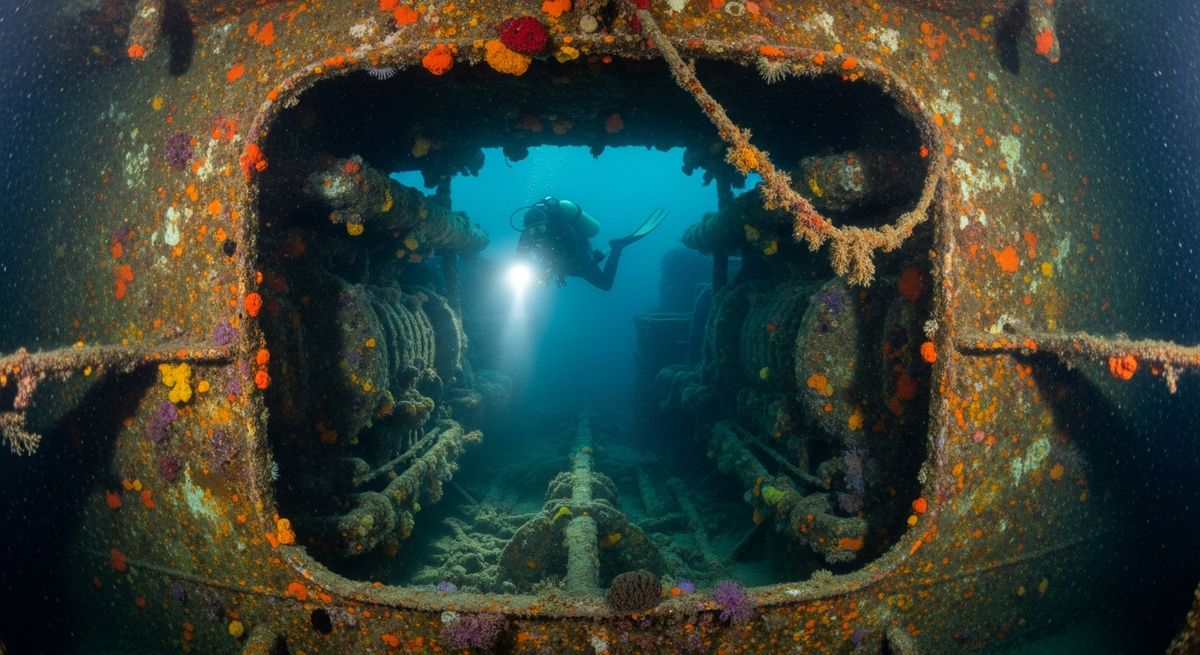
The Bimini Barge is one of those wrecks that just hits right, particularly for us when we're in the mood for something a bit more chilled out than a deep penetration. Sitting upright in only 17 metres, it’s not going to challenge your deco limits, but it offers a solid 30-40 minutes of really engaging exploration. We love how the structure has become a high-rise apartment block for resident fish. You’ll find loads of grunts tucked into every shadowy corner, their stripes almost vibrating in the ambient light, and big schools of snapper just hanging out above the deck, often so thick they shimmer like a silver curtain when the sun catches them. Our favourite thing to do here is just slow down, maybe poke around the cargo holds – which are wide open and safe – looking for the resident green moray eel we almost always spot peeking out. It’s perfect for intermediate divers who appreciate a wreck that’s been thoroughly integrated into the reef ecosystem, rather than just a rusty hulk. The visibility here is often fantastic, 20 metres plus, so you get a great sense of the wreck's scale as you approach, its dark silhouette rising from the sandy bottom. Best dived on an incoming tide, we find, when the water is often at its clearest.
Typical Bimini Barge (Wreck) Dive Profile
Illustrative profile based on site depth and type. Actual dive profiles vary - always follow your dive computer and training.
Safety Notes
Wreck site - avoid penetration without wreck diving certification. Watch for sharp metal and entanglement hazards.
Always perform a 3-minute safety stop at 5m before surfacing.
Bimini Barge (Wreck) Wreck History
Vessel Type
barge
Cause
unknown
The Bimini Barge is a fascinating piece of maritime history, believed to be one of the concrete ships built during the World Wars. Faced with steel shortages, the United States commissioned fleets of vessels built from reinforced concrete. While durable and cheap to produce, they were heavy and slow, and few saw active service. Many, like this barge, were later repurposed, often scuttled to serve as breakwaters or, in this case, an artificial reef.
Lying at a depth of 17 meters in the warm, turquoise waters of the Bahamas, the Bimini Barge has become a spectacular and popular dive site. Its large, flat deck and open holds provide a perfect habitat for a vast array of marine life. Divers are often greeted by resident sea turtles, southern stingrays gliding across the sand, and schools of horse-eye jacks that swirl around the superstructure. The wreck's simple, open structure makes it safe and easy to navigate, offering a world-class reef dive on a truly unique type of vessel.
Reviews for Bimini Barge (Wreck)
Conditions
Ocean conditions, forecast and tides for Bimini Barge (Wreck)
Bimini Barge (Wreck) Ocean Conditions
Monthly averages for Bimini Barge (Wreck), sourced from NOAA NDBC + Copernicus Marine (EU) - nearest station: 8722670 - Lake Worth Pier, FL (297km away)
October Averages
Sea Temperature
28°C
83°F · Range: 25.1–30.8°C
Air Temperature
27°C
80°F
Current Speed
4.47 cm/s
Direction: NW (296.6°)
Chlorophyll-a
0.047 mg/m³
Very clear (oligotrophic)
Salinity
36.54 PSU
Wind Speed
5.4 m/s
10.5 knots
Atmospheric Pressure
1014.5 hPa
Visibility
22 nmi
Based on 5 years of monitoring data · Data sources: NOAA NDBC + Copernicus Marine (EU)
Plan & book
Ways to dive Abaco, from day trips to liveaboards.
Day trips & courses
via GetYourGuideGuided dives, courses and snorkel trips with instant booking.
Find dive trips in AbacoPlaces to stay
via Booking.comHotels and dive resorts near Abaco.
Search stays in AbacoDive insurance
Most travel insurance excludes or limits scuba. Check what you need before you go.
Dive insurance explainedPartner links: we may earn a commission if you book, at no extra cost to you. How we make money
Where to Stay near Bimini Barge (Wreck)
Prices from Booking.com. We may earn a commission at no extra cost to you.