ARIMAR
Why dive here
With 531+ marine species recorded in the area - including barracuda, dolphins, dwarf minke whales, humpback whales and lemon sharks - ARIMAR offers some of Nassau & New Providence's richest wreck diving. Water ranges 25-30°C, warmest July, August, September.
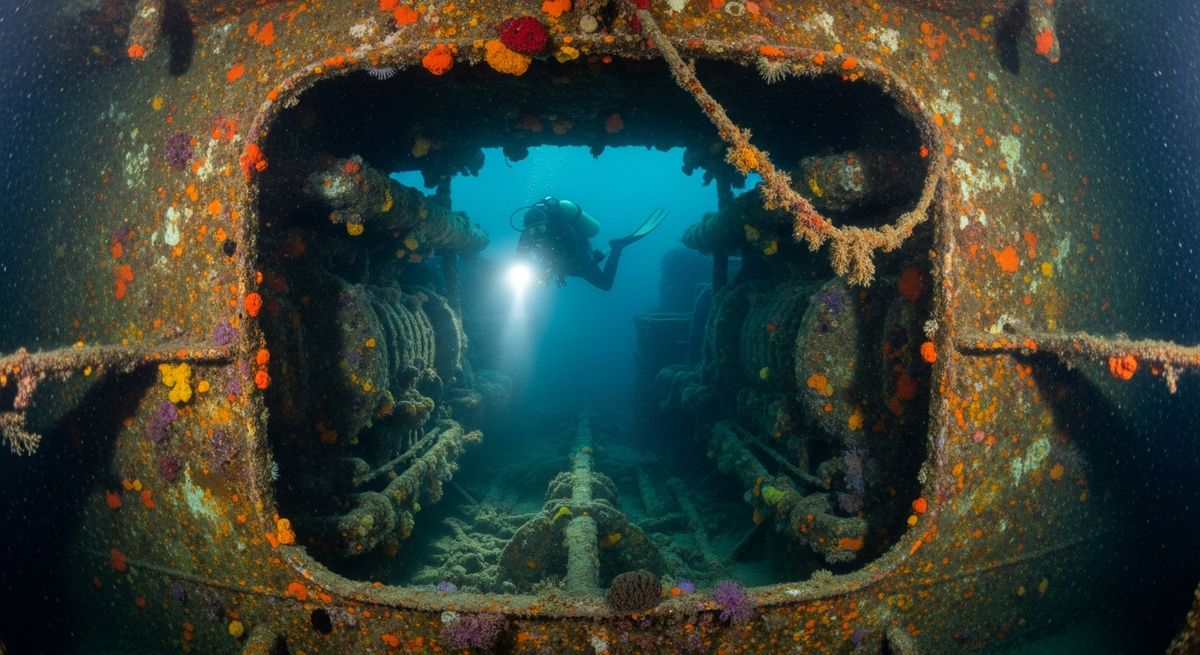
The Arimar, a sizeable motor vessel that met its end in 1971, now rests in just six metres of water. We love a wreck that’s shallow enough for an extended bottom time, and the Arimar delivers. It’s perfect for newer wreck divers or those who just want to poke around without the pressure of deep stops. The ship ran aground after drifting, so you get a sense of that final struggle as you swim over the twisted metal. The wreck itself is well-broken, with plenty of openings to peek into. You’ll find schools of sergeant majors shimmering around the superstructure, and we’ve often spotted French grunts huddled in the darker sections. On one dive, a spotted moray peered out from a pipe, completely unfazed by our presence. The shallow depth means sunlight penetrates everywhere, painting the scene in blues and greens. It's a relaxed dive, a good spot to practice buoyancy in tighter spaces, and our pick for an afternoon excursion when you want something easy but still interesting.
Typical ARIMAR Dive Profile
Illustrative profile based on site depth and type. Actual dive profiles vary - always follow your dive computer and training.
Safety Notes
Wreck site - avoid penetration without wreck diving certification. Watch for sharp metal and entanglement hazards.
ARIMAR Wreck History
Year Sunk
1971
Vessel Type
cargo ship
Cause
grounding
In October 1971, the 165-foot motor vessel Arimar was undertaking a long transatlantic voyage from Boca Grande, Florida, to Venice, Italy. Her journey was cut short in the Bahamas when she suffered a catastrophic engine failure. Powerless and adrift, the Arimar was at the mercy of the winds and currents, which pushed her inexorably towards the northern tip of Eleuthera. On October 26th, she ran hard aground on the shallow reef system just south of Egg Island, where the constant force of the waves broke her apart.
Today, the Arimar, often known simply as the Egg Island Wreck, is one of the most famous and beloved shallow wrecks in the Bahamas. Resting in only 6 meters of turquoise water, its rusted bow often pierces the surface, acting as a beacon for divers and snorkelers. The wreckage is scattered across the seafloor, creating a fascinating playground for exploration. Over the decades, it has transformed into a spectacular artificial reef, teeming with corals, sponges, and huge schools of colorful reef fish, making it a must-see site for underwater photographers and marine life enthusiasts.
Reviews for ARIMAR
Conditions
Ocean conditions, forecast and tides for ARIMAR
ARIMAR Ocean Conditions
Monthly averages for ARIMAR, sourced from NOAA NDBC + Copernicus Marine (EU) - nearest station: 8723214 - Virginia Key, FL (295km away)
October Averages
Sea Temperature
29°C
84°F · Range: 25.1–31.5°C
Air Temperature
28°C
82°F
Current Speed
6.71 cm/s
Direction: NW (333.4°)
Chlorophyll-a
0.057 mg/m³
Very clear (oligotrophic)
Salinity
36.73 PSU
Wind Speed
4 m/s
7.8 knots
Atmospheric Pressure
1014.6 hPa
Based on 5 years of monitoring data · Data sources: NOAA NDBC + Copernicus Marine (EU)
Plan & book
Ways to dive Nassau & New Providence, from day trips to liveaboards.
Day trips & courses
via GetYourGuideGuided dives, courses and snorkel trips with instant booking.
Find dive trips in Nassau & New ProvidencePlaces to stay
via Booking.comHotels and dive resorts near Nassau & New Providence.
Search stays in Nassau & New ProvidenceDive insurance
Most travel insurance excludes or limits scuba. Check what you need before you go.
Dive insurance explainedPartner links: we may earn a commission if you book, at no extra cost to you. How we make money
Where to Stay near ARIMAR
Prices from Booking.com. We may earn a commission at no extra cost to you.