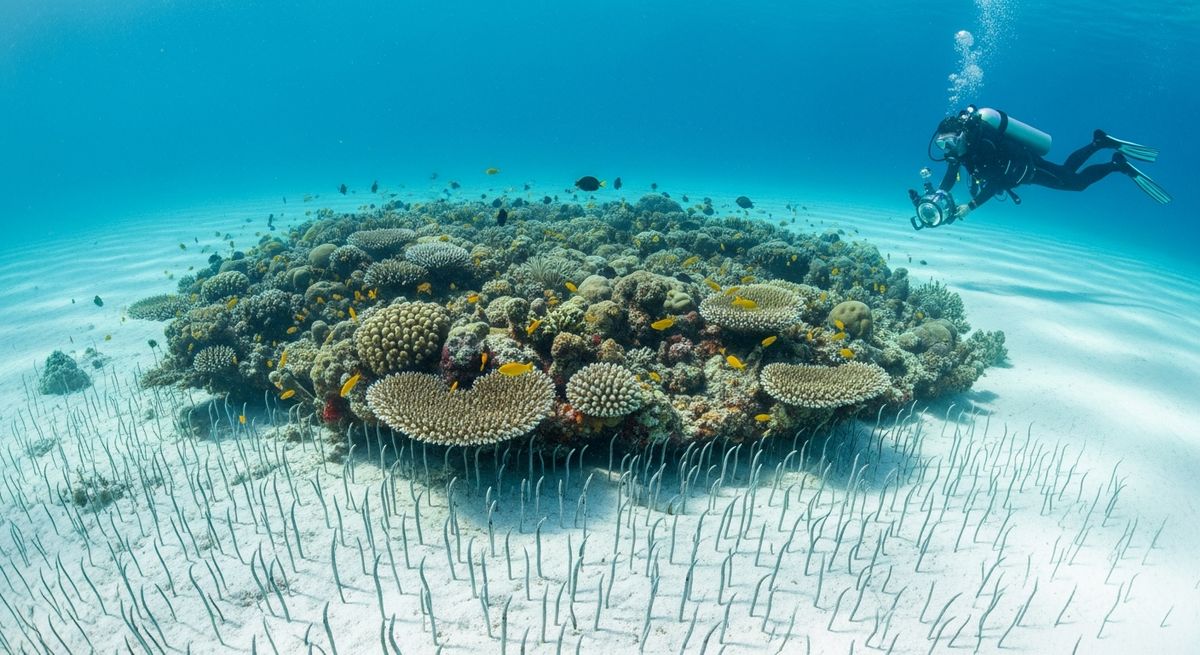
Phillips Dive Pier - Jardines de la Reina

Seaquest Deep is one of those sites we always hit up when we're in Roatán, despite the "Deep" in the name being a bit of a misnomer given the 20m max. It’s popular, sure, but for good reason. What we really love here is the sheer density of small, unusual critters in the sand. You’ll be finning along, eyes peeled for a Yellowhead Jawfish peeking out from its burrow, and then suddenly you're spotting a Warteye Stargazer buried, just its eyes twitching above the sand. We’ve had some cracking dives just hovering over the sandy patches, finding Sharpnose Pufferfish trundling by, or watching a pair of Shark nose gobies tend to their home. Visibility here is consistently good, usually around 20m, which helps immensely when you're trying to pick out a tiny Mimic Blenny. Our favourite tip for Seaquest Deep? Go slow. Really slow. Bring a good macro lens if you're into photography, because the real show here is in the details, not the big stuff. It’s perfect for divers who appreciate the subtle beauty of sand dwellers and aren’t afraid to spend twenty minutes admiring a well-hidden flounder.

Location
Jardines de la Reina, Cuba, Caribbean
Coordinates
19.898500, -75.164900
Type
reef

Marine Protected Area: Hatibonico

Best Time to Dive in Jardines de la Reina

The warmest water temperatures in Jardines de la Reina occur in September, averaging 30.4°C. The coolest conditions are in February at 27.1°C.

Monthly Water Temperatures

  • January: 27.5°C
  • February: 27.1°C
  • March: 27.1°C
  • April: 27.8°C
  • May: 28.8°C
  • June: 29.2°C
  • July: 29.8°C
  • August: 30.2°C
  • September: 30.4°C
  • October: 29.9°C
  • November: 29.2°C
  • December: 28.3°C

Nearby Dive Sites in Jardines de la Reina

Nearest Dive Centres to Phillips Dive Pier

Marine Life in Jardines de la Reina

Home to 492 recorded species including 404 reef fish, 34 hard corals, 10 whales & dolphins, 10 sharks & rays, 8 other, 6 sea snails & nudibranchs.

Notable Species

Recommended Packing List for Phillips Dive Pier

Based on average water temperature of 28.8°C, currents 16 cm/s.

  • Shorty or Rashguard - warm 29°C water needs minimal exposure protection
  • Mask - essential for every dive
  • Fins
  • BCD - buoyancy compensator
  • Regulator - your most safety-critical piece of gear
  • Dive Computer - tracks depth, time, and NDL
  • Surface Marker Buoy (SMB) - essential for boat pickups
  • Dive Torch - useful for crevices and colour at depth
  • Underwater Camera - capture your diving memories

Frequently Asked Questions

What is the typical depth range for diving at Phillips Dive Pier?
The typical depth range for diving at Phillips Dive Pier reaches a maximum of 14 meters. Within this depth, divers will find interesting features such as grass beds and coral formations. These are generally encountered between 6 meters (20 feet) and the site's maximum depth of 14 meters (approximately 46 feet).
What kind of marine life and underwater features can divers expect to see at Phillips Dive Pier?
Divers at Phillips Dive Pier can expect to encounter a vibrant reef environment, complete with extensive grass beds and coral formations. A notable underwater feature is a US Navy LCM-8 “Mike boat” wreck. The diverse marine life includes black tip reef sharks, several species of sea turtle, and both green and spotted eels.
Is Phillips Dive Pier suitable for beginner divers, or is it considered a more challenging dive site?
Phillips Dive Pier is considered an intermediate difficulty dive site. While not suitable for absolute beginners, divers with some experience and appropriate certification will find it rewarding. It offers a good balance of challenge and accessibility for those beyond entry-level.
What are the best times of year or day to dive at Phillips Dive Pier for optimal conditions?
The provided data does not specify the best times of year or day for optimal diving conditions at Phillips Dive Pier. For general guidance on planning your dive trip, you might consult our When to dive resource. We recommend checking local conditions closer to your travel dates.
What scuba diving certifications are required to dive at Phillips Dive Pier?
The specific scuba diving certifications required to dive at Phillips Dive Pier are not detailed in the provided information. However, given its intermediate difficulty rating, divers should typically hold at least an Advanced Open Water certification or equivalent. It's always best to confirm with local dive operators for precise requirements before planning your dive.
What are the typical current conditions and visibility like at Phillips Dive Pier?
Divers at Phillips Dive Pier can generally expect excellent visibility, averaging around 19 meters (approximately 62 feet). The provided data does not specify the typical current conditions for this dive site. It is advisable to consult with local dive centers for up-to-date information on currents.