Diving in Southwest Coast
Why dive here
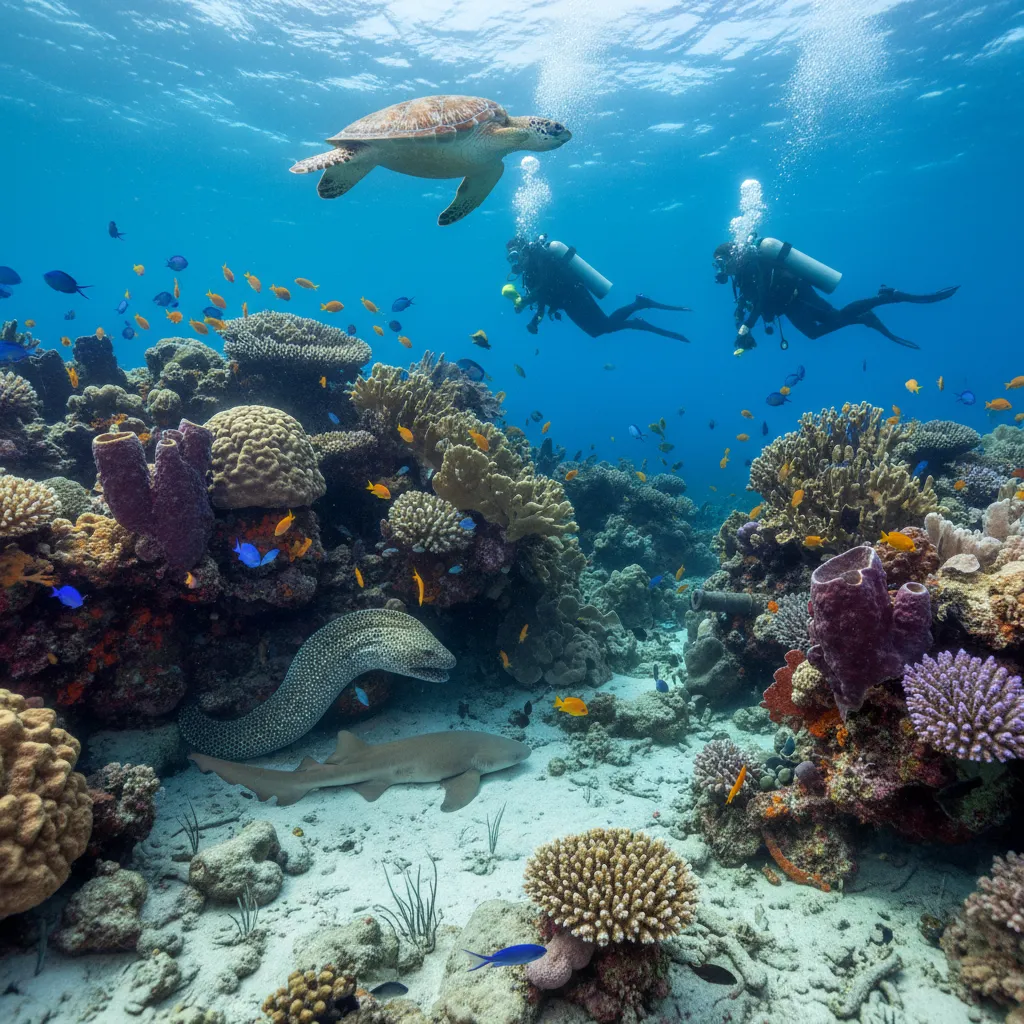
Southwest Coast offers some of Grenada's richest diving, with 263+ marine species recorded in the area - including barracuda, humpback whales, nurse sharks, orcas and sea turtles. Water ranges 27-30°C, warmest August, September, October.
Grenada's Southwest Coast hits that sweet spot for divers who appreciate variety without having to hop on a dozen different boats. We love that you can start your day exploring the eerie beauty of the *Bianca C* wreck, then spend your afternoon finning through the whimsical figures of the Underwater Sculpture Park, and still have time for a chilled-out reef dive. The currents here can be a bit frisky sometimes, especially around the exposed wrecks, but they’re also what bring in some of the bigger pelagic show-stoppers. Our favourite spots often involve a bit of muck diving too. Keep an eye out for the smaller, quirkier residents like the tiny Goldline Blenny or the surprisingly colourful Saddle Squirrelfish tucked into the crevices. We’ve had incredible luck spotting huge schools of Horse-eye Jacks here, their silver bodies flashing in unison as they patrol the deeper sections. If you're after a thrill, a drift dive along some of the deeper walls can bring you face to face with a cruising Mahi Mahi or a curious Dorado. Visibility is generally solid, but if you hit it after a strong rainfall, expect a bit more particulate in the water. Go early in the morning for the quietest dives.
Southwest Coast Dive Site Map
Dive sites and dive centres in Southwest Coast
Southwest Coast Dive Sites
73 dive sites in Southwest Coast
1 / 4 Wreck (Stern Courier)
The 1/4 Wreck, or Stern Courier, is our pick for a chill afternoon dive on Grenada’s southwest coast. It’s not about big swim-throughs here. This is the Courier’s stern section, tossed upside down at 11 metres, a jumble of hull plates and engine block. We love drifting over it, tracing the lines of the collapsed metal, finding a chain moray peeking from a dark crevice or a red clingfish tucked into the coral that’s steadily reclaiming the wreck. Visibility often hangs around 16 metres, which gives you plenty of time to hunt for the smaller stuff. We’ve found spinyhead blennies and dusky blennies in the nooks and crannies, and once, a tiny seahorse clinging to soft coral. It’s a gentle exploration, perfect for divers who prefer macro life and history over deep penetration. Come here late afternoon when the light shifts, it makes the colours pop.
1 / 4 Wreck (Stern Courier)
The 1/4 Wreck, or Stern Courier, is our pick for a chill afternoon dive on Grenada’s southwest coast. It’s not about big swim-throughs here. This is the Courier’s stern section, tossed upside down at 11 metres, a jumble of hull plates and engine block. We love drifting over it, tracing the lines of the collapsed metal, finding a chain moray peeking from a dark crevice or a red clingfish tucked into the coral that’s steadily reclaiming the wreck. Visibility often hangs around 16 metres, which gives you plenty of time to hunt for the smaller stuff. We’ve found spinyhead blennies and dusky blennies in the nooks and crannies, and once, a tiny seahorse clinging to soft coral. It’s a gentle exploration, perfect for divers who prefer macro life and history over deep penetration. Come here late afternoon when the light shifts, it makes the colours pop.
Anina (Wreck)
The Anina is one of those wrecks we keep coming back to. She was a cargo vessel, and you’ll find her resting on her starboard side at 30m, a relatively recent sinking in 2019, which means she’s still in excellent shape for exploring. We love how much of her structure remains intact; you can really get a feel for her working life. Drop down and you’ll find her hull covered in the beginnings of new growth, little clusters of sponges and corals attracting smaller reef fish. Schools of horse-eye jacks often swirl around the mast, and we’ve seen barracuda hanging patiently off the bow, eyeing up their next meal. Head into the holds if you’re comfortable with overhead environments; they’re quite open and you’ll often find grouper tucked away, or even a sleepy nurse shark if you’re lucky. Visibility averages about 14m here, which gives her a slightly mysterious feel without being too challenging. This is a great dive for anyone comfortable at depth and keen to explore a well-preserved wreck that’s steadily transforming into an artificial reef.
Anina (Wreck)
The Anina is one of those wrecks we keep coming back to. She was a cargo vessel, and you’ll find her resting on her starboard side at 30m, a relatively recent sinking in 2019, which means she’s still in excellent shape for exploring. We love how much of her structure remains intact; you can really get a feel for her working life. Drop down and you’ll find her hull covered in the beginnings of new growth, little clusters of sponges and corals attracting smaller reef fish. Schools of horse-eye jacks often swirl around the mast, and we’ve seen barracuda hanging patiently off the bow, eyeing up their next meal. Head into the holds if you’re comfortable with overhead environments; they’re quite open and you’ll often find grouper tucked away, or even a sleepy nurse shark if you’re lucky. Visibility averages about 14m here, which gives her a slightly mysterious feel without being too challenging. This is a great dive for anyone comfortable at depth and keen to explore a well-preserved wreck that’s steadily transforming into an artificial reef.
BIANCA C
The Bianca C. Now, this is a wreck. Not just any wreck, mind you, but arguably *the* wreck of the Caribbean. She’s huge, over 180 metres long, sitting upright in 48 metres of water. We love a good wreck dive, and the sheer scale of the Bianca C makes it an experience unlike almost anything else. You drop down, and she just materialises out of the blue, a vast, dark shape that takes your breath away. Her size means you're not going to see it all on one dive, so plan for multiple visits. We’d suggest focusing on the stern first, where the swimming pool – yes, a swimming pool – is a highlight, now home to schools of jacks and the occasional nurse shark resting on the deck. Heading into the upper decks, you can imagine the scale of the fire that sank her back in '61. The bridge section is largely collapsed, but the forward holds offer some great swim-throughs, just watch your buoyancy. The currents here can be unpredictable, sometimes mild, sometimes strong enough to really push you around, so keep an eye on the dive guide and your air. This site is for experienced wreck divers comfortable with depth and overhead environments. It's a proper adventure, a glimpse into history, and a thriving artificial reef all rolled into one.
Bianca C (Wreck)
The Bianca C sits upright in the sand, a proper behemoth. We love how the size truly hits you as you descend, the bow looming first, then the whole 180-metre length slowly revealing itself. This isn't just a dive, it’s a journey through a ghost ship, a cruise liner that caught fire back in '61. Our favourite part is swimming into the massive, open swimming pool areas, now a skeletal cage where schools of horse-eye jacks often hang in the blue. Look closely at the deck rails and superstructure; you’ll find plenty of shy hamlets tucked into crevices, and we’ve spotted more than a few chain morays peeking out. Visibility can average around 18 metres, which means you often get that dramatic, slightly eerie sense of the wreck disappearing into the depths. This is a dive for those who appreciate history and scale, definitely best suited for experienced divers comfortable with depths around 30 to 37 metres. If you hit it around mid-morning, the light can filter beautifully through the upper decks, illuminating the barracuda that patrol the higher sections.
Bianca C (Wreck)
The Bianca C sits upright in the sand, a proper behemoth. We love how the size truly hits you as you descend, the bow looming first, then the whole 180-metre length slowly revealing itself. This isn't just a dive, it’s a journey through a ghost ship, a cruise liner that caught fire back in '61. Our favourite part is swimming into the massive, open swimming pool areas, now a skeletal cage where schools of horse-eye jacks often hang in the blue. Look closely at the deck rails and superstructure; you’ll find plenty of shy hamlets tucked into crevices, and we’ve spotted more than a few chain morays peeking out. Visibility can average around 18 metres, which means you often get that dramatic, slightly eerie sense of the wreck disappearing into the depths. This is a dive for those who appreciate history and scale, definitely best suited for experienced divers comfortable with depths around 30 to 37 metres. If you hit it around mid-morning, the light can filter beautifully through the upper decks, illuminating the barracuda that patrol the higher sections.
Bianca C Wreck
We’ve dived a few wrecks in our time, but the Bianca C still gives us a shiver. This isn't just a sunken ship; it’s a colossal, ghost-like city down there, a 600-foot luxury liner that sank in 1961. Dropping onto the bridge at 30 metres, the sheer scale hits you. You can spend an entire dive just exploring the upper decks, the swimming pool (our favourite spot, surprisingly intact), and the vast holds. The ambient light filtering through the decks creates this eerie, ethereal glow, illuminating schools of broad-striped anchovies that swirl like liquid silver. Look closely, and you’ll spot shy hamlets darting between the decaying railings, and we’ve often found mottled conger morays peering out from shadowed crevices. It’s an advanced dive, for sure, with depths reaching 50 metres, and currents can pick up, so watch that bottom time. But for divers who love big, dramatic wrecks with a real sense of history, the Bianca C is simply magnificent. We always feel a bit humbled leaving its presence.
Black Forest - Grenada
Black Forest holds a special place on the southwest coast, mainly because it consistently delivers on the details. We love dropping onto the slope here, watching it unfold from about 12 metres down to the maximum depth of 20 metres. The name really comes alive with those dense thickets of black gorgonians, stretching out like a submerged forest. What truly sets it apart, though, are the elephant ear sponges. They start to appear lower down, huge orange folds that add a surprising splash of colour against the darker gorgonians. Keep your eyes peeled for the smaller stuff: we’ve seen Black Cyphomas crawling over the gorgonian branches, and there's usually a good population of shrimps, crabs, and eels tucked into every crevice. Lobsters often peek out from larger holes, and the occasional porcupinefish might drift past. Visibility averages a comfortable 17 metres, making it an excellent spot for photographers looking to capture the intricate details on the reef. It’s a site that rewards a slow pace and a keen eye, perfect for anyone who enjoys exploring the nooks and crannies of a healthy reef.
Black Forest - Grenada
Black Forest holds a special place on the southwest coast, mainly because it consistently delivers on the details. We love dropping onto the slope here, watching it unfold from about 12 metres down to the maximum depth of 20 metres. The name really comes alive with those dense thickets of black gorgonians, stretching out like a submerged forest. What truly sets it apart, though, are the elephant ear sponges. They start to appear lower down, huge orange folds that add a surprising splash of colour against the darker gorgonians. Keep your eyes peeled for the smaller stuff: we’ve seen Black Cyphomas crawling over the gorgonian branches, and there's usually a good population of shrimps, crabs, and eels tucked into every crevice. Lobsters often peek out from larger holes, and the occasional porcupinefish might drift past. Visibility averages a comfortable 17 metres, making it an excellent spot for photographers looking to capture the intricate details on the reef. It’s a site that rewards a slow pace and a keen eye, perfect for anyone who enjoys exploring the nooks and crannies of a healthy reef.
Boss Reef
Boss Reef, or Bass Reef as we still like to call it, holds a special place. It’s right outside Grand Anse Bay, a stretch that once teemed with big fish before the fishing pressure got too intense. We find it’s a site best explored slowly, letting your eyes adjust to the subtle movements. Dropping in, the reef begins at around 6 meters, gently sloping to its deepest point at 19 meters. Visibility averages 16 meters, which is usually plenty to appreciate the details. Head towards St. George's and you'll navigate through more stony corals, a robust landscape. But veer closer to Quarantine Point, and the scenery shifts dramatically. Here, you'll glide past a colourful display of soft corals and sponges, a real treat for macro fans. We’ve had fantastic luck spotting Opossum Pipefish tucked away here, and the Pearl Blennies are always a joy to watch darting between crevices. On a good day, we've even seen Devilfish lurking in the shadows. It’s a site that rewards patience, perfect for photographers or those who just want a relaxed dive with a surprising amount of tiny life.
Boss Reef
Boss Reef, or Bass Reef as we still like to call it, holds a special place. It’s right outside Grand Anse Bay, a stretch that once teemed with big fish before the fishing pressure got too intense. We find it’s a site best explored slowly, letting your eyes adjust to the subtle movements. Dropping in, the reef begins at around 6 meters, gently sloping to its deepest point at 19 meters. Visibility averages 16 meters, which is usually plenty to appreciate the details. Head towards St. George's and you'll navigate through more stony corals, a robust landscape. But veer closer to Quarantine Point, and the scenery shifts dramatically. Here, you'll glide past a colourful display of soft corals and sponges, a real treat for macro fans. We’ve had fantastic luck spotting Opossum Pipefish tucked away here, and the Pearl Blennies are always a joy to watch darting between crevices. On a good day, we've even seen Devilfish lurking in the shadows. It’s a site that rewards patience, perfect for photographers or those who just want a relaxed dive with a surprising amount of tiny life.
Show all 73 dive sites in Southwest Coast
- Boulder City - Grenada
- Boulder City - Grenada
- Buccaneer Molinere Bay (Wreck)
- Buccaneer Molinere Bay (Wreck)
- Car Pile - Grenada
- Cherry Hill
- Courier
- Don Cesar
- Dragon Bay
- Dr. Grooms Garden
- Escape Reef
- FIONA R
- Fiona (Wreck)
- Flamingo Bay
- Flamingo Bay
- Glovers Island
- Glovers Reef
- Grand Anse Beach
- Grand Canyon - Grenada
- Grand Mal Wall
- Grenada
- Halifax - Grenada
- Heartbreak Ridge - Grenada
- Hema One
- Hildur (Wreck)
- Kansas Reef
- King Mitch Wreck
- Kohanee
- LEANDER
- Lighthouse Reef - Grenada
- Magazine Reef
- Moliniere Underwater Sculpture Park
- MV Shakem, wreck
- Northern Exposure
- Persia (Wreck)
- Purple Rain
- Purple Rain
- Quarantine Point
- Red Bouy - Grenada
- River Road
- Road to Veronica
- Rum Runner (Wreck)
- San Juan (Wreck)
- Sculpture Park
- SHAKEM
- Shark Reef - Grenada
- Sherwood Forest
- South End
- Special Request
- Spice Island Reef
- Spotters Reef
- Stingray Alley
- The Blade
- The Cove
- Tyrrel Bay
- Valleys - Grenada
- VERONICA L
- Veronica L Wreck
- VIRGINIA
- Whibbles Reef
- Windmill Shallows
Southwest Coast Dive Centres
4 dive shops and operators in Southwest Coast
Ocean Wildlife in Southwest Coast
263 species recorded in Southwest Coast
Southwest Coast Daylight & Sunrise/Sunset
Sunrise and sunset times for Southwest Coast, calculated from coordinates
Today - Sunday 11 October
Sunrise
05:57
Sunset
17:53
Daylight
11h 55m
Golden Hour
17:24
First light (dawn) at 05:36 · Last light (dusk) at 18:14
Monthly Averages
| Month | Sunrise | Sunset | Daylight |
|---|---|---|---|
| Jan | 06:32 | 18:01 | 11h 29m |
| Feb | 06:30 | 18:14 | 11h 44m |
| Mar | 06:16 | 18:18 | 12h 3m |
| Apr | 05:56 | 18:20 | 12h 23m |
| May | 05:44 | 18:24 | 12h 40m |
| JunLongest | 05:43 | 18:33 | 12h 50m |
| Jul | 05:50 | 18:37 | 12h 46m |
| Aug | 05:57 | 18:29 | 12h 32m |
| Sep | 05:57 | 18:10 | 12h 13m |
| OctNow | 05:57 | 17:50 | 11h 53m |
| Nov | 06:05 | 17:40 | 11h 35m |
| DecShortest | 06:20 | 17:45 | 11h 25m |
Times are approximate local times based on longitude. Actual times may vary slightly depending on the exact timezone observed in Southwest Coast.
Where to Stay near Southwest Coast
Prices from Booking.com. We may earn a commission at no extra cost to you.
Marine Protected Areas near Southwest Coast
19 protected areas near Southwest Coast - please respect local regulations when diving
Southern Seascape
Ronde Island Group
South Carricou Islands
Grand Anse
Conference Bay
Levera
Sandy Island-Oyster Bay
Gouyave
Woburn-Clarks-Court Bay
Petite Dominique
Molinier-Beausejour
Molinier-Beausejour
Showing 12 largest of 19
Getting to Southwest Coast
Saint George's
Scarborough
Kingstown
Plan & book
Ways to dive Southwest Coast, from day trips to liveaboards.
Day trips & courses
via GetYourGuideGuided dives, courses and snorkel trips with instant booking.
Find dive trips in Southwest CoastPlaces to stay
via Booking.comHotels and dive resorts near Southwest Coast.
Search stays in Southwest CoastDive insurance
Most travel insurance excludes or limits scuba. Check what you need before you go.
Dive insurance explainedPartner links: we may earn a commission if you book, at no extra cost to you. How we make money