BIANCA C
Protected Area
Grand Anse
Why dive here
With 263+ marine species recorded in the area - including barracuda, humpback whales, nurse sharks, orcas and sea turtles - BIANCA C offers some of Southwest Coast's richest wreck diving. Water ranges 27-30°C, warmest August, September, October.
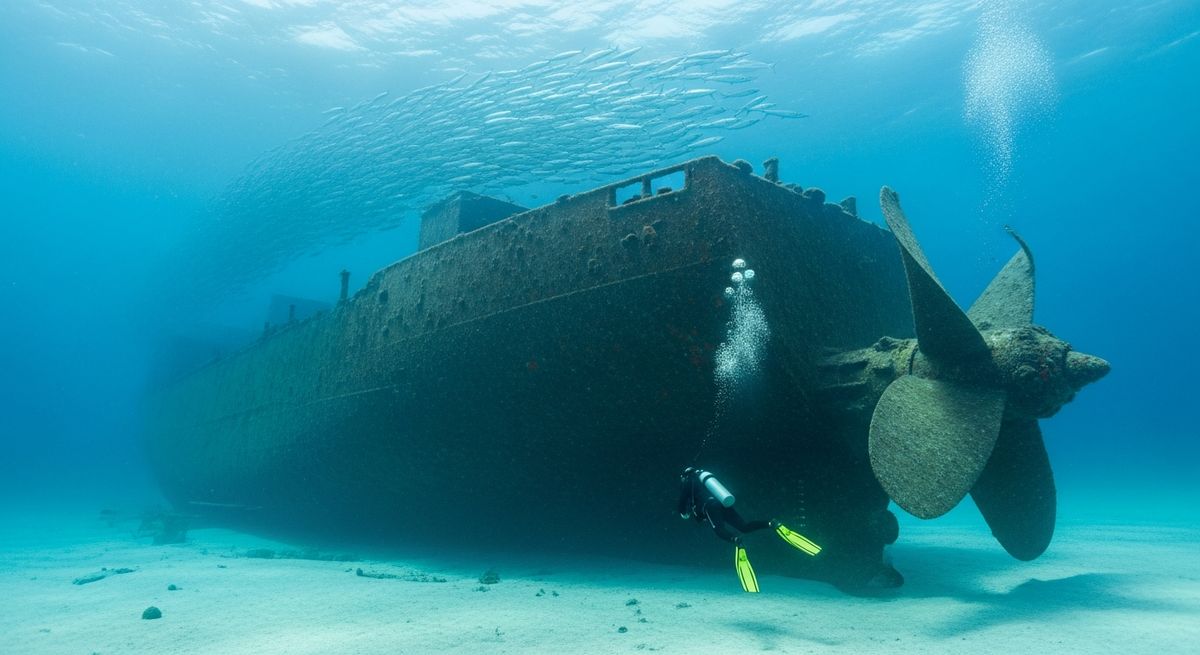
The Bianca C. Now, this is a wreck. Not just any wreck, mind you, but arguably *the* wreck of the Caribbean. She’s huge, over 180 metres long, sitting upright in 48 metres of water. We love a good wreck dive, and the sheer scale of the Bianca C makes it an experience unlike almost anything else. You drop down, and she just materialises out of the blue, a vast, dark shape that takes your breath away. Her size means you're not going to see it all on one dive, so plan for multiple visits. We’d suggest focusing on the stern first, where the swimming pool – yes, a swimming pool – is a highlight, now home to schools of jacks and the occasional nurse shark resting on the deck. Heading into the upper decks, you can imagine the scale of the fire that sank her back in '61. The bridge section is largely collapsed, but the forward holds offer some great swim-throughs, just watch your buoyancy. The currents here can be unpredictable, sometimes mild, sometimes strong enough to really push you around, so keep an eye on the dive guide and your air. This site is for experienced wreck divers comfortable with depth and overhead environments. It's a proper adventure, a glimpse into history, and a thriving artificial reef all rolled into one.
Typical BIANCA C Dive Profile
Illustrative profile based on site depth and type. Actual dive profiles vary - always follow your dive computer and training.
Safety Notes
Maximum depth 48m exceeds recreational limits (40m). Technical diving certification and equipment required.
Wreck site - avoid penetration without wreck diving certification. Watch for sharp metal and entanglement hazards.
Always perform a 3-minute safety stop at 5m before surfacing.
BIANCA C Wreck History
Year Sunk
1961
Vessel Type
passenger ship
Cause
fire
Tonnage
18,427 GRT
Often called the “Titanic of the Caribbean,” the Bianca C was a magnificent Italian passenger liner owned by the famed Costa Line. Originally launched in France in 1944 as the Maréchal Pétain, she underwent several name changes before being christened Bianca C. For years, she served as a symbol of luxury, gracefully plying the waters between Italy, the Caribbean, and Venezuela, carrying passengers in style and comfort across the Atlantic.
Her final voyage came to a tragic halt on October 22, 1961. While anchored in the harbor of St. George's, Grenada, a devastating explosion in the engine room ignited a ferocious fire that quickly engulfed the ship. In a remarkable display of bravery, the local fishermen and boat owners of Grenada mounted a heroic rescue, saving all but one of the nearly 700 passengers and crew. The ship burned for two days, a smoldering giant visible from the shore. The British frigate HMS Londonderry attempted to tow the crippled liner out to sea, but the tow line snapped, and the Bianca C gracefully slipped beneath the waves to her final resting place.
Today, the Bianca C is the largest diveable wreck in the Caribbean, a monumental site for advanced and technical divers. Lying upright on the seabed, the 600-foot wreck starts at around 30 meters, with her stern sitting at nearly 50 meters. Although time and currents have caused the superstructure to collapse, divers can still marvel at her immense scale, exploring the bow, davits, and one of her iconic swimming pools. The wreck is a thriving artificial reef, patrolled by schools of jack, barracuda, and the occasional eagle ray, offering a truly unforgettable deep-dive experience.
Nearest Dive Centres to BIANCA C
Dive shops near BIANCA C
Dive Grenada
Aquanauts Grenada
Scuba West Indies
Sandals La Source
Reviews for BIANCA C
Conditions
Ocean conditions, forecast and tides for BIANCA C
BIANCA C Ocean Conditions
Monthly averages for BIANCA C, sourced from Open-Meteo marine data - nearest station: Open-Meteo marine grid (12.03, -61.78) (0km away)
October Averages
Sea Temperature
30°C
86°F · Range: 29–31.7°C
Air Temperature
28°C
82°F
Wind Speed
5.61 m/s
10.9 knots
Atmospheric Pressure
1011.8 hPa
Based on 4 years of monitoring data · Data sources: Open-Meteo marine data
Plan & book
Ways to dive Southwest Coast, from day trips to liveaboards.
Day trips & courses
via GetYourGuideGuided dives, courses and snorkel trips with instant booking.
Find dive trips in Southwest CoastPlaces to stay
via Booking.comHotels and dive resorts near Southwest Coast.
Search stays in Southwest CoastDive insurance
Most travel insurance excludes or limits scuba. Check what you need before you go.
Dive insurance explainedPartner links: we may earn a commission if you book, at no extra cost to you. How we make money
Where to Stay near BIANCA C
Prices from Booking.com. We may earn a commission at no extra cost to you.