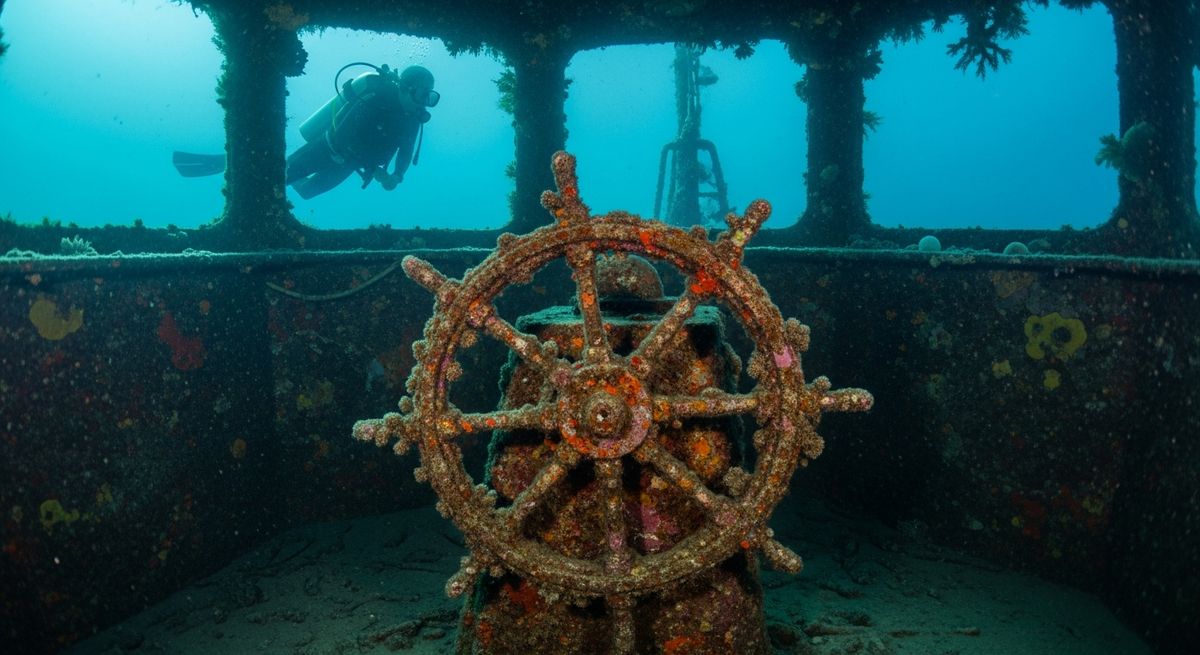
B-29 Aircraft Wreck
Protected Area
Tres Palmas de Rincón Marine Reserve
Why dive here
With 503+ marine species recorded in the area - including barracuda, blue sharks, dolphins, eagle rays and humpback whales - B-29 Aircraft Wreck offers some of Rincon & West Coast's richest wreck diving. Water ranges 27-30°C, warmest August, September, October.
We’ve dived a few plane wrecks in our time, but the B-29 off Rincon is a special one. It’s not a full bomber, mind you, more a collection of large pieces, but knowing the history – a stripped-down B-29 being towed from the Virgin Islands to Miami in 1968, only to sink in a storm – gives it real character. Dropping down to 25 metres, the first thing you notice is the size of the main sections. A massive wing, surprisingly intact, lies on its side, and you can see the engine nacelles clearly. The fuselage section is broken open, and that’s where things get interesting. This isn’t a penetration dive, but you can poke around the edges of the fuselage, peeking into what would have been the crew compartments. Schools of snapper and grunts swarm around the metal, using it as shelter, and we often spot a nurse shark tucked under the wing, almost camouflaged against the dark metal. Our favourite part has to be the way the light filters through the structure, catching the silver scales of the fish. It’s an intermediate dive, suitable for anyone comfortable at depth and with good buoyancy; strong currents can sometimes whip through, so a surface marker buoy is a good idea. This wreck is less about identifying specific aircraft parts and more about the atmosphere and the surprising amount of life it now supports.
Typical B-29 Aircraft Wreck Dive Profile
Illustrative profile based on site depth and type. Actual dive profiles vary - always follow your dive computer and training.
Safety Notes
Depth of 25m - Advanced Open Water certification recommended.
Wreck site - avoid penetration without wreck diving certification. Watch for sharp metal and entanglement hazards.
Always perform a 3-minute safety stop at 5m before surfacing.
B-29 Aircraft Wreck Wreck History
Year Sunk
1949
Vessel Type
aircraft
Cause
accident
The Boeing B-29 Superfortress is one of the most iconic aircraft in history, a technological marvel of its time, famed for its high-altitude pressurized cabins and its role in the final stages of World War II. After the war, these strategic bombers continued to serve with the U.S. Air Force, including at Ramey Air Force Base in Puerto Rico, which was a key Strategic Air Command outpost during the Cold War.
This particular B-29 was not a casualty of war, but of a post-war training accident. In 1949, during a routine flight out of Ramey, the aircraft experienced a catastrophic engine failure, forcing the crew to perform an emergency water landing off the coast of Aguadilla. Thanks to the skill of the pilots, the ditching was successful, and all crew members were able to evacuate safely before the massive plane sank to the bottom of the Atlantic.
Today, the B-29 is one of the Caribbean's most famous aircraft wrecks and a fantastic dive site accessible to recreational divers. Lying at a depth of around 25 meters, the wreck is broken into several large, recognizable sections. Divers can explore the distinct cockpit section, the enormous wings with their engines still attached, the tail assembly, and the scattered fuselage. Over the decades, the wreck has transformed into a vibrant artificial reef, attracting a huge variety of marine life, including schools of snapper, sergeant majors, and colorful corals that now encrust this piece of aviation history.
Nearest Dive Centres to B-29 Aircraft Wreck
Dive shops near B-29 Aircraft Wreck
Aquatica Underwater Adventures
The Black Anchor Scuba Diving & Snorkeling
Mako Dive LLC
Taino Divers
Rincon Diving & Snorkeling
Native Dive PR
Reviews for B-29 Aircraft Wreck
Conditions
Ocean conditions, forecast and tides for B-29 Aircraft Wreck
B-29 Aircraft Wreck Ocean Conditions
Monthly averages for B-29 Aircraft Wreck, sourced from Open-Meteo marine data - nearest station: Open-Meteo marine grid (18.34, -67.27) (8km away)
October Averages
Sea Temperature
30°C
87°F · Range: 29.3–31.2°C
Air Temperature
28°C
83°F
Wind Speed
6.84 m/s
13.3 knots
Atmospheric Pressure
1012.6 hPa
Based on 4 years of monitoring data · Data sources: Open-Meteo marine data
Plan & book
Ways to dive Rincon & West Coast, from day trips to liveaboards.
Day trips & courses
via GetYourGuideGuided dives, courses and snorkel trips with instant booking.
Find dive trips in Rincon & West CoastPlaces to stay
via Booking.comHotels and dive resorts near Rincon & West Coast.
Search stays in Rincon & West CoastDive insurance
Most travel insurance excludes or limits scuba. Check what you need before you go.
Dive insurance explainedPartner links: we may earn a commission if you book, at no extra cost to you. How we make money
Where to Stay near B-29 Aircraft Wreck
Prices from Booking.com. We may earn a commission at no extra cost to you.