Diving in Kadavu & Great Astrolabe Reef
Why dive here
Kadavu & Great Astrolabe Reef offers some of Fiji's richest diving, with 382+ marine species recorded in the area - including blue sharks, eagle rays, giant moray eels, humpback whales and sperm whales.
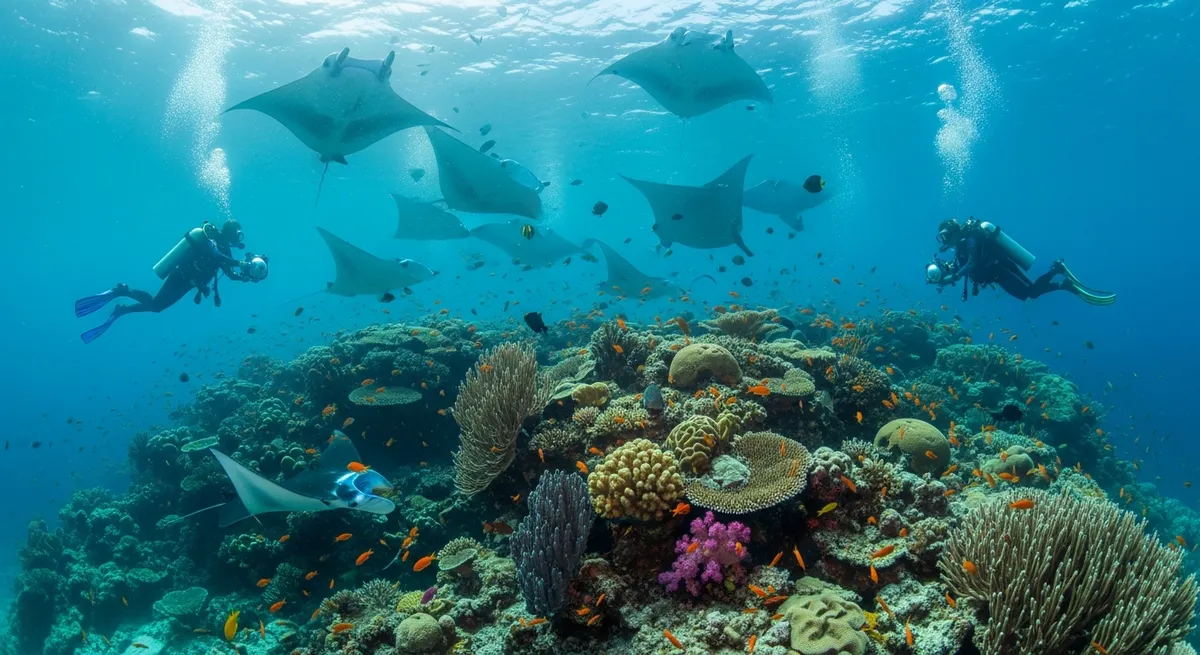
Kadavu and the Great Astrolabe Reef. This place feels like a proper expedition, not just another dive trip. We’re talking about one of the biggest barrier reefs on the planet, and honestly, it still feels wild. The currents here can be lively, which is exactly what keeps the reef so healthy and brings in the bigger stuff. We love a good drift dive through channels where the water just zips you along, past immense staghorn coral gardens. Keep an eye out for the Crossroads Reefgoby, they’re tiny but everywhere if you look closely. Our favourite spots are often on the outer walls, where you get that deep blue drop-off. You’ll definitely see silvertip sharks patrolling the edges, a truly impressive sight. If you’re lucky, and timing is everything, the manta rays show up in numbers, often between May and October. We’d suggest going early in the morning for those encounters, before the sun gets too high. There's a particular joy to a muck dive around some of the shallower bays too; we’ve spotted cowries and the oddly charming Brown Snake Moray there. It’s not always about the big pelagics, though Kadavu certainly delivers on those. The sheer scale of the reef means you rarely see another boat, which is a rare treat these days.
Kadavu & Great Astrolabe Reef Dive Site Map
Dive sites and dive centres in Kadavu & Great Astrolabe Reef
Kadavu & Great Astrolabe Reef Dive Sites
265 dive sites in Kadavu & Great Astrolabe Reef
3 Sisters
The 3 Sisters site in Kadavu offers a really pleasant, easy dive. We're talking gentle slopes down to around 23 meters, perfect if you're just getting started or fancy a relaxed drift. You'll find a good mix of hard and soft corals here, with plenty of reef fish flitting between the bommies. It’s a comfortable depth for checking out the smaller stuff – nudibranchs, maybe a lionfish tucked away. Think of it as a nice warm-up, or a chill afternoon dive when you're not chasing big pelagics.
Always Cool
Always Cool is a gentle introduction to Kadavu’s quieter side. At a comfortable 19 metres, it’s a perfect spot for newer divers to get comfortable, or for anyone wanting an easy, relaxed dive. We've often seen schools of unicornfish grazing over the hard corals, and the occasional whitetip reef shark cruising by in the late afternoon. The currents here are usually negligible, making for a very calm dive where you can take your time to really look for the smaller stuff hiding in the reef.
Amazing Maze
Amazing Maze lives up to its name, a network of swim-throughs and shallow coral canyons just off Kadavu. It's a relaxed dive, topping out at 19 metres, making it a good spot for newer divers to practice buoyancy control without feeling rushed. We've spent a good hour here just drifting through the formations, poking around for nudibranchs and watching small reef fish dart between the coral heads. It’s not a drift dive, so you can really take your time exploring the different nooks and crannies. A good afternoon option when you're looking for something calm after a more energetic morning dive.
Annie’s Bommie
Annie’s Bommie, tucked into Fiji’s Kadavu, is a really approachable spot. The main attraction here is a single, large coral head that comes up from the seafloor to about five metres below the surface. We often see it swarming with anthias and damsels, and if you look closely into the crevices, you're likely to find some smaller nudibranchs or perhaps a scorpionfish tucked away. It's a relaxed dive, topping out at 20 metres, perfect for newer divers looking to build confidence without strong currents, or for anyone who just wants a peaceful reef exploration.
Anytime
Anytime lives up to its name; it’s a consistently pleasant dive for shaking off the travel dust or just enjoying a relaxed afternoon. The reef here, a gentle slope reaching 22 meters, is loaded with healthy hard corals. We've seen plenty of reef sharks cruising by, along with the usual cast of parrotfish and angelfish darting among the bommies. It’s a comfortable depth for beginners, and while it might not deliver the adrenaline rush of some of Kadavu’s drift dives, it's a solid, easy choice for a good dive.
ANZAC
ANZAC, a mellow dive on Kadavu’s Great Astrolabe Reef, is perfect for a relaxed afternoon. The reef plateaus around 22 meters, a comfortable depth for anyone still building their confidence. We often find schooling fusiliers here, thick enough that they shimmer like a silver curtain, and the occasional whitetip reef shark cruises by. It’s a gentle introduction to the area’s corals without the stronger currents some of the other sites demand.
Aquarium
Aquarium, just off Kadavu, is a solid intermediate dive, nothing too challenging. At 17 meters, it’s a comfortable depth for a good bottom time. You’ll find a bustling patch of reef here, with schools of surgeonfish and parrotfish munching away on the corals. It’s a good spot for some relaxed exploring, maybe catching sight of a reef shark patrolling the edges. We’d suggest it for divers looking for a pleasant, easy dive without strong currents.
Arch
The Arch, a straightforward cave dive in Kadavu, is a good spot for newer divers looking to explore overhead environments. Dropping to about 20 meters, you navigate through a series of openings, often seeing schools of small reef fish sheltering inside. It’s less about big pelagics here and more about the structure itself, the light filtering in, and the occasional whitetip reef shark cruising past the entrance. We'd suggest going in the morning; the sun angle really makes the inner sections glow.
Backyard Beach
Backyard Beach is one of those easy, relaxed dives that just feels right, especially after a long journey to Kadavu. It's a shallow spot, topping out around 13 metres, making it ideal for anyone just getting their fins wet or looking for a gentle refresher. We've spent plenty of surface intervals here, watching the water for movement before dropping in. Expect a gentle drift along a healthy coral slope, where we’ve often spotted juvenile reef sharks cruising in the shallows and plenty of parrotfish munching on the coral. It’s a great place to slow down and really observe the smaller stuff.
Barracuda Drift
Barracuda Drift in Kadavu is exactly what it sounds like – an easy, relaxing drift. At a mellow 18 meters, it’s a perfect introduction to current diving for beginners, or just a nice warm-up for more experienced divers. The current here usually isn't too challenging, just enough to gently carry you past schools of fusiliers and the occasional reef shark cruising by. We’ve spotted grey reefs and whitetips making their rounds, and the soft corals here are a pleasant backdrop. It’s a good spot for some easy photography, too, without fighting a strong surge.
Barracuda Hole
Barracuda Hole, off Kadavu, is a fairly straightforward drift along a sloping reef. You'll often find a decent school of barracuda here, sometimes hovering in the blue, sometimes closer to the reef edge. It’s a good spot for a relaxed dive, usually with mild currents that make for an easy ride. We’d suggest it for divers looking for a predictable encounter with bigger fish without too much effort.
Base Jump
Base Jump earns its name from the sheer drop-off you follow down to 20 metres, though it’s a gentle ride, suitable for newer divers. We found the coral here healthy, with plenty of branching acropora providing homes for swarms of small reef fish – damselfish and anthias mostly. The real draw, for us, was gliding along the wall, keeping an eye out into the blue for passing pelagics. It’s a relaxed drift, a good spot to ease into your Kadavu diving without too much fuss.
Show all 265 dive sites in Kadavu & Great Astrolabe Reef
- Bats Reef
- BAWAQA
- Beqa Lagoon
- Beqa Passage
- Beqa Resort House Resort
- Black Magic Mountain
- Black Wall
- Block 24
- Blue Room
- Blue Wall
- Breath Taker
- Brown Trousers
- Bula Maker
- Bula Tula
- Bullseye
- Caesar's Rocks
- Cakaubasabasaga Reef
- Cakaudawai Reef
- Cakaulevu Reef
- Cannibal’s Cave
- Cannon Cove
- Carpet Cove
- CASTAWAY
- Challis Reef
- Charybdis Reef
- Chile
- Clifton Reefs
- Colleen’s Garden
- COLONIAL BOY
- Combe Reef
- COMPASS ROSE
- Coral Awegasm
- Coral Gardens
- Coral Key
- Coral Seafan
- Coral Wonderland
- Corner Point
- Crazy Reef
- Crossroads
- Dawson Reef
- Deja Vu
- Disneyland
- Dragon Tales
- Dream House
- Dream Maker
- Dream Weaver
- Dua Tale
- E6
- Easter Kangaroo
- Eaton Reef
- Elijah’s Reef
- Entrance Reef
- E.T.
- Fantasea
- Fantastic
- Fisherman’s Rock
- FNS LATUI
- Garden of Eden
- Gee Six
- Goddard Reefs
- Golden Crown
- Golden Dream
- Golden Gate
- Golden Gates
- Golden Reef
- Great Astrolabe Reef
- Grottos
- Hakuna Matata
- Hales Reef
- Ham Reef
- Harness Reef
- Heartbreak Ridge
- Heaven’s Door
- HNY 2012
- Hong Kong
- Hood Reef
- Hooligan’s Rock
- Hope Reef
- House Reef EAST
- Hutch Haven
- Ilo Reef
- Instant Replay
- Ithi Thambi Reef
- Jema
- Joe’s Farm
- Johns Reef
- Joske Reef
- Kasaleka Reef
- Kelly Reef
- Kinikini Reef
- Kioa Reefs
- Korotongo Reef
- Kuata Back Reef
- Kuata Beach
- Labryinth
- Lake Reef
- Laukoto Lailai
- Laukoto Reef
- Legend of Navo
- Lekaleka Reef
- Long Reef
- Long Reef
- Lost World
- Low Reefs
- Lua Reef
- Magic Reef
- Mahaffy Reef
- Malan Cay
- Malevu
- Malolo Barrier Reef
- MAMANUTHA PRINCESS
- Mambulitha Reef
- Mani’s Reef
- Manning Reef
- Mantaray House Reef
- Margally
- Marrie’s Magic
- MASSACHUSETTS
- May Tag
- Mbalavu Reef
- Mbavu Reef
- Mbavu Reef
- Mbengga Barrier Reef
- Mbuli Mbuli Reef
- Mellow Yellow
- Millar Reef
- Mississippi
- Mitchell Reef
- Mokusiga Bay
- Moon Reef
- Mothea Reef
- Mount Mutiny (Hi8)
- Moya Reef
- MV Ovalau II wreck dive
- My Favorite
- Nabaibai Passage
- Naidiri Passage
- Naitata Flats
- Naiyala Reef
- Nakumbu
- Nalova pass
- Namalata Reefs
- Namalimali Reef
- NAMOTU FISH MARKET
- Namualevu Wall
- Nanuku Reefs
- Nasilai Reef
- Nasilambalavu Reef
- Navigation Ninja
- Navigator Wreck
- Nawawa Bay
- NEGERA
- Nemo’s Playground
- Neptune’s Rhapsody
- Nigali Passage
- No Viz Reef
- Nudibranch Valley
- Nuku Reef
- Nursery
- Oasis
- One Bay
- OVALAU
- Pandora Reef
- Pandora’s Box
- PAPUAN EXPLORER
- Papuan Explorer wreck dive
- Patriot Reef
- Phantasea Dome
- Picasso
- Picnic Island
- Pidu’s Garden
- Pinnacle
- Pinnacles
- Plantation Pinnacles
- Point Break
- Pot Luck
- Pure Magic
- Purple Haze
- Purple Rain, Fiji
- Purple Reef
- Rakiraki
- R&B Dream
- Redemption
- Ridge Reef
- Ring of fire
- Rix Garden
- Root Canal
- Salad Bowl
- Sand Patch
- SANDY
- Scott’s Reef
- Sea Fan City
- Sea Fan Reef
- Seven Sisters
- Shark Reef
- Shark Reef Pacific Harbour Dive Adventures
- Shark Reef - Toberua
- Simple Green
- Split Rock
- STELLA MARIS
- Stepping Stones
- Steps
- Stone Henge
- Sunrise Beach
- Sunset Point Reef
- Supermarket
- Swim Through Heaven
- SY Fiji Siren mooring
- Talaga Point
- Tasu 2 wreck
- Tavaniko Point
- Tavarua Wall
- Taylor’s Cross
- TB-1
- Tequila Sunrise
- Thakau Lekaleka
- Thakau Levu
- Thakau Mboromboro
- Thakau Moi
- Thakau Momo
- Thakau ni Kombatia
- The Aisle
- The Awakening Bull Shark Dive
- The BISTRO - Shark Dive AQUATREK
- The Canyons
- THE COLOSSEUM Coral Coast Divers private shark sanctuary
- The Flinstone
- The Labyrinth
- The Pipeline
- The Three Nuns
- The Wall
- Three nuns
- Timna’s Towers
- Turtle head
- Turtle Wall
- Ultimate Shark Encounter
- Underwater Phantasea
- Underwater World
- Vatu Express
- Village Reef
- Vitawatawa Channel
- VITI
- Viti Levu
- Viti Levu Diving: See the Sharks of Fiji
- Vunavadra Nursery
- Wahu Wall
- Water Park
- Watogo Point
- Wedding Chapel
- Wheat Field
- Why Not
- Wilkes Passage
- Zara’s Garden
Kadavu & Great Astrolabe Reef Dive Centres
51 dive shops and operators in Kadavu & Great Astrolabe Reef
Aqua-Trek Denarau
Aqua Trek - Mana Island
Aqua-Trek Pacific Harbour
Barefoot Kuata
Barefoot Kuata Resort
Barefoot Manta
Beqa Adventure Divers Ltd
Beqa Dive Adventures
Show all 51 dive centres in Kadavu & Great Astrolabe Reef
- Beqa Lagoon Resort
- Blue Lagoon Beach Resort
- Castaway Island Resort
- Coconut Beach Resort
- Coral Coast Divers
- Dive Academy Fiji
- Diveaway Fiji Ltd
- Dive Yasawa Lagoon
- Dua Dua Beach Resort
- Fiji Aggressor
- Hydro Sports Fiji
- Kaiwai Watersports at Fiji Marriott Resort
- Kaiwai Watersports at Sheraton, Tokoriki Island
- Kaiwai Watersports at Six Senses Resort
- MANTARAY DIVE LTD
- Mantaray Island Resort
- Matamanoa Island Resort
- Nai’a Fiji
- Nakelo Treasure Island Resort
- Octopus Resort
- Papageno Resort & Dive
- Paradise Cove Resort
- Purple Turtle
- Purple Turtle Fiji
- Purple Turtle - Matamanoa
- RA DIVERS
- Ratu Kini Dive Resort
- REEF SAFARI FIJI
- Reef Safari - Intercontinental Resort
- Reef Safari - South Sea Island
- Royal Davui Resort
- Sau Bay Resort and Spa
- Subsurface Fiji
- Subsurface Malolo
- Subsurface Musket Cove Resort
- Tokoriki Diving
- Turtle Island Resort
- Viti Water Sports - Nadi
- Viwa Island Resort
- Vomo Island Resort
- Waidroka Bay Resort
- Whitetip Marine Adventures
- WHITETIP MARINE ADVENTURES PTE LTD
Ocean Wildlife in Kadavu & Great Astrolabe Reef
382 species recorded in Kadavu & Great Astrolabe Reef
Kadavu & Great Astrolabe Reef Daylight & Sunrise/Sunset
Sunrise and sunset times for Kadavu & Great Astrolabe Reef, calculated from coordinates
Today - Sunday 11 October
Sunrise
05:49
Sunset
18:13
Daylight
12h 24m
Golden Hour
17:44
First light (dawn) at 05:27 · Last light (dusk) at 18:35
Monthly Averages
| Month | Sunrise | Sunset | Daylight |
|---|---|---|---|
| Jan | 05:51 | 18:55 | 13h 4m |
| Feb | 06:08 | 18:49 | 12h 41m |
| Mar | 06:17 | 18:30 | 12h 13m |
| Apr | 06:23 | 18:06 | 11h 43m |
| May | 06:32 | 17:50 | 11h 18m |
| JunShortest | 06:42 | 17:47 | 11h 5m |
| Jul | 06:45 | 17:55 | 11h 10m |
| Aug | 06:34 | 18:04 | 11h 30m |
| Sep | 06:11 | 18:09 | 11h 59m |
| OctNow | 05:46 | 18:14 | 12h 28m |
| Nov | 05:31 | 18:27 | 12h 56m |
| DecLongest | 05:34 | 18:44 | 13h 10m |
Times are approximate local times based on longitude. Actual times may vary slightly depending on the exact timezone observed in Kadavu & Great Astrolabe Reef.
Where to Stay near Kadavu & Great Astrolabe Reef
Prices from Booking.com. We may earn a commission at no extra cost to you.
Marine Protected Areas near Kadavu & Great Astrolabe Reef
28 protected areas near Kadavu & Great Astrolabe Reef - please respect local regulations when diving
Yadua Taba
Vanua Votua
Vanua Malolo/Vanua Malolo-Yaro
Vanua Rakiraki, Ra
Vanua Navolau
Vanua Tavua
Vanua Cokovata Nakorotubu
Vanua Naviti-Gunu
Vanua Raviravi
Vanua Yanuca
Vanua Wai
Vanua Sawau
Showing 12 largest of 28
Getting to Kadavu & Great Astrolabe Reef
Nadi
Nausori
Labasa
Plan & book
Ways to dive Kadavu & Great Astrolabe Reef, from day trips to liveaboards.
Day trips & courses
via GetYourGuideGuided dives, courses and snorkel trips with instant booking.
Find dive trips in Kadavu & Great Astrolabe ReefPlaces to stay
via Booking.comHotels and dive resorts near Kadavu & Great Astrolabe Reef.
Search stays in Kadavu & Great Astrolabe ReefDive insurance
Most travel insurance excludes or limits scuba. Check what you need before you go.
Dive insurance explainedPartner links: we may earn a commission if you book, at no extra cost to you. How we make money