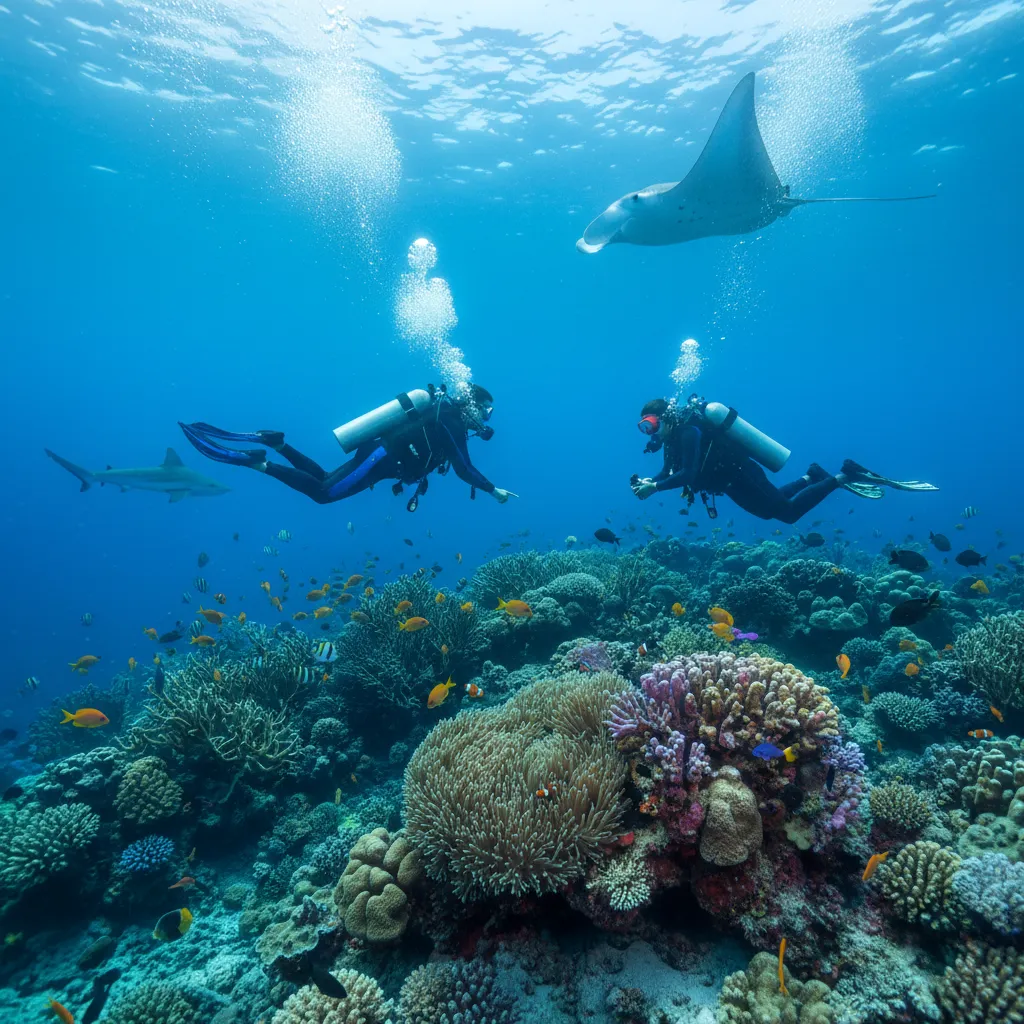
Diving in Majuro Atoll
Why dive here
Majuro Atoll offers some of Marshall Islands's richest diving, with 182+ marine species recorded in the area - including barracuda, blacktip reef sharks, eagle rays, grey reef sharks and whitetip reef sharks. Water ranges 29-30°C, warmest August, September, October.
Majuro might be the capital, but don’t let that conjure images of bustling dive boats. It’s far more laid-back. The diving here is surprisingly accessible for a remote Pacific atoll, with gentle reef slopes and some exhilarating channel drifts. We often encounter schools of Blackfin Soldierfish tucked into overhangs and we’ve seen plenty of Gray Reef Sharks cruising the currents. Our favourite spots are where the channels meet the open ocean, especially on an incoming tide when the water really pushes through, bringing in bigger pelagics. We love the simplicity of diving Majuro. You’re not fighting crowds; it feels like you have the ocean to yourselves. Keep an eye out for the more unusual residents - the vibrant Green-blotched Parrotfish really stand out against the corals, and we’ve spent ages watching Anchor Trunkfish meticulously picking through the sand. Visibility can hit 30 metres on a good day, especially during the drier months from December to April. Expect warm water year-round, typically around 28-29°C. The currents in the channels can be strong, which is fantastic for a drift dive, but it does mean some sites are better suited for advanced divers. We’d suggest chatting with the local dive centre about the day’s conditions; they know the atoll intimately.
Majuro Atoll Dive Site Map
Dive sites and dive centres in Majuro Atoll
Majuro Atoll Dive Sites
5 dive sites in Majuro Atoll
Anemone Nr. 1
Anemone Nr. 1 is one of those spots that just makes us smile. We’re talking about a reef absolutely carpeted in anemones, far more than you’d expect even in a healthy Pacific atoll. Drop in, and you’re immediately enveloped by the gentle sway of thousands of tentacles, mostly a muted yellow or green, dotted with their resident clownfish. It's not the dramatic drop-off type of dive, more of a gently sloping garden, but we love how intimate it feels. Keep your eyes peeled for the smaller stuff here. Banded cleaner shrimp are everywhere, often tucked into the folds of the anemones, ready to service any passing fish. We've spent entire dives just watching the intricate dance between the clownfish and their hosts, a quiet spectacle. For photographers, the light playing through the anemones is incredible, especially mid-morning. It's a relaxed dive, perfect for taking your time, good for those who like to focus on macro life and appreciate the quieter beauty of a thriving reef.
Aquarium
Aquarium, in Majuro Atoll, feels exactly as its name suggests: a massive fish tank you get to swim inside. We love how sheltered this reef is; it’s perfect for new divers finding their fins or for experienced folks who just want a relaxed dive with minimal fuss. Drifting over the coral at a comfortable 10-15 meters, you'll be surrounded by schools of Blackfin Chromis and Yellowstripe Wormfish. Look closer and you'll spot Honeycomb Groupers tucked into crevices. We've spent entire dives here just hovering, watching the drama unfold. The coral coverage is genuinely impressive, forming a dense, colourful backdrop for the constant parade of fish. Keep an eye out for the Mimic Surgeonfish, and if you’re lucky, a cruising Foxface. Visibility here is usually great, often 20 metres or more, making it easy to just soak in the sheer volume of life. It’s our favourite spot in Majuro for an easy afternoon dive when you want to see a lot without a lot of effort.
Calalin Channel
Calalin Channel isn’t for the faint of heart, but if you’re an experienced diver who loves a good drift, this is your spot. We love the sheer energy of it, the feeling of being propelled through the water, with the current doing all the work. You’ll drop in, usually with a fair bit of surge, then the channel just sucks you in, pushing you along past walls of hard coral. Keep your eyes peeled for grey reef sharks cruising through the blue – we’ve seen them in decent numbers here, sometimes a dozen or more. Eagle rays are a common sight too, gliding by with that effortless grace. The whole dive is a wild ride, from 10m down to around 30m, and it finishes out on the reef flats. Our favorite part is when you hit the slightly calmer areas, you can really take in the smaller details: the vibrant parrotfish, those big blackfin barracuda hanging motionless, and occasionally a curious polkadot cod peeking from a crevice. It’s an advanced dive, definitely, and you need to be comfortable with strong currents, but for that exhilarating rush and the chance to see some serious pelagics, it’s worth every bit of effort.
Raycrew
Raycrew is one of those spots that just feels right, a proper coral reef dive. We don't always get excited about just "coral reef," but this one has a certain magic to it, especially when the light hits just so. It’s not about huge pelagics here, more about a busy, bustling reef that keeps your eyes scanning. We love drifting along, picking out the smaller details. You'll spot a surprising number of Humphead Unicornfish, which are always fun to watch as they graze. Look closer for Messmate Pipefish tucked into the coral, and the flash of a Yellowmargin Triggerfish darting past. The stony corals here are healthy and form a labyrinth that makes for interesting swimming, feeling like you’re exploring an ancient city. We’ve found the best visibility tends to be in the morning, before any afternoon chop picks up. It’s a comfortable dive, nothing too challenging, ideal for divers who enjoy a relaxed pace and appreciate the smaller, intricate side of reef life.
West Coral Pass
West Coral Pass is where Majuro really flexes its muscle. We love a good pass dive, and this one delivers that exhilarating rush. Drop in at the mouth and let the current carry you into the lagoon. It's less a drift and more like being shot through a confetti canon of fusiliers and snapper. You’ll feel the water surge, pushing you past coral bommies absolutely swarming with fish. We’ve seen Blacktip reef sharks cruising the deeper edges, and the schools of Humphead unicornfish are just immense. Keep an eye out for the Orange-lined triggerfish, they’re particularly bold here, often finning right up to you. It’s not a dive for the faint-hearted if the current is ripping, but if you’re comfortable with some speed, it’s pure adrenaline. The sheer volume of fish is what makes it a standout.
Majuro Atoll Dive Centres
1 dive shop and operator in Majuro Atoll
Ocean Wildlife in Majuro Atoll
182 species recorded in Majuro Atoll
Majuro Atoll Daylight & Sunrise/Sunset
Sunrise and sunset times for Majuro Atoll, calculated from coordinates
Today - Sunday 11 October
Sunrise
05:22
Sunset
17:22
Daylight
12h 0m
Golden Hour
16:54
First light (dawn) at 05:01 · Last light (dusk) at 17:43
Monthly Averages
| Month | Sunrise | Sunset | Daylight |
|---|---|---|---|
| Jan | 05:52 | 17:37 | 11h 45m |
| Feb | 05:53 | 17:47 | 11h 54m |
| Mar | 05:42 | 17:47 | 12h 4m |
| Apr | 05:27 | 17:44 | 12h 16m |
| May | 05:19 | 17:45 | 12h 26m |
| JunLongest | 05:20 | 17:52 | 12h 32m |
| Jul | 05:26 | 17:56 | 12h 30m |
| Aug | 05:29 | 17:51 | 12h 21m |
| Sep | 05:26 | 17:36 | 12h 10m |
| OctNow | 05:22 | 17:20 | 11h 58m |
| Nov | 05:26 | 17:14 | 11h 48m |
| DecShortest | 05:39 | 17:22 | 11h 43m |
Times are approximate local times based on longitude. Actual times may vary slightly depending on the exact timezone observed in Majuro Atoll.
Where to Stay near Majuro Atoll
Prices from Booking.com. We may earn a commission at no extra cost to you.
Marine Protected Areas near Majuro Atoll
3 protected areas near Majuro Atoll - please respect local regulations when diving
Mili Atoll
Arno
Majuro
Getting to Majuro Atoll
Majuro Atoll
Kwajalein
Plan & book
Ways to dive Majuro Atoll, from day trips to liveaboards.
Day trips & courses
via GetYourGuideGuided dives, courses and snorkel trips with instant booking.
Find dive trips in Majuro AtollPlaces to stay
via Booking.comHotels and dive resorts near Majuro Atoll.
Search stays in Majuro AtollDive insurance
Most travel insurance excludes or limits scuba. Check what you need before you go.
Dive insurance explainedPartner links: we may earn a commission if you book, at no extra cost to you. How we make money