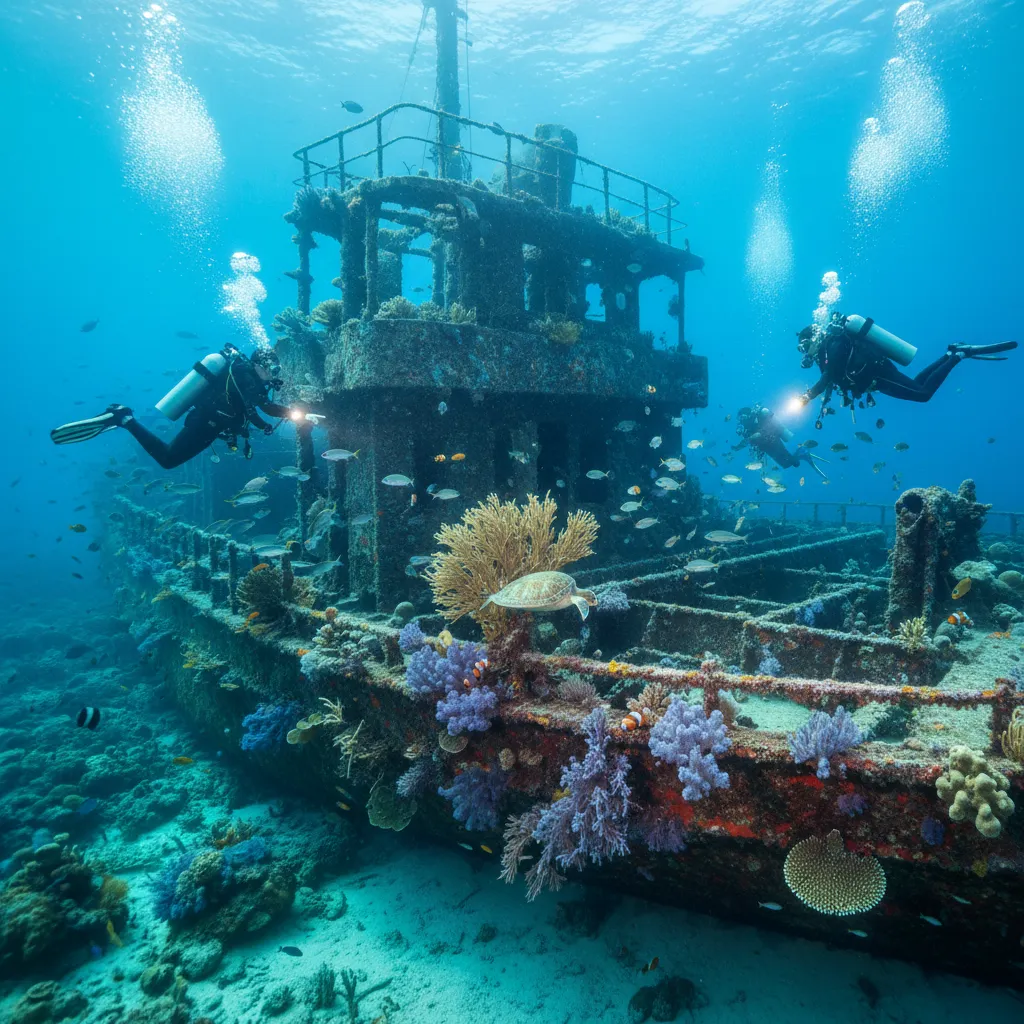
Diving in Chuuk (Truk) Lagoon
Why dive here
Chuuk (Truk) Lagoon offers some of Micronesia's richest diving, with 195+ marine species recorded in the area - including barracuda, blacktip reef sharks, eagle rays, grey reef sharks and whitetip reef sharks. Water ranges 29-30°C, warmest August, October, November.
Chuuk Lagoon, or Truk as many of us still call it, isn't just a dive destination; it's a history lesson you can swim through. You’re descending into a museum, plain and simple, and it’s unlike anywhere else on the planet. We love the sheer weight of history here, the palpable sense of time standing still amongst the wrecks of Operation Hailstone. Our favourite wrecks, like the San Francisco Maru with its tanks and trucks, or the Fujikawa Maru’s fighter planes in the holds, feel intensely personal. We remember seeing a Spotted Toby dart between the decaying machinery, a tiny splash of life against the somber steel. The visibility can be variable, sometimes a glorious 25 metres, other times a moody 10, adding to the atmospheric dive. The current is generally mild within the lagoon itself, making for relaxed penetrations for those with the right training. There are over 60 Japanese warships and aircraft, bombed and sunk in 1944, resting on the seabed. You’ll find everything from cargo ships to destroyers, each one a unique time capsule. We’d suggest visiting between December and April for the calmest surface conditions, though the diving is good year-round. While the wrecks are the undeniable star, keep an eye out for the resident Bumphead Parrotfish cruising the shallower reef edges, or the brilliant flash of a Decorated Butterflyfish against a coral-encrusted bulkhead.
Chuuk (Truk) Lagoon Dive Site Map
Dive sites and dive centres in Chuuk (Truk) Lagoon
Chuuk (Truk) Lagoon Dive Sites
42 dive sites in Chuuk (Truk) Lagoon
AIKOKU MARU
The Aikoku Maru is one of those wrecks that just hits different. We love that it’s a big ship, nearly 150 metres long, sitting upright and mostly intact on the seabed at 55 metres. Descending through the blue, you start to make out the superstructure, then the sheer scale of the hull. It’s dark down there, proper deep wreck diving, so good lights are essential. Our favourite part has to be the cargo holds, especially Hold No. 3, where you can still see stacks of ammunition and even skeletal remains - a sobering reminder of its history. Another highlight is the stern, where the massive propeller is still in place, encrusted with thick sponges and hard corals. Schools of barracuda often circle the mast, and we’ve seen plenty of reef sharks cruising by. While it’s a deep dive, the lack of strong current and generally good visibility in Chuuk means experienced wreck divers will find it a truly rewarding exploration. Just remember your bottom time and plan your deco stops properly.
AMAGISAN MARU
The Amagisan Maru holds a special place for us in Chuuk. This 138-meter tanker, settled upright at 45 meters, is an exercise in scale. We love exploring her enormous engine room, the massive pistons and crankshaft still surprisingly intact, a testament to the engineering of the time. You’ll feel a cool thermocline as you descend past the superstructure, often with schools of trevally circling the mast. Entry to the various holds is easy, revealing stacks of oil drums, and sometimes a few sake bottles scattered amongst the debris. The stern offers a fantastic swim-through into the propeller shaft tunnel, dark and narrow, but well worth the effort for the eerie silence it holds. Keep an eye out for nudibranchs clinging to the metalwork, their vibrant colours a stark contrast to the rust. This site suits experienced divers comfortable with depth and overhead environments, offering a tangible link to history.
Betty Bomber
We love the Betty Bomber for its sheer completeness. It’s a Type 97, Mitsubishi G4M, and she sits upright on a sandy bottom, surprisingly shallow given the history. We usually find her at around 15 metres, depending on the tide, making her an easy, long dive. The cockpit is a highlight, clear to see with the instrument panel still somewhat intact, and the machine guns are still mounted in the tail section. It’s a tangible link to Operation Hailstone. Look closely, and you’ll see soft corals already starting to encrust the fuselage, with schools of glassfish shimmering around the wings. It’s a moving experience, perfect for wreck enthusiasts who appreciate history and the slow reclamation by the ocean.
Chuuk Diving: The Wrecks of Truk Lagoon
Truk Lagoon is less about the reef and more about the ghosts of history. We’re talking about an entire Japanese fleet, sunk in 1944, now resting on the seafloor. You’ll spend your dives exploring cargo holds filled with gas masks, ammunition, and tanks, or peeking into engine rooms where gauges are still eerily intact. Over the decades, soft corals and anemones have taken hold, drawing in schools of fusiliers, patrolling reef sharks, and a surprising amount of macro life if you look closely. It’s a compelling, sometimes sombre, experience best suited for advanced divers comfortable navigating overhead environments.
Chuuk Lagoon Barrier Reefs Awash
The Awash site sits right on the barrier reef, a good spot to see what thrives outside the lagoon's sheltered waters. We often find the current picks up here, bringing in pelagics like grey reef sharks and schooling barracuda. It’s a drift dive for the most part, best suited for experienced divers comfortable with moving water. Expect healthy hard corals, sea fans, and plenty of reef fish in the shallows.
DAI NI HINO MARU
The Dai Ni Hino Maru, a Japanese cargo ship, rests upright in about 36 metres, a silent monument to Operation Hailstone. What we love about this wreck is the way it’s slowly being consumed by the reef. Down on the main deck, there are still sake bottles scattered amongst the coral, and in the forward holds, you’ll find piles of ammunition alongside trucks and chassis frames. The ambient light at depth here can be quite muted, so good lights are essential for poking around the holds, but it adds to the atmosphere. We’d suggest keeping an eye out for the resident moray eels that have made homes in the superstructure, and there are often schools of fusiliers circling the masts. The stern features a significant gun, draped in soft corals, a truly striking sight. It’s a dive that combines history with vibrant reef life, perfect for experienced wreck divers who appreciate a good penetration, though even outside the holds, there’s plenty to explore.
Emily Flying Boat
The Emily Flying Boat, or H6K, offers a different flavour of wreck dive in Chuuk. It’s an aircraft, not a ship, and that distinction makes it one of our favourites. We love the way it rests on the sandy bottom, largely intact, its immense wingspan stretching out like a ghostly manta ray. You can trace its outline, see the cockpit controls, even peer into the bomb bay where reef sharks often cruise past. It feels incredibly poignant, a snapshot from another time, with light filtering through the lagoon’s surface and glinting off the corroded metal. This isn’t a deep dive, usually around 15 metres, so it’s perfect for those longer bottom times to really explore. We always suggest taking a moment to appreciate the sheer scale of it, then focusing on the details: the engines, the propeller blades, and the way the coral has started to colonise the fuselage. Keep an eye out for triggerfish flitting around the edges and schooling fusiliers darting in and out of the open sections. It's a fantastic site for photographers and anyone keen to experience a very unique piece of history underwater.
Emily Flying Boat
The Emily Flying Boat. It’s a cracker. Sitting upright in just 15 metres, this Japanese Kawanishi H8K is an easy dive, perfect for getting a feel for Chuuk’s wrecks without the depth. We love how intact it is; the cockpit windows are still there, and you can swim right through the fuselage. Light filters in, making the internal structure really pop, especially when the sun hits the old instruments. Look closely, and you’ll spot Crested Sabretooth Blennies peering out from crevices, or a Foxface nudging through the frame. Around the wings, schools of Blue Trim Parrotfish often hang out, and we’ve seen Maori Wrasse cruising the perimeter. It’s the sheer scale of the Emily that gets you, even in the shallows. Our favourite part is lingering near the tail, imagining its past, while Bullethead Parrotfish graze on the coral now growing there. A truly excellent first wreck for anyone visiting the lagoon.
Fujikawa Maru
The Fujikawa Maru is, without question, one of our favourite dives in Chuuk Lagoon. It's a proper wreck, and its history feels palpable the moment you drop down. We love gliding past the bow guns, still pointed defiantly skyward, and imagining the final moments before she settled to the seabed. The cargo holds are where the Fujikawa really shines. Inside hold two, we've spent countless minutes hovering among the Zero fighter planes – wings folded, cockpits open – an eerie, silent graveyard of wartime aviation. Further aft, hold three often holds a surprise; sometimes we've found spare props stacked neatly, other times just the ghostly outlines of machinery. We always make sure to duck into the engine room, a labyrinth of gauges and valves, where flashlight beams cut through the gloom revealing schools of glassfish shimmering like liquid silver. Look closely at the superstructure; the soft corals have transformed it into a riot of purples and oranges, with reef sharks often cruising languidly overhead and plenty of jacks zipping past. It’s a dive that rewards slow exploration and a keen eye for both history and biology.
Fujikawa Maru
The Fujikawa Maru is a wreck we always recommend, especially for first-timers to Chuuk. Dropping down, you hit the bow around 10 meters, and the mast reaches even shallower, usually swarming with juvenile fusiliers. We love easing into the main deck, where the cargo holds gape open, revealing those famous Zero fighter planes. They’re still remarkably intact, wingtips touching in the gloom, and seeing them down there gives you chills. Further back, the engine room is a highlight, and you can make out the machinery quite clearly, with schools of cardinalfish darting through the beams of your torch. The deck guns are impressive, completely overgrown with colourful cauliflower corals and huge colonies of stony coral, attracting parrotfish and surgeonfish. Keep an eye out for blacktip reef sharks cruising the perimeter; they often make an appearance. It's an intermediate dive, really, because while there’s plenty to see outside, we’d suggest some penetration experience to get the most out of those holds. The Fujikawa Maru offers a powerful mix of history and vibrant coral growth, making it an excellent introduction to what Chuuk Lagoon is all about.
Fujikawa Maru
The Fujikawa Maru is a wreck dive, pure and simple, and if you’re coming to Chuuk, you’re likely coming for her. We love how the bow guns are so overgrown with soft corals, they almost look like part of the reef itself. Dropping down, you feel the water cool slightly as you pass into the immense shadow of the hull, and then it’s just wall-to-wall exploration. Inside, the engine room is a highlight, but for us, the real draw is the aircraft cargo bay. Mitsubishi A6M Zeros, wings folded, are still there, perfectly preserved in the gloom. It’s an incredibly poignant experience, hovering inches from a piece of history. Visibility here can sometimes be a little hazy, especially after a storm, but that only adds to the atmosphere, making the wreck feel even more mysterious. Keep an eye out for the honeycomb groupers lurking in the darker corners and the flash of bicolor parrotfish flitting among the coral encrusted bulkheads. We’d suggest a dive with a good torch, even on a bright day, to really appreciate the interior details.
FUJIKAWA MARU
The *Fujikawa Maru* sits upright, a proper ghost ship, and it’s one of our favourite dives in Chuuk for a reason. Drop down to the bow and you’ll find two large bow guns still in place, encrusted in corals. It gives you a real sense of the history, the urgency of its final moments. We love venturing into the holds, especially number two, where you can still spot fighter aircraft – Zero fuselages, engines, wings – piled up. The light filters in, illuminating the rusted metal and the soft corals that have taken hold. Further back, the engine room is a highlight, accessible for those with the right training, offering a tighter, more atmospheric exploration. The structure itself, though deep at 33 metres, is wonderfully colonised. You’ll see schools of fusiliers and snapper hanging around the masts, and often a few reef sharks patrolling the perimeter. It’s a dive that delivers on history and marine life in equal measure; a truly evocative experience that’s best suited to experienced wreck divers comfortable with penetration.
Show all 42 dive sites in Chuuk (Truk) Lagoon
- FUJISAN MARU
- Fumitsuki Maru
- FUMITSUKI (POSSIBLY)
- Haian Maru
- Heian Maru
- HEIHAN MARU
- Hoki Maru
- I-169 Submarine
- KANAZONO MARU
- Kensho Maru
- Kiyosumi Maru
- Murilo Atoll Reef Mainly Awash
- Neoch Atoll Reef Awash
- Nippo Maru
- Rio de janeiro Maru
- RIO DE JANEIRO MARU
- Rio de Janiero Maru
- San Francisco Maru
- San Francisco Maru
- Sankisan Maru
- Shinkoku Maru
- Shinkoku Maru
- Shinkoku Maru
- TAIHO MARU
- Truk Lagoon
- Unkai Maru
- Yamagiri Maru
- YAMAGIRI MARU
- YUBAE MARU
- Yubai Maru
Chuuk (Truk) Lagoon Dive Centres
3 dive shops and operators in Chuuk (Truk) Lagoon
Ocean Wildlife in Chuuk (Truk) Lagoon
195 species recorded in Chuuk (Truk) Lagoon
Chuuk (Truk) Lagoon Daylight & Sunrise/Sunset
Sunrise and sunset times for Chuuk (Truk) Lagoon, calculated from coordinates
Today - Sunday 11 October
Sunrise
05:40
Sunset
17:40
Daylight
12h 0m
Golden Hour
17:12
First light (dawn) at 05:19 · Last light (dusk) at 18:01
Monthly Averages
| Month | Sunrise | Sunset | Daylight |
|---|---|---|---|
| Jan | 06:10 | 17:54 | 11h 44m |
| Feb | 06:11 | 18:04 | 11h 53m |
| Mar | 06:00 | 18:05 | 12h 4m |
| Apr | 05:45 | 18:02 | 12h 17m |
| May | 05:36 | 18:03 | 12h 27m |
| JunLongest | 05:37 | 18:10 | 12h 33m |
| Jul | 05:44 | 18:14 | 12h 31m |
| Aug | 05:47 | 18:09 | 12h 22m |
| Sep | 05:44 | 17:54 | 12h 10m |
| OctNow | 05:40 | 17:38 | 11h 58m |
| Nov | 05:44 | 17:32 | 11h 47m |
| DecShortest | 05:57 | 17:39 | 11h 42m |
Times are approximate local times based on longitude. Actual times may vary slightly depending on the exact timezone observed in Chuuk (Truk) Lagoon.
Where to Stay near Chuuk (Truk) Lagoon
Prices from Booking.com. We may earn a commission at no extra cost to you.
Marine Protected Areas near Chuuk (Truk) Lagoon
1 protected area near Chuuk (Truk) Lagoon - please respect local regulations when diving
And Atoll
Getting to Chuuk (Truk) Lagoon
Weno Island
Plan & book
Ways to dive Chuuk (Truk) Lagoon, from day trips to liveaboards.
Day trips & courses
via GetYourGuideGuided dives, courses and snorkel trips with instant booking.
Find dive trips in Chuuk (Truk) LagoonPlaces to stay
via Booking.comHotels and dive resorts near Chuuk (Truk) Lagoon.
Search stays in Chuuk (Truk) LagoonDive insurance
Most travel insurance excludes or limits scuba. Check what you need before you go.
Dive insurance explainedPartner links: we may earn a commission if you book, at no extra cost to you. How we make money