AMAGISAN MARU
Why dive here
With 195+ marine species recorded in the area - including barracuda, blacktip reef sharks, eagle rays, grey reef sharks and whitetip reef sharks - AMAGISAN MARU offers some of Chuuk (Truk) Lagoon's richest wreck diving. Water ranges 29-30°C, warmest August, October, November.
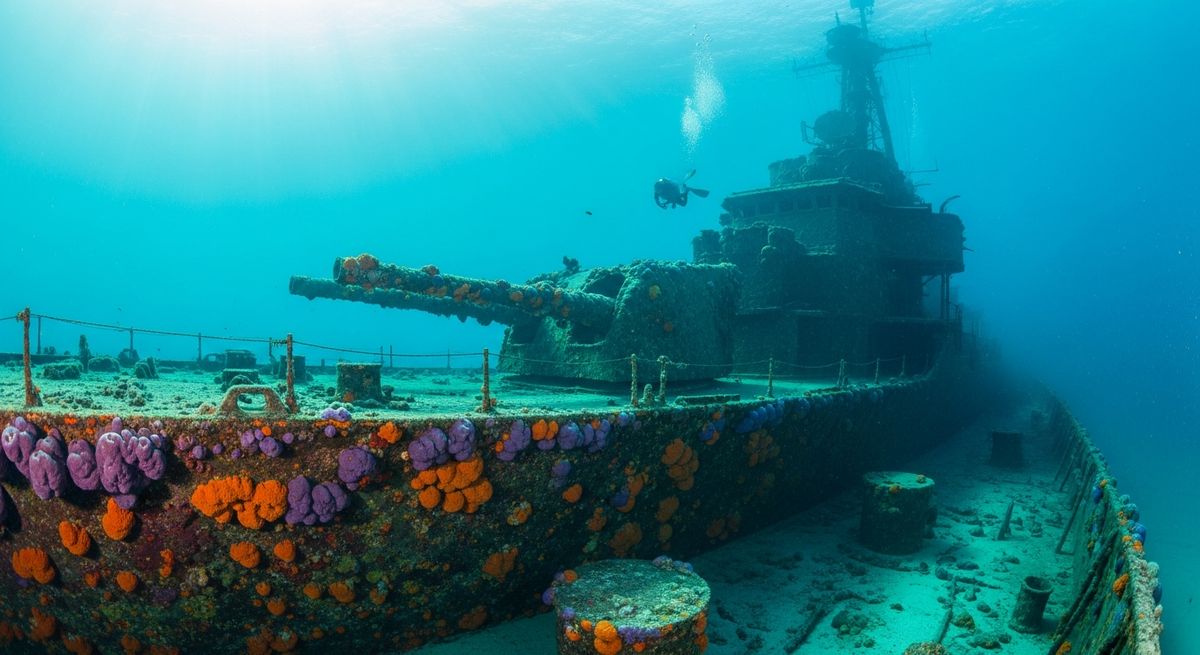
The Amagisan Maru holds a special place for us in Chuuk. This 138-meter tanker, settled upright at 45 meters, is an exercise in scale. We love exploring her enormous engine room, the massive pistons and crankshaft still surprisingly intact, a testament to the engineering of the time. You’ll feel a cool thermocline as you descend past the superstructure, often with schools of trevally circling the mast. Entry to the various holds is easy, revealing stacks of oil drums, and sometimes a few sake bottles scattered amongst the debris. The stern offers a fantastic swim-through into the propeller shaft tunnel, dark and narrow, but well worth the effort for the eerie silence it holds. Keep an eye out for nudibranchs clinging to the metalwork, their vibrant colours a stark contrast to the rust. This site suits experienced divers comfortable with depth and overhead environments, offering a tangible link to history.
Typical AMAGISAN MARU Dive Profile
Illustrative profile based on site depth and type. Actual dive profiles vary - always follow your dive computer and training.
Safety Notes
Maximum depth 45m exceeds recreational limits (40m). Technical diving certification and equipment required.
Wreck site - avoid penetration without wreck diving certification. Watch for sharp metal and entanglement hazards.
Always perform a 3-minute safety stop at 5m before surfacing.
AMAGISAN MARU Wreck History
Year Sunk
1944
Vessel Type
cargo ship
Cause
warfare
The Amagisan Maru was a passenger-cargo ship built in 1933 for the Mitsui Bussan Kaisha line. Like many civilian vessels, she was requisitioned for service with the Imperial Japanese Navy during World War II. Her fate was sealed when she was caught at anchor in Truk Lagoon, a major Japanese naval base in the Central Pacific, during a massive U.S. Navy attack.
On February 17, 1944, Operation Hailstone commenced. It was a devastating two-day air and surface assault that caught the Japanese forces by surprise. Carrier-based aircraft from Task Force 58 swarmed the lagoon, sinking over 40 ships and destroying hundreds of aircraft. The Amagisan Maru was one of the many victims, hit by bombs and sent to the bottom of the lagoon where she has remained ever since.
Today, the Amagisan Maru is a premier wreck dive for advanced and technical divers. She sits upright in approximately 45 metres of water, with her deck accessible to those with deep-diving qualifications. The wreck is largely intact, and divers can explore her holds, which still contain items like tanker trucks and other war materials. The bridge and engine room offer fantastic penetration opportunities for the properly trained. As with all the wrecks in Truk Lagoon, she is now a vibrant artificial reef, covered in coral and teeming with marine life, serving as both a war grave and a spectacular underwater museum.
Nearest Dive Centres to AMAGISAN MARU
Dive shops near AMAGISAN MARU
View all dive centres in Chuuk (Truk) LagoonReviews for AMAGISAN MARU
Conditions
Ocean conditions, forecast and tides for AMAGISAN MARU
AMAGISAN MARU Ocean Conditions
Monthly averages for AMAGISAN MARU, sourced from Open-Meteo marine data - nearest station: Open-Meteo marine grid (7.41, 151.84) (2km away)
October Averages
Sea Temperature
30°C
86°F · Range: 29.3–31.4°C
Air Temperature
28°C
82°F
Wind Speed
6.4 m/s
12.4 knots
Atmospheric Pressure
1009.4 hPa
Based on 4 years of monitoring data · Data sources: Open-Meteo marine data
Plan & book
Ways to dive Chuuk (Truk) Lagoon, from day trips to liveaboards.
Day trips & courses
via GetYourGuideGuided dives, courses and snorkel trips with instant booking.
Find dive trips in Chuuk (Truk) LagoonPlaces to stay
via Booking.comHotels and dive resorts near Chuuk (Truk) Lagoon.
Search stays in Chuuk (Truk) LagoonDive insurance
Most travel insurance excludes or limits scuba. Check what you need before you go.
Dive insurance explainedPartner links: we may earn a commission if you book, at no extra cost to you. How we make money
Where to Stay near AMAGISAN MARU
Prices from Booking.com. We may earn a commission at no extra cost to you.