AIKOKU MARU
Why dive here
With 195+ marine species recorded in the area - including barracuda, blacktip reef sharks, eagle rays, grey reef sharks and whitetip reef sharks - AIKOKU MARU offers some of Chuuk (Truk) Lagoon's richest wreck diving. Water ranges 29-30°C, warmest August, October, November.
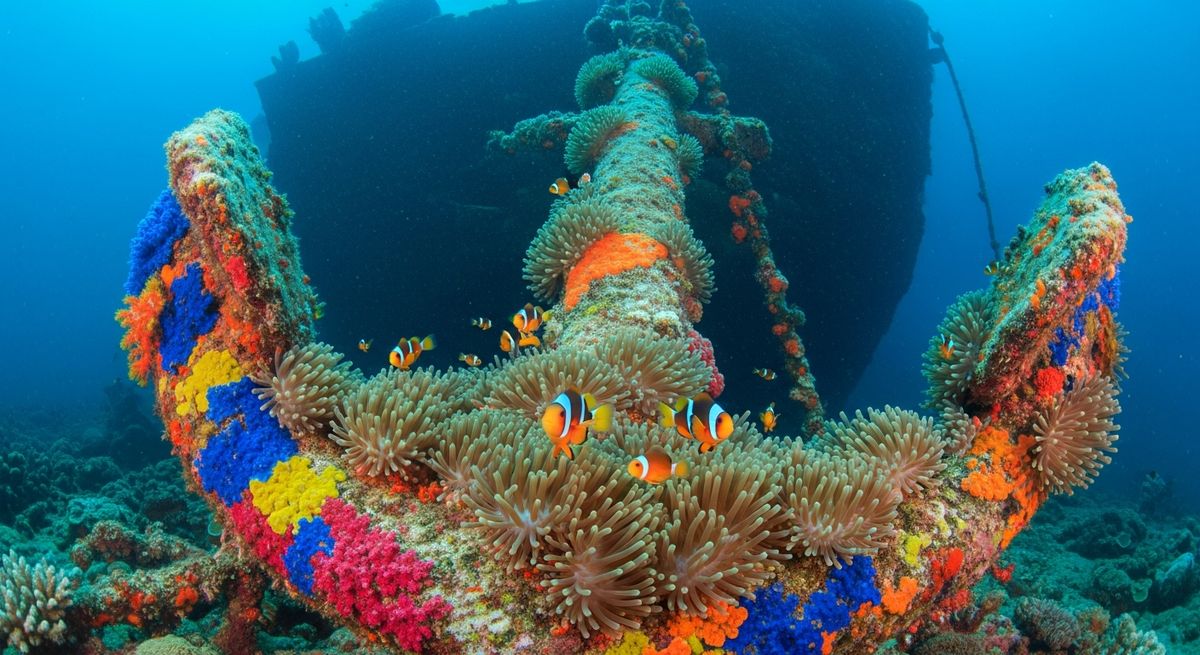
The Aikoku Maru is one of those wrecks that just hits different. We love that it’s a big ship, nearly 150 metres long, sitting upright and mostly intact on the seabed at 55 metres. Descending through the blue, you start to make out the superstructure, then the sheer scale of the hull. It’s dark down there, proper deep wreck diving, so good lights are essential. Our favourite part has to be the cargo holds, especially Hold No. 3, where you can still see stacks of ammunition and even skeletal remains - a sobering reminder of its history. Another highlight is the stern, where the massive propeller is still in place, encrusted with thick sponges and hard corals. Schools of barracuda often circle the mast, and we’ve seen plenty of reef sharks cruising by. While it’s a deep dive, the lack of strong current and generally good visibility in Chuuk means experienced wreck divers will find it a truly rewarding exploration. Just remember your bottom time and plan your deco stops properly.
Typical AIKOKU MARU Dive Profile
Illustrative profile based on site depth and type. Actual dive profiles vary - always follow your dive computer and training.
Safety Notes
Maximum depth 55m exceeds recreational limits (40m). Technical diving certification and equipment required.
Wreck site - avoid penetration without wreck diving certification. Watch for sharp metal and entanglement hazards.
Always perform a 3-minute safety stop at 5m before surfacing.
AIKOKU MARU Wreck History
Year Sunk
1944
Vessel Type
ammunition ship
Cause
combat
Tonnage
10,437 GRT
The Aikoku Maru was a modern Japanese vessel that began her career in 1940 as an armed merchant cruiser, raiding Allied shipping lanes. She was later converted to a submarine tender and finally to an ammunition and troop transport ship, a role that would seal her fate. As part of the Japanese fleet stationed at the formidable naval base in Chuuk (Truk) Lagoon, she was a key logistical asset for the Imperial Japanese Navy's operations in the Pacific.
Her end came on February 17, 1944, during the massive US Navy air raid known as Operation Hailstone. While attempting to escape the lagoon, the Aikoku Maru was struck by an aerial torpedo from a US Navy Avenger. The torpedo detonated in a hold packed with ammunition, triggering a catastrophic explosion that vaporized the forward section of the ship and sent her to the bottom in seconds, taking hundreds of embarked soldiers with her. The blast was so powerful it was reported to have downed the attacking aircraft.
Today, the Aikoku Maru is one of Chuuk Lagoon's most famous deep wrecks, resting at a depth of 55 meters. The 150-meter-long vessel is a somber and awe-inspiring sight. Divers can explore the relatively intact stern, complete with large anti-aircraft guns, before moving towards the shattered bow section that serves as a testament to the violence of her sinking. It remains a powerful underwater memorial to those who perished in the attack.
Nearest Dive Centres to AIKOKU MARU
Dive shops near AIKOKU MARU
View all dive centres in Chuuk (Truk) LagoonReviews for AIKOKU MARU
Conditions
Ocean conditions, forecast and tides for AIKOKU MARU
AIKOKU MARU Ocean Conditions
Monthly averages for AIKOKU MARU, sourced from Open-Meteo marine data - nearest station: Open-Meteo marine grid (7.41, 151.84) (2km away)
October Averages
Sea Temperature
30°C
86°F · Range: 29.3–31.4°C
Air Temperature
28°C
82°F
Wind Speed
6.4 m/s
12.4 knots
Atmospheric Pressure
1009.4 hPa
Based on 4 years of monitoring data · Data sources: Open-Meteo marine data
Plan & book
Ways to dive Chuuk (Truk) Lagoon, from day trips to liveaboards.
Day trips & courses
via GetYourGuideGuided dives, courses and snorkel trips with instant booking.
Find dive trips in Chuuk (Truk) LagoonPlaces to stay
via Booking.comHotels and dive resorts near Chuuk (Truk) Lagoon.
Search stays in Chuuk (Truk) LagoonDive insurance
Most travel insurance excludes or limits scuba. Check what you need before you go.
Dive insurance explainedPartner links: we may earn a commission if you book, at no extra cost to you. How we make money
Where to Stay near AIKOKU MARU
Prices from Booking.com. We may earn a commission at no extra cost to you.