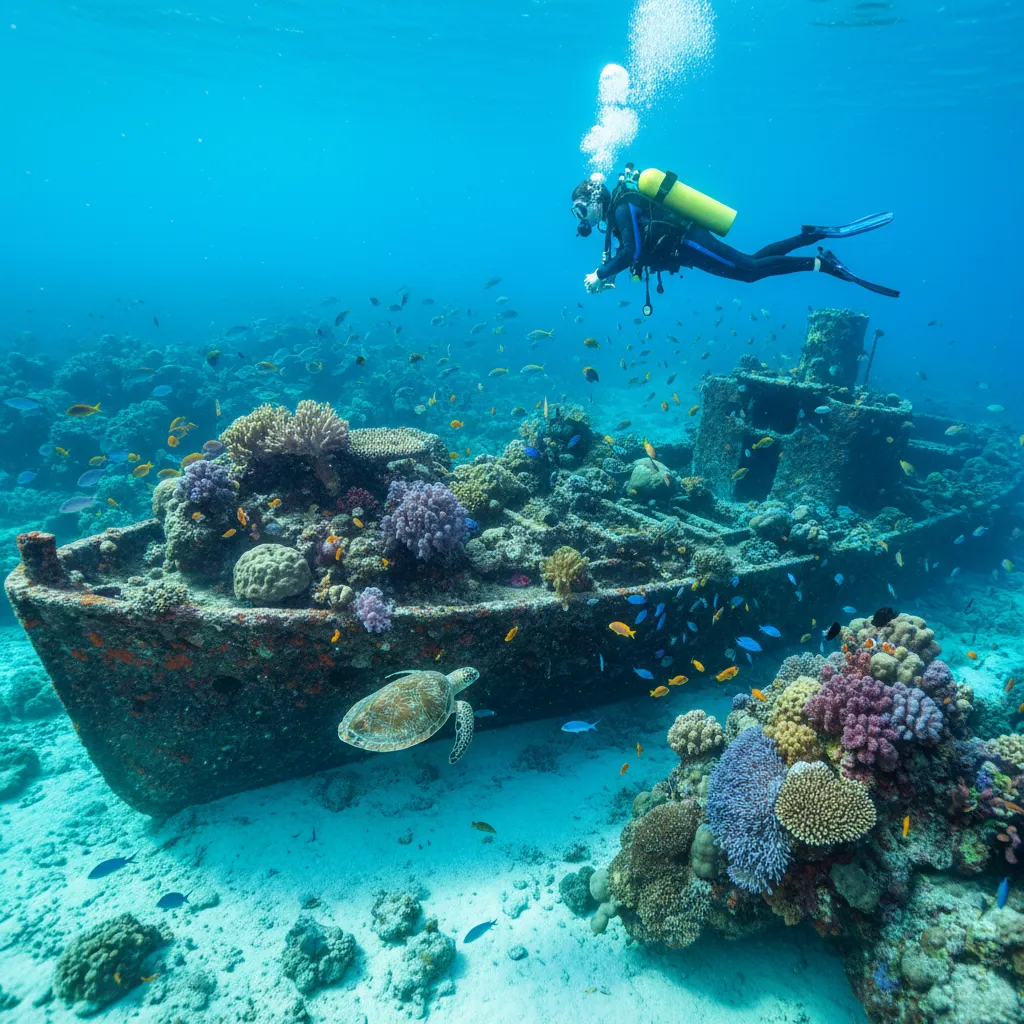
Diving in Espiritu Santo
Why dive here
Espiritu Santo offers some of Vanuatu's richest diving, with 280+ marine species recorded in the area - including blacktip reef sharks, dugongs, dwarf minke whales, octopuses and pygmy seahorses. Water sits around 29°C.
Espiritu Santo isn't just a dive destination; it's a history lesson you can swim through. We love it for the sheer scale of the SS President Coolidge, a monstrous wreck that swallows you whole. Dropping onto her deck in 20m of water, you feel the weight of history, seeing the cargo holds crammed with Jeeps and cannons. Our favourite spots are the medical supplies in the infirmary, still neatly stacked, and the "Lady" statue in the ballroom, a poignant reminder of lives lived and lost. Visibility here can be 20-30m on a good day, but it’s the Coolidge that truly captivates, not the reef fish, though we've spotted plenty of Parrotfish grazing the coral that's started to colonise the wreck. The currents can be mild to moderate, especially around the bow, so we always suggest paying attention to the brief. Beyond the Coolidge, Million Dollar Point offers a quirky dive, an artificial reef born from discarded WWII equipment - a strange, beautiful graveyard of bulldozers and Coca-Cola bottles. It’s an easy dive, great for beginners, while the Coolidge is definitely for the advanced diver. We'd suggest getting a few dives under your belt before tackling the deeper penetration dives, but even just exploring the exterior is incredible.
Espiritu Santo Dive Site Map
Dive sites and dive centres in Espiritu Santo
Espiritu Santo Dive Sites
19 dive sites in Espiritu Santo
Aore Adventures Sports & Lodge
Aore Adventures might not be the most famous name on Santo, but we think their house reef is seriously underrated. You roll off the boat (or even straight from the jetty) into surprisingly healthy coral, right in front of the lodge. We've spent hours finning around here, spotting juvenile lionfish tucked into crevices and those huge, almost ridiculously blue, small giant clams. It’s an easy, calm dive, perfect for a relaxed afternoon or a checkout dive. The water here feels warm and clear, often around 25-30 meters of visibility, especially when the tide's coming in. We've seen some cracking little critters too: tiny gobies perched on their sand burrows, the flashy orange-lined triggerfish darting about, and once, a rather grumpy-looking hunchback locust lobster scuttling across the sand. It’s not about big pelagics here; it's about slowing down and appreciating the smaller stuff. We love it as a warm-up before hitting the Coolidge.
Chails Reef
Chails Reef, off Espiritu Santo, offers a straightforward reef dive. You’ll find a mix of hard and soft corals here, providing shelter for the usual reef fish – damselfish, parrotfish, and the occasional anemonefish. It's a relaxed site, good for knocking off the rust or for divers who prefer a gentler pace away from the bigger wrecks. We generally find it’s best explored slowly, keeping an eye out for smaller critters tucked into the coral.
CHYAU FENG NO.12
The Chyau Feng No.12, often just called the "Fishing Boat Wreck," is a fascinating contrast to Santo’s larger, deeper wrecks. We love this site because it’s a brilliant shore dive, sitting just off Palikulo Point. It's really accessible, which means more bottom time exploring the details. This old fishing vessel ran aground in 1977 and now lies in incredibly shallow water, parts of it even break the surface at low tide. You’ll weave through the exposed superstructure, the mast reaching up like a gnarled finger. Below the waterline, the hull is wonderfully encrusted with corals, and we’ve spent ages just watching the damselfish dart in and out of the nooks and crannies. Look closely, and you’ll spot nudibranchs grazing on the growth. The light here is often spectacular, especially on a sunny afternoon, dappling through the deck plates and illuminating schools of tiny baitfish. It's a relaxed dive, perfect for photographers or anyone wanting to spend an hour simply observing. Visibility can vary with the tide, but we find it’s usually clear enough to appreciate the details of this old workhorse.
Cindy s Reef
Cindy's Reef offers a straightforward coral dive, gentle and calm, making it a good choice for those looking for an easy afternoon. We've seen a decent array of smaller reef fish flitting through the corals here, nothing particularly huge, but plenty to keep your eyes busy. It's a relaxed site, especially suitable for newer divers or those who prefer a less demanding dive without strong currents.
FAUABU TWOOMEY
Okay, Fauabu Twoomey. Not your typical postcard wreck, but that’s precisely why we love it. This isn't a deep dive, it's barely a dive at all in places. What you get is a motor vessel, driven hard aground in 1970, with parts of her superstructure still breaking the surface at low tide. We’d suggest going at high tide if you want to properly explore, otherwise, you'll be doing more snorkelling and wading than diving. The Twoomey lies close to shore, making it super accessible, even if the exact "difficulty" is more about navigating the shallows than battling current. What strikes you immediately is the sheer amount of life that has taken over. We’re talking schools of cardinalfish darting through what used to be her holds, anemones swaying on metal plates, and parrotfish grazing on the soft corals that coat every available surface. It’s like a living museum of salvage. Look closely in the nooks and crannies for nudibranchs, and keep an eye out for a passing turtle or two, especially around the more intact sections of the hull. This site is fantastic for photographers who like a natural light setting and for anyone who loves the story of a wreck reclaimed by the ocean, rather than just a quick dip through a deep, dark hull.
FEDERESEN NALKUTAN
Federesen Nalkutan, now this is a proper wreck, not just some scattered bits of metal. We love how accessible it is, sitting right on the reef flat, practically begging for a snorkel or a shallow dive. This 43-meter motor vessel went ashore during Cyclone Eric in '85, and you can still see the bulk of her hull and superstructure largely intact. Drop in and you'll find the wreck utterly plastered in hard corals, big plate formations, and colourful branching varieties. Schools of fusiliers dart in and out of the holds, and we've seen some surprisingly large parrotfish munching away on the growth. The bridge area is particularly fun to poke around, with sunlight filtering through, illuminating the resident damselfish. It’s a site for anyone who enjoys the simple pleasure of exploring a well-preserved wreck in clear, shallow water, with plenty of fish life to keep things interesting. Best dived around high tide to avoid scraping your belly on the reef.
FEDERESEN NALKUTAN (PROBABLY)
The Federeesen Nalkutan, or at least that's what we think she is, offers a really unique slice of Santo’s wreck diving. This motor vessel went ashore during Cyclone Eric in 1985, leaving her high and dry, or rather, very shallow. We love that you can actually snorkel this one, exploring the parts of her hull and superstructure that poke above the surface. It feels like you're diving history without needing deep certs. What you'll find here is a wreck in transition. The parts still submerged are now home to a surprising amount of fish – we've seen schools of juvenile snapper darting around the keel and small parrotfish grazing the algae. Above water, the rusted metal offers a stark contrast to the blue sky, and below, the shallow depths mean fantastic light penetration, illuminating the nooks and crannies where smaller critters hide. This site is brilliant for snorkelers, freedivers, and even new divers wanting a chill wreck experience without the pressures of depth or current. Our tip: go at high tide for the best submerged views, and bring a good macro lens for the surprising amount of life in the shallows.
HIP CHOW
Okay, let's talk about Hip Chow. This isn't your usual deep wreck dive; in fact, it barely qualifies as a dive. We're talking about a rusty old motor vessel, high and dry on the reef flats at Pinalum. It ran aground back in 1970, and the sea has been slowly reclaiming it ever since. What you get here is a fantastic snorkelling and photography spot. The wreck itself is a skeleton, stripped bare by decades of sun and salt. But that's its charm. We love watching the waves surge through the exposed ribs of the hull, creating a rhythmic, almost metallic clanging sound. It's a great spot for beginners or anyone who just wants to potter around with a mask and snorkel. Look closely in the shallow pools that form inside the wreck at low tide; we've seen everything from tiny crabs scuttling amongst the barnacles to juvenile parrotfish darting through the rusted metal. It’s an interesting contrast to the deeper wrecks Espiritu Santo is famous for, a quiet testament to the ocean’s power.
Million Dollar Point
Million Dollar Point is… well, it’s exactly what it sounds like. After World War II, the Americans decided it was cheaper to bulldoze millions of dollars of perfectly good equipment off a pier than to ship it back home. Think jeeps, bulldozers, crates of Coke bottles, even parts of landing craft, all stacked up underwater. We love it because it’s a time capsule, a real physical echo of history. Dropping in, you’re met with these incredible artificial canyons of rusting metal, now completely colonised by corals. Orbicular batfish drift by like wary sentinels, and we’ve spotted huge schools of scad darting through the wrecks. Look closely and you’ll find plenty of smaller life – parrotfish grazing, and we’ve even found Bennett’s pufferfish tucked into crevices. The depth ranges from just a few metres down to 30, so it’s easy diving for anyone, whether you’re newly certified or just want a long, relaxed bottom time. Our favourite part is weaving through the old machinery, imagining the sheer scale of the waste, all while spotting cowries and blennies. Head there in the morning, the light plays really nicely off the metal.
Million Dollar Point
Million Dollar Point isn't your usual wreck dive, and that's why we love it. Imagine a mountain of military hardware just dumped into the sea – jeeps, bulldozers, cranes, miles of corrugated iron, even stacks of Coca-Cola bottles. All of it pushed off a pier by the US military post-WWII, rather than sell it cheap to the British and French colonial powers. It’s a fascinating, almost surreal landscape underwater. You descend into a kind of apocalyptic junkyard, the light filtering through the water picking out the angular shapes of machinery. Schools of charcoal damsels dart through the twisted metal, and we've spotted some impressively large argus grouper lurking in the shadows. Look closely, and you'll find ornate cowries clinging to the older sections, and often a bright orange-lined triggerfish patrolling its territory. It’s an easy dive, shallow enough for long bottom times, making it perfect for photographers who want to spend ages framing those unique shots of nature reclaiming industry. Our tip: go in the morning for the best light penetration onto the deeper stacks.
NEPTUNE (POSSIBLY)
We love a good mystery, and Neptune, or what we *think* is Neptune, delivers. This isn’t a pristine wreck, perfectly upright and preserved. It’s a mess of twisted metal, scattered across a shallow reef, which is precisely its charm. The story goes it ran aground in 1973, suffered a holed engine room, and slowly disintegrated. Now, at just 10 metres, it’s a brilliant, easy dive, perfect for a long bottom time, hunting for macro life amongst the debris. You'll spend your time here exploring chunks of hull and superstructure, completely encrusted in hard corals. Schools of fusiliers dart over the wreckage, and we always spot a few clownfish defending their anemones. Look closely in the crevices; we’ve had some fantastic encounters with moray eels and the occasional reef shark cruising by. It’s not the SS President Coolidge, but for a chilled-out dive with a sense of history and plenty of interesting nooks to poke around in, it’s one of our favourite spots.
PRESIDENT COOLIDGE
The SS President Coolidge isn't just a wreck dive, it's a journey into a specific moment in history. We love that feeling of descending through the thermocline and seeing the sheer scale of the ship emerge from the blue. It sits on its port side, a colossal steel behemoth that once carried passengers and later, troops. You can spend multiple dives here and still feel like you've only scratched the surface. Our favourite parts are definitely the cargo holds, where you’ll find jeeps and artillery still stacked as they were on that fateful day in 1942. The "Lady" statue in the first class lounge, draped in soft corals and patrolled by flashlight fish, is a genuinely eerie and beautiful sight. The bow, draped in growth, offers the best chance to spot large pelagics cruising by, while the stern, shallower at 25m, has resident reef sharks. This dive suits confident wreck divers who appreciate exploration and history. Just remember your penetration training, and good buoyancy is a must to avoid stirring up the decades of silt. We’d also suggest going in the morning; the light filtering through the upper decks is just magical.
Show all 19 dive sites in Espiritu Santo
Espiritu Santo Dive Centres
4 dive shops and operators in Espiritu Santo
Ocean Wildlife in Espiritu Santo
280 species recorded in Espiritu Santo
Espiritu Santo Daylight & Sunrise/Sunset
Sunrise and sunset times for Espiritu Santo, calculated from coordinates
Today - Sunday 11 October
Sunrise
05:27
Sunset
17:50
Daylight
12h 22m
Golden Hour
17:21
First light (dawn) at 05:06 · Last light (dusk) at 18:11
Monthly Averages
| Month | Sunrise | Sunset | Daylight |
|---|---|---|---|
| Jan | 05:32 | 18:29 | 12h 57m |
| Feb | 05:48 | 18:24 | 12h 36m |
| Mar | 05:55 | 18:07 | 12h 12m |
| Apr | 05:59 | 17:44 | 11h 45m |
| May | 06:06 | 17:30 | 11h 24m |
| JunShortest | 06:16 | 17:28 | 11h 12m |
| Jul | 06:19 | 17:36 | 11h 17m |
| Aug | 06:09 | 17:44 | 11h 35m |
| Sep | 05:47 | 17:47 | 12h 0m |
| OctNow | 05:25 | 17:50 | 12h 26m |
| Nov | 05:11 | 18:01 | 12h 50m |
| DecLongest | 05:15 | 18:18 | 13h 3m |
Times are approximate local times based on longitude. Actual times may vary slightly depending on the exact timezone observed in Espiritu Santo.
Where to Stay near Espiritu Santo
Prices from Booking.com. We may earn a commission at no extra cost to you.
Marine Protected Areas near Espiritu Santo
12 protected areas near Espiritu Santo - please respect local regulations when diving
Vatthe
President Coolidge and Million Dollar Point
Naomebaravu-Malo
Aore
Bucaro Aore
Lake Letas
Loru Protected Area
Ringi Te Suh Marine Conservation Reserve
Vendik Protected Area
Ringi te Extension Reserve
Nagha mo Pineia Protected Area
Lekavik
Getting to Espiritu Santo
Luganville
Port Vila
Gaua Island
Plan & book
Ways to dive Espiritu Santo, from day trips to liveaboards.
Day trips & courses
via GetYourGuideGuided dives, courses and snorkel trips with instant booking.
Find dive trips in Espiritu SantoPlaces to stay
via Booking.comHotels and dive resorts near Espiritu Santo.
Search stays in Espiritu SantoDive insurance
Most travel insurance excludes or limits scuba. Check what you need before you go.
Dive insurance explainedPartner links: we may earn a commission if you book, at no extra cost to you. How we make money