Diving in Ishigaki & Yaeyama
Why dive here
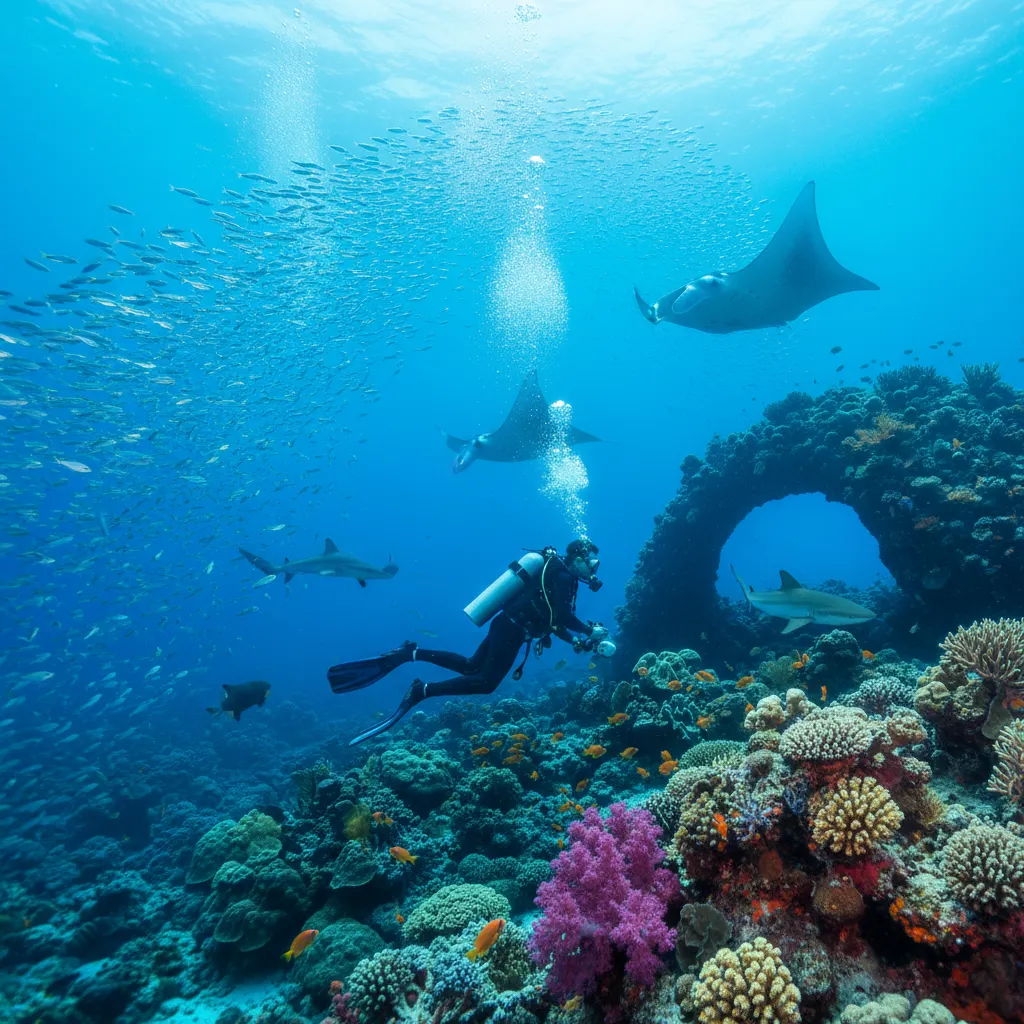
Ishigaki & Yaeyama offers some of Japan's richest diving, with 428+ marine species recorded in the area - including bull sharks, manta rays, mobula rays (devil rays), seahorses and sea turtles. Water ranges 23-30°C, warmest July, August, September.
Ishigaki, and the Yaeyama islands beyond it, feel like Japan's answer to the South Pacific, but with a distinctly Japanese flavour. We love it for the sheer variety, from the dramatic drift dives to the surprisingly intricate coral gardens. Manta Scramble is the obvious draw, and for good reason; seeing these giants glide in during the spring to autumn months is a genuine thrill, sometimes so close you can hear the displacement of water as they pass. It’s a clean, open ocean experience. But look past the mantas, and you’ll find our favourite spots: the healthy hard coral fields. Montipora and brain corals here are just spectacular. We're talking vast, undulating landscapes of coral that feel ancient. Some of the caves are fantastic too, like going through a geological maze. Currents can be brisk on the deeper sites, so a bit of experience certainly helps, but there’s plenty for newer divers in the sheltered bays. We’d suggest going in late spring or early autumn to dodge the peak summer crowds and still catch good manta action.
Ishigaki & Yaeyama Dive Site Map
Dive sites and dive centres in Ishigaki & Yaeyama
Ishigaki & Yaeyama Dive Sites
53 dive sites in Ishigaki & Yaeyama
Antoniogaudei
Antoniogaudei is one of those dives that sticks with you, a genuinely unique experience in Ishigaki. We love it for the sheer scale of the coral structures, reminiscent of a submerged cathedral. Picture massive brain root corals forming arches and tunnels, light filtering through the gaps creating these incredible shafts. It’s not about pelagics here, though you'll spot plenty of speckled groupers tucked into the overhangs and the usual reef fish darting between the staghorn and table corals. Our favourite moment is always navigating through the tighter sections, feeling the cool water against your skin as you emerge into a wider chamber absolutely covered in honeycomb and pachyseris corals. You’ll definitely want a good dive light to appreciate the colours, especially if you’re searching for the Gardiner's headshield slugs or those vibrant bicolor nudibranchs we often find. It’s a site that rewards slow exploration, taking your time to really soak in the architectural feel of the reef. We'd suggest going on a sunny day; the sunbeams really elevate the whole experience.
Antonio Gaudi
Antonio Gaudi is a good spot for newer divers in Ishigaki, with a maximum depth of 26m. The rock formations here give the site its name, creating some interesting swim-throughs and overhangs to explore. You'll find a variety of smaller reef fish sheltering in the nooks and crannies. It’s a straightforward dive, suitable for getting comfortable in the water.
Cross Hole
Cross Hole isn't just a wreck; it's a history lesson playing out in real time under the waves. We’re talking about a WWII cargo ship, well broken up now, but with enough structure left to make for a fantastic exploration. The stern section is our favourite part, with that big propeller still very much intact, often draped in schools of cardinalfish. We love squeezing through the cargo holds, where the light filters down in shafts, illuminating thick clusters of soft corals and anemones that have completely taken over. As you fin around the deck, keep an eye out for the resident moray eels peeking from crevices and the occasional turtle munching on algae. Visibility here can vary, but on a good day, the light show inside the holds is genuinely mesmerising. It’s an intermediate dive, straightforward enough for competent open water divers comfortable with depth, but still offering plenty of nooks and crannies to satisfy the more experienced wreck enthusiast. We’d suggest going in the morning; the sun angle really makes the internal light beams pop.
Crystal Beach
Crystal Beach sits off Ishigaki and offers a straightforward dive to 17m. It’s mostly sand and small coral patches, though we’ve often found a few interesting critters tucked away here if you look closely. Visibility can be quite good on a calm day, making it a decent spot for newer divers getting comfortable or those looking for an easy second dive. Don't expect dramatic topography; it's more about the gentle pace.
Crystal Park
Crystal Park is a shallow site in Ishigaki, perfect for new divers or those looking for a relaxed second dive. The maximum depth is 11 meters, making it easy to manage air and bottom time. We usually see a good variety of reef fish here, along with nudibranchs and smaller crustaceans tucked into the rocks. It’s a gentle introduction to the local underwater world.
Emperor’s Chair
Emperor’s Chair in Ishigaki is a solid intermediate dive, peaking at 17 meters. It’s named for a large, chair-like rock formation that sits on the seafloor. We’ve found the currents here can be a bit frisky at times, so good buoyancy helps. You’ll often spot plenty of anemonefish tucked into their homes and schools of yellowfin goatfish patrolling the sandy patches. It’s a reliable spot for a relaxed dive, without being overly dramatic.
Hanadainone
Hanadainone is where we go when we want to feel small. This isn't a site for picking out nudibranchs, though you’ll spot a cowry or two if you look closely. It’s all about the sheer scale of the coral bommies, rising like underwater mountains. We’re talking colossal cauliflower and staghorn colonies that have been growing for decades, maybe even centuries. The water here often has a beautiful blue tinge, and when the sun hits those massive coral structures, the whole place just glows. You’ll drift past walls of lesser valley coral and intricate brain corals, with schools of fusiliers sometimes so dense they momentarily block the light. Our favourite part is finding the sheltered pockets where speckled groupers eye you with an air of ancient wisdom. It’s a gentle drift, best suited for divers who appreciate the grandeur of a mature reef and want to experience something truly expansive.
Hanazawa Drop
Hanazawa Drop, near Ishigaki, is a solid entry-level wall dive, perfect for those getting comfortable with a bit of vertical exploration. The wall itself starts quite shallow, around 5m, and drops gently to about 16m, making it easy to manage your depth. We often see schools of cardinalfish hugging the overhangs here, and the cracks in the wall are home to moray eels peering out. It’s a relaxed dive, usually with minimal current, and a good spot to practice buoyancy control while enjoying some interesting rock formations.
Hateruma Island
Hateruma Island, down in the Yaeyama chain, feels a bit more remote, and the diving often reflects that. At 18 meters, it’s a comfortable depth for intermediates, and we’ve often found some interesting smaller critters tucked into the reef structure here. Keep an eye out for nudibranchs and flatworms especially – it’s a good spot for macro enthusiasts. The visibility tends to be decent, making for relaxed dives where you can take your time exploring the nooks and crannies. It's not a big pelagic site, but for a quiet afternoon exploring, it definitely has its charm.
IOT
IOT in Ishigaki is a solid choice for newer divers. The site drops to 18 metres, making it comfortable for those still building their confidence. We often see a good variety of reef fish here, along with some friendly anemonefish. It's a relaxed dive, good for getting back into things or simply enjoying a calm afternoon underwater.
Ishigaki double reef
The Double Reef here, just off Ishigaki, is a bit of a local secret, and we love it. It’s exactly what it sounds like – two parallel coral ridges running north to south, separated by a sandy channel about five metres deep. The outer reef wall drops down, but we stick to the top where the light is best. The real magic happens between those two ridges. It’s like a superhighway for fish. You'll often find big schools of Indian mackerel zipping through, sometimes chased by something larger. Keep an eye out for the smaller stuff too; the Dapple Coris and Three-spot wrasse are always busy flitting between the coral heads. We’ve seen some seriously chunky Staghorn coral formations here, and the Large meandroid brain corals are impressive. Visibility can be brilliant on a calm day, giving you a real sense of the reef’s structure. Our favourite time to dive it is mid-morning, just as the sun gets high, really making the colours pop. It’s a pretty easy drift, perfect for anyone who enjoys a relaxed dive with plenty of fish action.
Kaiho Sports Club
Kaiho Sports Club, despite the slightly misleading name, is essentially a shallow, protected bay that’s become a go-to for confined water training in Ishigaki. You're looking at a maximum depth of two meters here, making it perfect for those first breaths underwater. We've seen everything from lionfish tucked under small overhangs to small schools of damselfish flitting amongst the rocks. It’s a gentle introduction to diving and a reliable spot for instructors to get new divers comfortable before heading to deeper reefs.
Show all 53 dive sites in Ishigaki & Yaeyama
- Kanokawa Nakanose
- Kinmenone
- Kohamajima Island
- Kurima Beach
- Kuroshima Nakamoto Cave
- Kuroshima V-Drop
- Kurosuhôru
- Manta City Point
- Manta Ray Scramble
- Manta Scramble
- Middle Book
- Middle Book
- Nagura Coral Garden
- Nakanojima Channel
- Naruhodo The Cave
- Ogan
- Oganzaki Lighthouse
- Osaki Batfish Reef
- Osaki Hanagoi Reef
- Osaki Lion Fish Palace
- Panari Big Corner
- Sakieda Big Arch
- Sakieda Maze
- Sakuraguchi
- Sand Pool
- Shiratori
- Sukuji Gurukun Rock
- Taketomi Island UW Hotspring
- Taketomi South Potato Rock
- The Devil’s Palace
- Three Rocks
- Tokakinsone
- Toriike
- Twin Cave
- Ukon Denchi
- Ukon Denchi
- W-Achi
- Yabiji
- Yonaguni Monument
- Yonara Channel
- Yonehara Reef
Ishigaki & Yaeyama Dive Centres
12 dive shops and operators in Ishigaki & Yaeyama
BLUE SEASON IRIOMOTE
Blue Water
Diving School Marea Miyakojima
DIVING SERVICE HEKIKAI
MARINECLUB
MOANA Diving College ISHIGAKIJIMA
ORION
Pipeline
Show all 12 dive centres in Ishigaki & Yaeyama
Ocean Wildlife in Ishigaki & Yaeyama
428 species recorded in Ishigaki & Yaeyama
Ishigaki & Yaeyama Daylight & Sunrise/Sunset
Sunrise and sunset times for Ishigaki & Yaeyama, calculated from coordinates
Today - Sunday 11 October
Sunrise
05:39
Sunset
17:21
Daylight
11h 42m
Golden Hour
16:51
First light (dawn) at 05:16 · Last light (dusk) at 17:44
Monthly Averages
| Month | Sunrise | Sunset | Daylight |
|---|---|---|---|
| Jan | 06:29 | 17:16 | 10h 46m |
| Feb | 06:18 | 17:38 | 11h 20m |
| Mar | 05:53 | 17:52 | 11h 59m |
| Apr | 05:22 | 18:05 | 12h 43m |
| May | 05:00 | 18:19 | 13h 19m |
| JunLongest | 04:55 | 18:33 | 13h 39m |
| Jul | 05:03 | 18:35 | 13h 31m |
| Aug | 05:18 | 18:18 | 13h 1m |
| Sep | 05:29 | 17:49 | 12h 19m |
| OctNow | 05:41 | 17:18 | 11h 37m |
| Nov | 05:59 | 16:57 | 10h 58m |
| DecShortest | 06:19 | 16:57 | 10h 38m |
Times are approximate local times based on longitude. Actual times may vary slightly depending on the exact timezone observed in Ishigaki & Yaeyama.
Where to Stay near Ishigaki & Yaeyama
Prices from Booking.com. We may earn a commission at no extra cost to you.
Marine Protected Areas near Ishigaki & Yaeyama
14 protected areas near Ishigaki & Yaeyama - please respect local regulations when diving
共同漁業権区域(沖縄県)
西表石垣
八重干瀬
多良間
伊良部
崎山湾・網取湾
名蔵アンパル
伊良部
与那覇湾
与那覇湾
沖縄県漁業調整規則第37条表第1号
沖縄県漁業調整規則第37条表第2号
Showing 12 largest of 14
Getting to Ishigaki & Yaeyama
Ishigaki
Hualien City
Taipei (Songshan)
Plan & book
Ways to dive Ishigaki & Yaeyama, from day trips to liveaboards.
Day trips & courses
via GetYourGuideGuided dives, courses and snorkel trips with instant booking.
Find dive trips in Ishigaki & YaeyamaPlaces to stay
via Booking.comHotels and dive resorts near Ishigaki & Yaeyama.
Search stays in Ishigaki & YaeyamaDive insurance
Most travel insurance excludes or limits scuba. Check what you need before you go.
Dive insurance explainedPartner links: we may earn a commission if you book, at no extra cost to you. How we make money