ASCALON
Protected Area
Rocky Islets ( A
Why dive here
With 91+ marine species recorded in the area - including blue whales, giant moray eels, humpback whales, orcas and sea turtles - ASCALON offers some of Hikkaduwa & South Coast's richest wreck diving. Water ranges 28-31°C, warmest March, April, May.
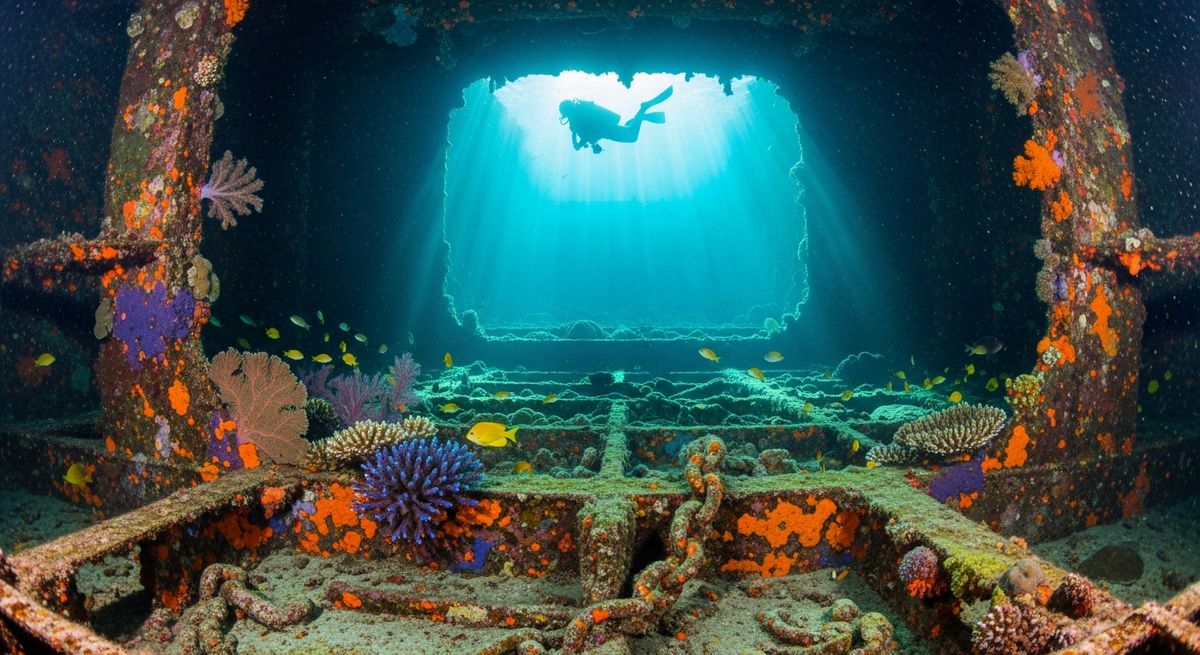
Ascalon, right off Hikkaduwa, is one of our favourites for a quick, shallow dive that still feels like an exploration. You’re looking at a steamship, sunk way back in 1882, now lying in just two metres of water. We love that it’s so accessible. You can easily spend an hour finning over its scattered remains, peering into the nooks and crannies of the boiler and engine parts. What makes it special, beyond the history, is how the reef has just swallowed it whole. Moray eels poke their heads from collapsed plating, schools of snapper drift through the open holds, and sometimes, if you're lucky, you'll spot a reef shark cruising by. It’s perfect for snorkelers too, or divers who want a relaxed second dive without any depth restrictions. The visibility is usually excellent, letting sunlight flood the wreck, illuminating the dense growth of corals that have made it their home. An easy, rewarding dive.
Typical ASCALON Dive Profile
Illustrative profile based on site depth and type. Actual dive profiles vary - always follow your dive computer and training.
Safety Notes
Wreck site - avoid penetration without wreck diving certification. Watch for sharp metal and entanglement hazards.
ASCALON Wreck History
Year Sunk
1887
Vessel Type
cargo ship
Cause
grounding
Tonnage
2,298 GRT
The SS Ascalon was a British steamship built in 1882, a proud vessel of the Victorian era's merchant fleet. In October 1887, she was on a long voyage from Aden to Calcutta, laden with cargo. As she navigated the waters off the southern coast of what was then Ceylon, disaster struck. The Ascalon ran hard aground on the treacherous reefs near Hikkaduwa. The powerful Indian Ocean swell battered the stranded ship, breaking her back and ensuring she would never sail again. The crew was saved, but the ship and her cargo were a total loss, surrendered to the sea.
Lying in just 2 meters of water, the Ascalon is less of a traditional wreck dive and more of an enchanting snorkel or shallow dive experience. Over a century of immersion in the warm, clear waters has transformed the wreckage into a part of the reef itself. Her engines and boilers are still recognizable, but they are now completely encrusted in vibrant corals and swarmed by colorful reef fish. The extreme shallowness means the site is bathed in sunlight, making for spectacular underwater photography. It’s a unique opportunity to explore the remains of a 19th-century steamship as an integrated part of a thriving marine ecosystem.
Nearest Dive Centres to ASCALON
Dive shops near ASCALON
Poseidon Diving Center
Dive For You
Submarine Diving School
Divinguru Unawatuna
Pearl Divers
Weligama Bay Diving Centre
Reviews for ASCALON
Conditions
Ocean conditions, forecast and tides for ASCALON
ASCALON Ocean Conditions
Monthly averages for ASCALON, sourced from Open-Meteo marine data - nearest station: Open-Meteo marine grid (6.45, 79.98) (12km away)
October Averages
Sea Temperature
29°C
84°F · Range: 27.7–30°C
Air Temperature
26°C
79°F
Wind Speed
5.07 m/s
9.9 knots
Atmospheric Pressure
1010.1 hPa
Based on 4 years of monitoring data · Data sources: Open-Meteo marine data
Plan & book
Ways to dive Hikkaduwa & South Coast, from day trips to liveaboards.
Day trips & courses
via GetYourGuideGuided dives, courses and snorkel trips with instant booking.
Find dive trips in Hikkaduwa & South CoastPlaces to stay
via Booking.comHotels and dive resorts near Hikkaduwa & South Coast.
Search stays in Hikkaduwa & South CoastDive insurance
Most travel insurance excludes or limits scuba. Check what you need before you go.
Dive insurance explainedPartner links: we may earn a commission if you book, at no extra cost to you. How we make money
Where to Stay near ASCALON
Prices from Booking.com. We may earn a commission at no extra cost to you.