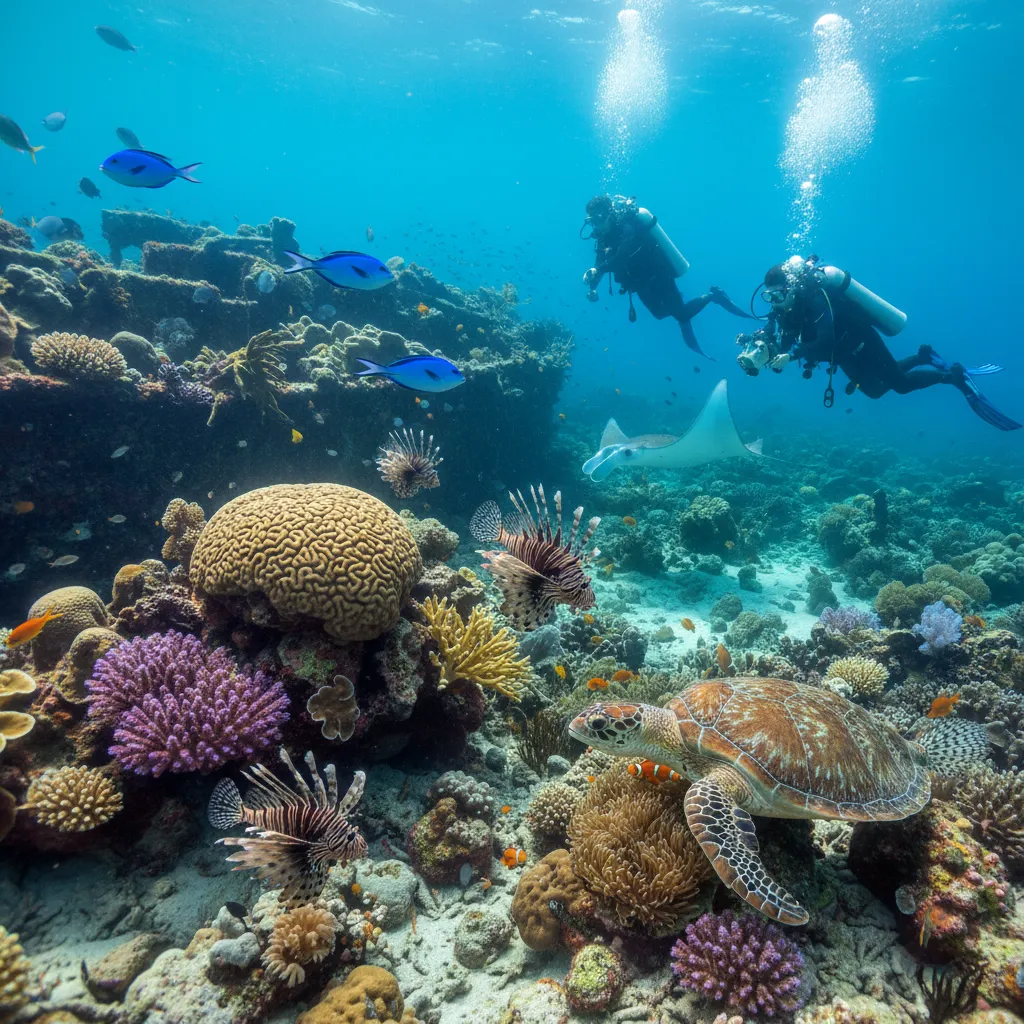
Diving in Hikkaduwa & South Coast
Why dive here
Hikkaduwa & South Coast offers some of Sri Lanka's richest diving, with 91+ marine species recorded in the area - including blue whales, giant moray eels, humpback whales, orcas and sea turtles. Water sits around 28°C.
We love Hikkaduwa for its easy going vibe and surprising amount of wreck diving, a nice counterpoint to the more common reef dives you find along Sri Lanka’s south coast. It’s certainly a busy place topside, but once you slip below the surface, the clamour fades into the low hum of schooling perch and the quiet rustle of burrowing urchins. Our favourite sites here are the wrecks, particularly the Conch and the Earl of Shaftesbury, both sitting at depths accessible to intermediate divers and often hosting large schools of fusiliers that can be so thick they block out the sun. Keep an eye out for pharaoh cuttlefish on the reef edges, especially in the shallower sections where the staghorn coral thrives. The currents here are generally mild, making it a good spot for beginners to get comfortable, but they can pick up a bit on the deeper wreck dives, so it’s worth checking the local conditions. Visibility averages a solid 15-20 metres during the peak season from November to April, though it drops off sharply with the monsoon rains. You'll often find blue-lined surgeonfish grazing the corals and the occasional large-toothed ponyfish darting through the open water. While tiger sharks are rare visitors, we have seen them cruising the deeper parts of the reef during calmer periods.
Hikkaduwa & South Coast Dive Site Map
Dive sites and dive centres in Hikkaduwa & South Coast
Hikkaduwa & South Coast Dive Sites
63 dive sites in Hikkaduwa & South Coast
AENOS
The Aenos wreck sits just off Hikkaduwa’s coast, a shallow dive at a consistent two meters. This freighter went down in 1956, and what's left is a decent amount of the hull and superstructure, easy to make out. It’s perfect for new divers or anyone wanting a relaxed, long bottom time. We’ve seen plenty of reef fish sheltering in the nooks and crannies, and it’s a good spot to practise buoyancy without worrying about depth limits. Visibility can vary, but on a good day, you can spend ages just cruising over the remains, watching schools of fusiliers dart in and out of the rusted metal.
ALSIA
The ALSIA wreck sits in seriously shallow water, barely two metres deep off Hikkaduwa. It’s what we’d call a proper snorkeller's wreck, or a great spot for your first real introduction to a sunken vessel, before you go deeper. You’ll find the remains of a motor vessel, its hull and superstructure still reasonably intact, making for an easy swim-around. Light streams through, illuminating schools of small reef fish darting amongst the twisted metal, and we often spot moray eels tucked into crevices. It’s a good, relaxed dive, perfect for easy exploration without the pressure of depth or currents.
ASCALON
Ascalon, right off Hikkaduwa, is one of our favourites for a quick, shallow dive that still feels like an exploration. You’re looking at a steamship, sunk way back in 1882, now lying in just two metres of water. We love that it’s so accessible. You can easily spend an hour finning over its scattered remains, peering into the nooks and crannies of the boiler and engine parts. What makes it special, beyond the history, is how the reef has just swallowed it whole. Moray eels poke their heads from collapsed plating, schools of snapper drift through the open holds, and sometimes, if you're lucky, you'll spot a reef shark cruising by. It’s perfect for snorkelers too, or divers who want a relaxed second dive without any depth restrictions. The visibility is usually excellent, letting sunlight flood the wreck, illuminating the dense growth of corals that have made it their home. An easy, rewarding dive.
ASTORIA
The Astoria holds a special place for us in Hikkaduwa. It’s not one of those ancient, barnacle-encrusted wrecks lost to time, but a relatively recent sinking from 1997. That means it’s still very much a ship, not just a pile of plates. She was a 70-meter carrier, built in 1956, and now rests upright at 18 meters, making it an ideal depth for extended bottom times and good natural light penetration. We love dropping down onto her deck and seeing the bridge still largely intact. You can swim through the cargo holds, imagining what she might have carried. The holds are now home to schools of snapper and fusiliers, darting in and out of the shadows. Look closely, and you’ll spot nudibranchs on the encrusting corals that are starting to take hold. The stern is our favourite section, often draped with schooling bannerfish, and if you’re lucky, a turtle might be cruising by. It’s a comfortable dive, usually with mild currents, and perfect for anyone who enjoys exploring a coherent wreck. It’s not just a quick swim-over; there’s plenty to see if you take your time.
Avondster
The Avondster wreck lies right in Galle Harbour, just 50 metres from Marine Drive, which makes for an incredibly easy shore entry. At a maximum depth of 5 metres, it’s a perfect spot for newer divers or anyone looking for a relaxed, shallow exploration. This old Dutch East India Company ship, an English vessel originally, sank while partly loaded with Areca nuts. The wreck itself isn't a massive, intact structure, but you'll find plenty of scattered timbers and parts of the hull to poke around. It's an interesting history lesson and a surprisingly peaceful dive given its location, with a good chance of spotting some smaller reef fish making homes in the crevices.
Barrakuda Point
Barrakuda Point, off Hikkaduwa, is a straightforward dive. You’ll find schools of barracuda, as the name suggests, often circling in the mid-water column. We’ve also spotted moray eels tucked into crevices along the reef. It's a decent spot for newer divers looking for some pelagic action without strong currents.
Black Coral Wreck
Dropping down to 40 meters, the Black Coral Wreck is a proper technical dive, not one for a casual afternoon splash. It’s a medium-sized wreck, a bit broken up but still recognisable, with its single boiler a clear landmark. That boiler, and indeed much of the surrounding structure, is completely covered in deep-water black coral, a really striking sight against the blue. You’ll find all sorts of reef fish darting around its crevices, with the occasional larger pelagic cruising past in the deeper water. It's a challenging dive, and we'd recommend it for those comfortable with deeper profiles and wreck penetration, offering a solid taste of Sri Lanka's technical diving scene.
Cargo Wreck
The Cargo Wreck, or *Pecheur Breton* as she was originally known, is a substantial dive. This 90-meter cargo carrier sits upright, offering certified divers a deep dive into the hold and superstructure. We've often found schooling batfish hanging around the main deck, and look closely within the nooks and crannies for moray eels. It’s a rewarding dive for those who enjoy exploring the history and the marine life that now calls these sunken vessels home.
CHIEF DRAGON
The Chief Dragon is one of those wrecks we keep coming back to. We find her sitting upright at 33 metres, her sheer size immediately apparent. She’s a big bulk carrier, 112 metres long, and has been down since ’83, giving the ocean plenty of time to turn her into a reef. Descending, you can often feel a slight thermocline around 20 metres, then the water cools a little and visibility often opens up as you reach the deck. There’s plenty to explore here. We love dropping into the cargo holds, where the light filters down in eerie shafts, illuminating schooling snappers and fusiliers. Keep an eye out for giant morays peeking from the darker recesses and the occasional reef shark patrolling the perimeter. The engine room is accessible if you’re comfortable with overhead environments, a truly atmospheric penetration for experienced wreck divers. This site is a proper deep wreck dive, best for advanced divers comfortable with depth and currents, which can pick up a bit out here. Go early in the morning for the calmest conditions and best light.
CHRYSSOPIGI CROSS
The Chryssopigi Cross wreck in Hikkaduwa is one of those sites we always come back to when we’re in the area. It sits shallow, just ten metres down, making it perfect for a long, relaxed dive or even a snorkel if the conditions are calm. This isn’t some deep, dark mystery; it’s an accessible wreck, spread out on a rocky bottom, and it’s seen a lot of action since she went down in 1977. What we love about the Chryssopigi Cross is how much of it you can still make out. The bow section is particularly intact, a substantial structure where you can peer into what were once holds. We’ve spent many an hour here watching schools of snappers dart in and out of the metal framework. Look closely and you’ll find moray eels tucked into crevices, their heads poking out with that characteristic wary stare. The wreck itself has become a rock garden, draped in soft corals and anemones, which add a surprising splash of colour to the rust. We find it’s best dived in the morning, before the afternoon winds tend to pick up, keeping the visibility at its clearest. It’s a great site for newer wreck divers or anyone who appreciates history, especially with that impressive 146-metre length to explore.
Crow Island
Crow Island is a solid spot for a casual dive, especially if you're looking for something relaxed around Hikkaduwa. It’s pretty shallow, topping out at 10 metres, so it’s a good choice for newer divers or those who just want to spend some quality time exploring without rushing the deco. We’ve drifted along here often, spotting plenty of parrotfish munching on the coral, a scattering of moray eels tucked into crevices, and occasionally a turtle cruising past. It's not a site that will blow your mind with massive pelagics, but it's reliably pleasant for an easy afternoon underwater.
Dakune Gala
Dakune Gala, off Hikkaduwa, offers a decent reef dive. You'll find scattered coral formations hosting parrotfish, snapper, and the occasional turtle. It’s a good choice for those looking for a relaxed, straightforward dive, probably best suited for newer divers or a chill second dive of the day. Visibility here can vary, but on a good day, it's a pleasant cruise.
Show all 63 dive sites in Hikkaduwa & South Coast
- Diyamba Gala
- Eel Rock
- EXTRACTO 1
- Galle Ship Wreck
- GEORGIOS K
- Goda Gala
- Goda Gala Diyamba
- Hikkaduwa Coral Sanctuary
- HMS DAEDALUS
- JETPUR SHAHER
- Jungle Beach
- Kapungoda Wreck 1
- Kapungoda Wreck 2
- Kirala Gala
- Knife Rock
- Lagoon Reef
- Lotus Barge
- Mada Gala
- MEDHUFAARU
- MELIKSAH
- MI LIDDY
- NILGIRI
- PAHLAWAN
- Panadura Wreck
- PASTEE 1802
- PECHEUR BRETON
- PERIDOT
- PHAROS CH.
- Rangoon
- Rangoon Wreck
- sea horse
- SECUNDRA
- Siri
- SOLI
- SS Conch Wreck
- SS Orestes
- Submarine Diving School
- Talpe Reef
- Taprobane Reefs
- The Conch
- THERMOPYLAE SIERRA
- TRANS ASIA
- Unawatuna Bay Wreck
- UNIVERSAL TRADER
- VALIANT ENTERPRISE
- VELA VI
- WOMBAT
- Wreck of Great Basses wreck
- Yala Rock
- Y-Gala
- Ypsylon Diving
Hikkaduwa & South Coast Dive Centres
9 dive shops and operators in Hikkaduwa & South Coast
Dive For You
Divinguru Unawatuna
Island Scuba
Lanka Sportreizen - Marina, Bentota
Pearl Divers
Polhena Diving Center
Poseidon Diving Center
Submarine Diving School
Show all 9 dive centres in Hikkaduwa & South Coast
Ocean Wildlife in Hikkaduwa & South Coast
91 species recorded in Hikkaduwa & South Coast
Hikkaduwa & South Coast Daylight & Sunrise/Sunset
Sunrise and sunset times for Hikkaduwa & South Coast, calculated from coordinates
Today - Sunday 11 October
Sunrise
05:27
Sunset
17:27
Daylight
12h 1m
Golden Hour
17:00
First light (dawn) at 05:06 · Last light (dusk) at 17:48
Monthly Averages
| Month | Sunrise | Sunset | Daylight |
|---|---|---|---|
| Jan | 05:56 | 17:43 | 11h 47m |
| Feb | 05:57 | 17:52 | 11h 55m |
| Mar | 05:47 | 17:52 | 12h 5m |
| Apr | 05:32 | 17:48 | 12h 16m |
| May | 05:24 | 17:49 | 12h 25m |
| JunLongest | 05:26 | 17:56 | 12h 30m |
| Jul | 05:32 | 18:00 | 12h 28m |
| Aug | 05:35 | 17:55 | 12h 20m |
| Sep | 05:31 | 17:41 | 12h 10m |
| OctNow | 05:27 | 17:26 | 11h 59m |
| Nov | 05:30 | 17:20 | 11h 50m |
| DecShortest | 05:43 | 17:28 | 11h 45m |
Times are approximate local times based on longitude. Actual times may vary slightly depending on the exact timezone observed in Hikkaduwa & South Coast.
Where to Stay near Hikkaduwa & South Coast
Prices from Booking.com. We may earn a commission at no extra cost to you.
Marine Protected Areas near Hikkaduwa & South Coast
10 protected areas near Hikkaduwa & South Coast - please respect local regulations when diving
Great Basses and Little Basses Marine Sanctuary
Bundala
Bundala NP
Rekawa
Ussangoda NP
Godawaya
Rumassala SAN
Hikkaduwa NP
Muthurajawela
Rocky Islets ( A
Getting to Hikkaduwa & South Coast
Colombo
Colombo
Mattala
Plan & book
Ways to dive Hikkaduwa & South Coast, from day trips to liveaboards.
Day trips & courses
via GetYourGuideGuided dives, courses and snorkel trips with instant booking.
Find dive trips in Hikkaduwa & South CoastPlaces to stay
via Booking.comHotels and dive resorts near Hikkaduwa & South Coast.
Search stays in Hikkaduwa & South CoastDive insurance
Most travel insurance excludes or limits scuba. Check what you need before you go.
Dive insurance explainedPartner links: we may earn a commission if you book, at no extra cost to you. How we make money