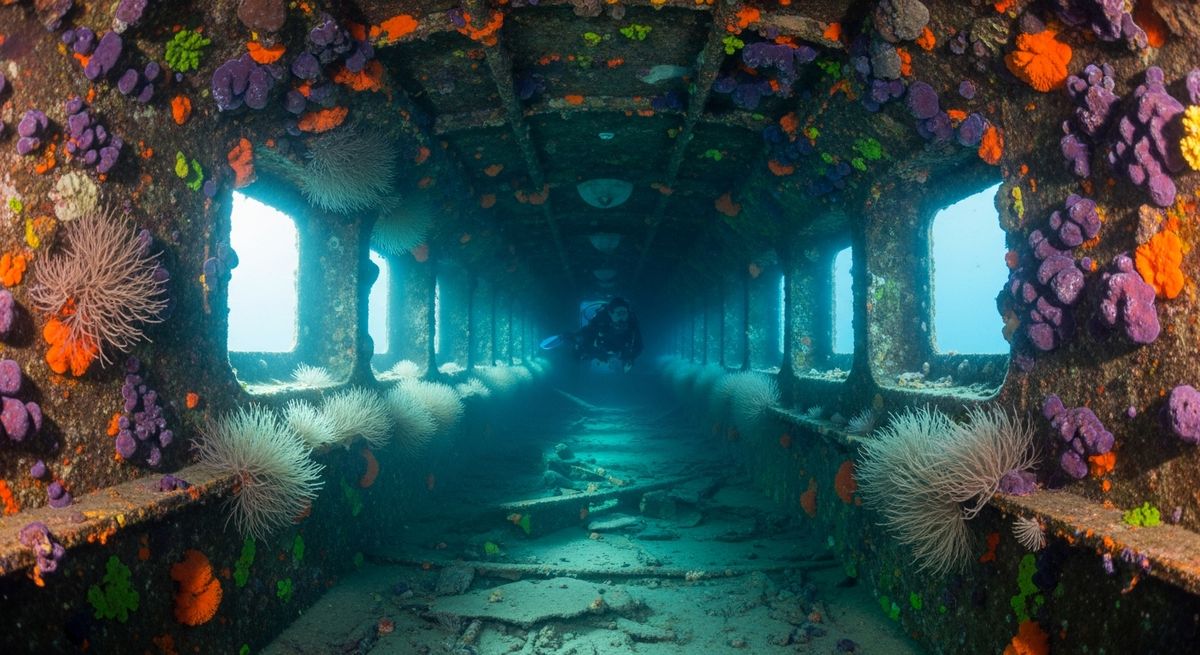
ASTORIA
Protected Area
Muthurajawela
Why dive here
With 91+ marine species recorded in the area - including blue whales, giant moray eels, humpback whales, orcas and sea turtles - ASTORIA offers some of Hikkaduwa & South Coast's richest wreck diving. Water ranges 28-31°C, warmest March, April, May.
The Astoria holds a special place for us in Hikkaduwa. It’s not one of those ancient, barnacle-encrusted wrecks lost to time, but a relatively recent sinking from 1997. That means it’s still very much a ship, not just a pile of plates. She was a 70-meter carrier, built in 1956, and now rests upright at 18 meters, making it an ideal depth for extended bottom times and good natural light penetration. We love dropping down onto her deck and seeing the bridge still largely intact. You can swim through the cargo holds, imagining what she might have carried. The holds are now home to schools of snapper and fusiliers, darting in and out of the shadows. Look closely, and you’ll spot nudibranchs on the encrusting corals that are starting to take hold. The stern is our favourite section, often draped with schooling bannerfish, and if you’re lucky, a turtle might be cruising by. It’s a comfortable dive, usually with mild currents, and perfect for anyone who enjoys exploring a coherent wreck. It’s not just a quick swim-over; there’s plenty to see if you take your time.
Typical ASTORIA Dive Profile
Illustrative profile based on site depth and type. Actual dive profiles vary - always follow your dive computer and training.
Safety Notes
Wreck site - avoid penetration without wreck diving certification. Watch for sharp metal and entanglement hazards.
Always perform a 3-minute safety stop at 5m before surfacing.
ASTORIA Wreck History
Year Sunk
1997
Vessel Type
cargo ship
Cause
unknown
The story of the Astoria off Sri Lanka's south coast is shrouded in a bit of mystery. This 70-meter carrier vessel, built in 1956, met its end on September 25, 1997. Unlike many wrecks lost in violent storms, the Astoria simply sank while resting at anchor near the popular tourist town of Hikkaduwa. The specific cause of its foundering is not well-documented, leaving divers to speculate on what might have happened that day-perhaps a sudden leak or a shift in cargo.
Resting at a perfect recreational depth of 18 meters, the Astoria has become one of the signature wreck dives in the region. Its accessible depth and location make it a popular choice for divers of various skill levels. The wreck is largely intact, offering opportunities to explore its deck, bridge, and swim-throughs in the cargo holds. Over the years, it has developed into a magnificent artificial reef, covered in soft corals and sponges, and attracting a dense population of marine life, including lionfish, moray eels, and vast schools of snappers.
Nearest Dive Centres to ASTORIA
Dive shops near ASTORIA
View all dive centres in Hikkaduwa & South CoastReviews for ASTORIA
Conditions
Ocean conditions, forecast and tides for ASTORIA
ASTORIA Ocean Conditions
Monthly averages for ASTORIA, sourced from Open-Meteo marine data - nearest station: Open-Meteo marine grid (6.45, 79.98) (12km away)
October Averages
Sea Temperature
29°C
84°F · Range: 27.7–30°C
Air Temperature
26°C
79°F
Wind Speed
5.07 m/s
9.9 knots
Atmospheric Pressure
1010.1 hPa
Based on 4 years of monitoring data · Data sources: Open-Meteo marine data
Plan & book
Ways to dive Hikkaduwa & South Coast, from day trips to liveaboards.
Day trips & courses
via GetYourGuideGuided dives, courses and snorkel trips with instant booking.
Find dive trips in Hikkaduwa & South CoastPlaces to stay
via Booking.comHotels and dive resorts near Hikkaduwa & South Coast.
Search stays in Hikkaduwa & South CoastDive insurance
Most travel insurance excludes or limits scuba. Check what you need before you go.
Dive insurance explainedPartner links: we may earn a commission if you book, at no extra cost to you. How we make money
Where to Stay near ASTORIA
Prices from Booking.com. We may earn a commission at no extra cost to you.