Diving in Dar es Salaam & Offshore Islands
Why dive here
Dar es Salaam & Offshore Islands offers some of Tanzania's richest diving, with 41+ marine species recorded in the area - including humpback whales, sea turtles, spinner dolphins, napoleon wrasse and pufferfish. Water ranges 26-29°C, warmest March, April, December.
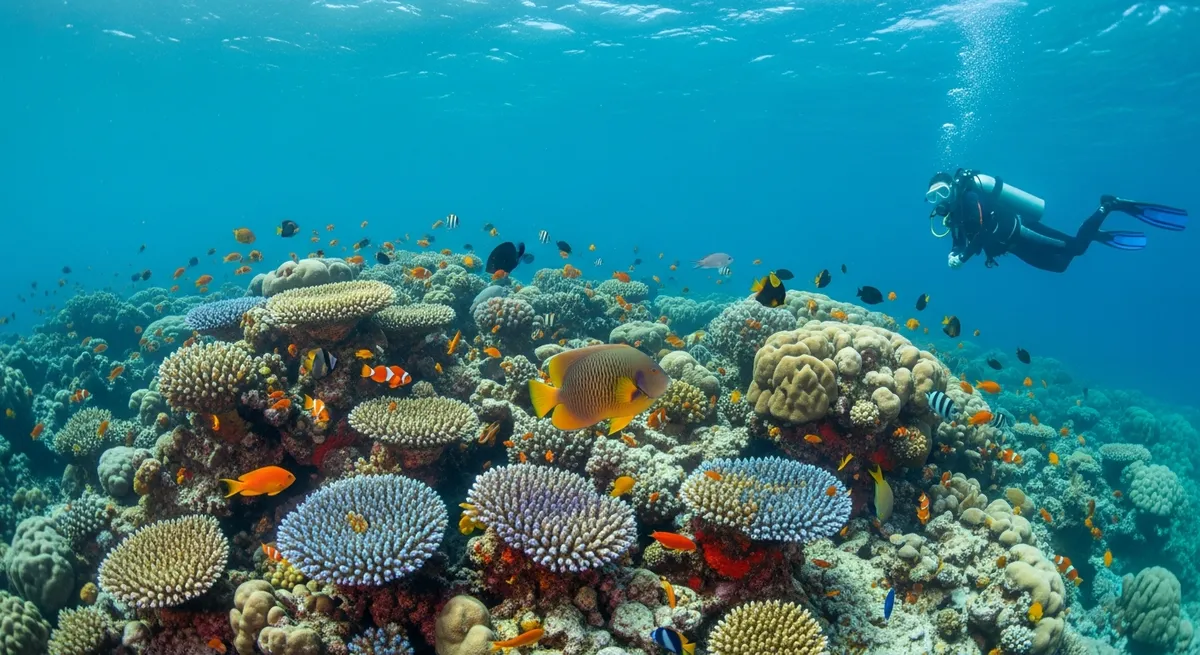
Dar es Salaam isn't the first place that springs to mind for Tanzanian diving, with Zanzibar hogging much of the spotlight. But venture out to the offshore islands, particularly those within the marine reserves, and you’ll find some genuinely charming spots. We love the feeling of slipping into a calm blue and watching schools of fusiliers drift by, sometimes so dense they really block the light. The reefs around Bongoyo and Mbudya are our favourites; they're not dramatic walls, but gentle slopes and patches, full of vibrant coral growth and a good variety of reef fish. You'll often spot flowery flounders camouflaged perfectly on the sand, or a banded toby poking around the coral heads. We’ve had lovely drift dives here too, just letting the current carry us past the seagrass beds where you might spot a Pacific cornetfish hovering. Visibility can vary, but on a good day, it’s a serene place to spend an afternoon underwater. Go early in the morning for the calmest conditions and fewer boats.
Dar es Salaam & Offshore Islands Dive Site Map
Dive sites and dive centres in Dar es Salaam & Offshore Islands
Dar es Salaam & Offshore Islands Dive Sites
26 dive sites in Dar es Salaam & Offshore Islands
Aquarium
The Aquarium, just off Dar es Salaam, lives up to its name. It’s a relatively shallow coral reef, and we’ve often found it calm enough for less experienced divers or those looking for an easy second dive. You can expect a good scattering of reef fish here – angelfish, butterflyfish, and parrotfish are common, darting amongst the coral bommies. It’s a pleasant, straightforward dive when you’re in the area.
Big Wall
Big Wall, as the name suggests, offers exactly that: a substantial drop-off that draws you down. You’ll find a mix of smaller reef fish hugging the wall, like Indo-Pacific sergeants darting around, and if you keep your eyes peeled, we’ve spotted eroded cowries tucked into crevices. It’s a good spot for a relaxed drift, letting the current do some of the work, and the depth allows for some decent bottom time if you're mindful of your no-decompression limits. This site is a solid choice for those who appreciate the geology of a dive as much as the critters.
Big Wall
The Big Wall off Dar es Salaam offers a straightforward wall dive. Drop down and follow the reef edge, which descends into deeper water. We usually see a good mix of smaller reef fish here, like Indo-Pacific sergeants and goldbar wrasse, often schooling in the cracks and crevices. Keep an eye out for the more unusual finds, like bloodspot pipefish tucked away. It's a reliable dive for divers looking for a relaxed exploration rather than huge pelagics.
Captain Muddy
Captain Muddy is one of those sites we always find ourselves coming back to. It’s not about huge pelagics or dramatic drop-offs, but a pure joy for anyone who loves hunting for the small stuff, especially the shells. We love the sandy patches here, broken up by seagrass beds of *Thalassia* and *Halodule*. Get low, really low, and take your time. You’ll be rewarded. Our favourite finds here are the cone snails – we’ve consistently spotted the Golden-Yellow Cone and the Cloth-of-Gold Cone, their intricate patterns just stunning against the sand. Look closely for the tell-tale trails of arthritic spider conchs and the more camouflaged Granular Frog Shell. It's a site that really forces you to slow down, to appreciate the macro, the things that often get overlooked on faster dives. We’d suggest going in the late morning, after any overnight surge has settled, giving you clearer visibility to spot those smaller details. It’s a site for the patient, for the keen-eyed, and perfect for photographers with a macro lens. If you rush it, you’ll miss the magic.
Club 54
Club 54, near Dar es Salaam, offers a straightforward reef dive that’s generally calm. You’ll typically find a good range of Indian Ocean reef fish – think triggerfish, snapper, and sometimes a passing turtle. It’s a solid spot for less experienced divers looking for a relaxed exploration without strong currents or complex navigation.
Diving spot
Now, Dar es Salaam isn’t exactly on every diver's radar, but "Diving Spot" near the offshore islands offers a genuine surprise. We love this site for its chilled-out vibe and the sheer variety of smaller stuff. Dropping down, you’re often greeted by schools of fusiliers, their silver scales flashing as they ripple past, sometimes so thick they practically block out the sun. It’s a gentle drift, perfect for just cruising along and letting your eyes wander. We’ve spent entire dives here simply watching Green Turtles munching on algae, completely unbothered by our presence. Keep an eye out for the Broom-tail Filefish, a quirky little character that always makes us smile. The reef itself isn't dramatic walls, but a series of lovely coral bommies, home to everything from curious Blue Spotted Wrasses to the occasional Whitespotted Whipray gliding gracefully over the sand. It’s a great spot for macro enthusiasts and anyone who enjoys a relaxed dive without battling strong currents. Our favourite time to dive here is mid-morning, just as the sun really starts to illuminate the shallows.
End of the world
The End of the World site off Dar es Salaam is a gentle slope, perfect for a relaxed dive. We’ve drifted along here often, spotting reef fish, moray eels tucked into the rock formations, and occasional rays gliding past. It’s an easy-going dive, well-suited for newer divers or anyone looking for a calm afternoon underwater. Visibility can vary, but we often get a decent 15 meters on a good day.
Fundo Gap
Fundo Gap offers a drift dive through a channel between two small islands. We often find schooling fusiliers here, along with the occasional reef shark patrolling the deeper sections. Currents can be strong, so it’s best suited for experienced divers comfortable with faster drifts. It's a solid choice when you want some action without venturing too far offshore.
Fungu Yasini Island
Fungu Yasini is one of those places that genuinely surprises you. We've always found it a solid day trip from Dar, a decent boat ride out, but totally worth it. Once you drop in, you’re often greeted by schools of fusiliers so thick they almost block the sun, a real sensory overload as they swirl around you. Look closer among the coral bommies and you’ll spot those gorgeous Indian Ocean oriental sweetlips, their stripes shimmering, often tucked away in small groups. What we really love about Fungu Yasini is the sheer variety packed into a relatively small area. We’ve spent whole dives just watching the intricate patterns of Six-line wrasse darting between the coral, or trying to spot the elusive Messmate Pipefish camouflaged against the reef. It’s not about huge pelagics here, though a turtle might cruise by; it’s about the smaller, colourful stuff. We'd suggest going on a weekday if you can, it tends to be less busy, letting you really soak it all in without too many other divers around. It’s a site that rewards slow diving, perfect for macro enthusiasts and anyone who enjoys finding something new every time they visit.
HMS Pegasus
The HMS Pegasus is a proper wreck dive, not just some scattered debris. We love it because it’s big, offering plenty to poke around in, and it’s shallow enough that you can really stretch out your bottom time. You’re descending onto history here, an 1897 cruiser sunk in a WWI battle, and you can feel that weight when you fin over its deck. What you'll see is a wreck thoroughly claimed by the ocean. Shoals of black-barred surgeonfish dart through the skeletal remains, while bandied maori wrasse patrol the deeper sections. Look closely in the crevices for snakehead cowries and the flash of a fringelip blenny. We’d suggest focusing on the bow section; the structure is still impressive, and it tends to draw in larger brown-spotted groupers. Visibility can vary, so aim for slack tide if you want the clearest view of the entire wreck. It’s a site that suits divers who appreciate a blend of history and healthy marine life, rather than just a quick glimpse of a sunken ship.
KRONBERG
Kronberg, she’s a peculiar one. Scuttled way back in 1915 to prevent her falling into British hands, this steamship was originally meant to supply the German cruiser SMS Königsberg. Now, she rests in just two metres of water, almost entirely exposed at low tide, in Manza Bay up near Tanga. We love how accessible she is, perfect for an extended snorkel or a very, very shallow dive. You can literally walk out to her at certain tides. The wreck herself is quite broken up, but you get a real sense of her scale, especially the massive propeller shaft. Schools of snappers and rabbitfish often mill around the deeper pockets of wreckage, and we’ve spotted morays peeking from the nooks. It’s a fantastic spot for photographers looking for something a bit different, where the light plays beautifully off the rusted metal. Our tip: go at mid-tide when there’s enough water to swim over her, but the structure is still clearly defined by the surface. It’s less a deep exploration and more an atmospheric encounter with history.
Lighthouse
Lighthouse, off Dar es Salaam, offers a straightforward dive, popular with local operators. You'll generally find good visibility, around 15-20 metres, and a sandy bottom with scattered coral bommies. Expect to see reef fish, often schooling fusiliers, and we’ve spotted moray eels tucked into crevices. It’s a solid choice for a relaxed dive, good for newer divers or a warm-up.
Show all 26 dive sites in Dar es Salaam & Offshore Islands
Dar es Salaam & Offshore Islands Dive Centres
27 dive shops and operators in Dar es Salaam & Offshore Islands
Afro Divers
Aqua Africa
Awesome Ocean Diving
Big Blu Mafia Island Diving Center
Blue Fin Diving
Buccaneer Diving
Dive 360 Pemba Ltd
Dive Planet Mafia Island
Show all 27 dive centres in Dar es Salaam & Offshore Islands
- Diving and Watersports Center
- Diving Center
- Diving Center
- Diving The Crab
- DYC Dive Center
- Fundu Lagoon / 710 Dive Centre
- Lulu Diving Center
- Mafia Island Diving
- One Ocean
- One Ocean Dive Centre
- Pemba Dive Center
- Rising Sun Diving Centre
- Scuba Caribe
- Spanish dancer divers
- SSI Freediving
- TGI diving
- TGI Diving Nungwi
- Thalassa Dive Center
- Yellow Fins Diving Kenya
Ocean Wildlife in Dar es Salaam & Offshore Islands
41 species recorded in Dar es Salaam & Offshore Islands
Dar es Salaam & Offshore Islands Daylight & Sunrise/Sunset
Sunrise and sunset times for Dar es Salaam & Offshore Islands, calculated from coordinates
Today - Sunday 11 October
Sunrise
06:03
Sunset
18:15
Daylight
12h 12m
Golden Hour
17:47
First light (dawn) at 05:42 · Last light (dusk) at 18:36
Monthly Averages
| Month | Sunrise | Sunset | Daylight |
|---|---|---|---|
| Jan | 06:20 | 18:43 | 12h 23m |
| Feb | 06:29 | 18:45 | 12h 16m |
| Mar | 06:27 | 18:36 | 12h 8m |
| Apr | 06:22 | 18:22 | 12h 0m |
| May | 06:22 | 18:16 | 11h 53m |
| JunShortest | 06:28 | 18:18 | 11h 50m |
| Jul | 06:33 | 18:24 | 11h 51m |
| Aug | 06:29 | 18:25 | 11h 57m |
| Sep | 06:16 | 18:20 | 12h 4m |
| OctNow | 06:02 | 18:15 | 12h 13m |
| Nov | 05:57 | 18:17 | 12h 21m |
| DecLongest | 06:05 | 18:30 | 12h 25m |
Times are approximate local times based on longitude. Actual times may vary slightly depending on the exact timezone observed in Dar es Salaam & Offshore Islands.
Where to Stay near Dar es Salaam & Offshore Islands
Prices from Booking.com. We may earn a commission at no extra cost to you.
Marine Protected Areas near Dar es Salaam & Offshore Islands
19 protected areas near Dar es Salaam & Offshore Islands - please respect local regulations when diving
Pemba Channel Conservation Area
Menai Bay
Dar es Salaam
Misali Island
Forest Reserve Name Unknown (TZA) (Mangrove) No.18
Forest Reserve Name Unknown (TZA) (Mangrove) No.19
Forest Reserve Name Unknown (TZA) (Mangrove) No.10
Maziwe Island
Mangrove
Mangrove
Chumbe Island Coral Park (CHICOP)
Ras Kiuyu
Showing 12 largest of 19
Getting to Dar es Salaam & Offshore Islands
Chake Chake
Mombasa
Zanzibar
Plan & book
Ways to dive Dar es Salaam & Offshore Islands, from day trips to liveaboards.
Day trips & courses
via GetYourGuideGuided dives, courses and snorkel trips with instant booking.
Find dive trips in Dar es Salaam & Offshore IslandsPlaces to stay
via Booking.comHotels and dive resorts near Dar es Salaam & Offshore Islands.
Search stays in Dar es Salaam & Offshore IslandsDive insurance
Most travel insurance excludes or limits scuba. Check what you need before you go.
Dive insurance explainedPartner links: we may earn a commission if you book, at no extra cost to you. How we make money