Diving in Zanzibar & Pemba
Why dive here
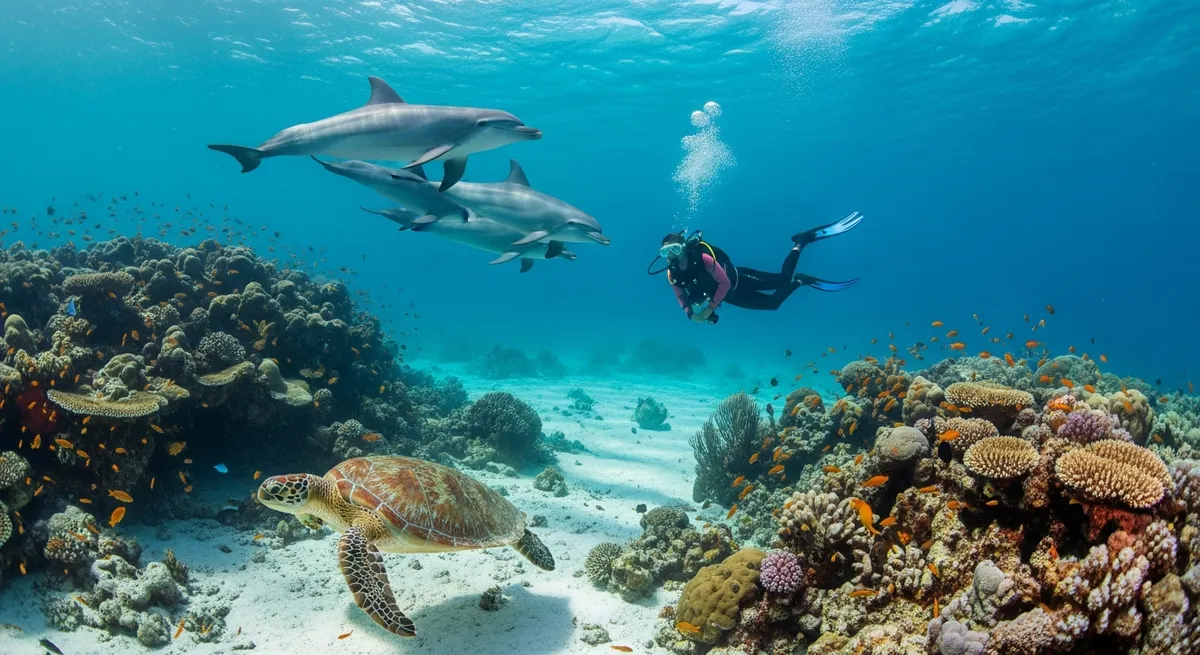
Zanzibar & Pemba offers some of Tanzania's richest diving, with 312+ marine species recorded in the area - including barracuda, blue-spotted stingrays, dolphins, eagle rays and hammerhead sharks. Water sits around 28°C.
Zanzibar and Pemba offer a real split personality when it comes to diving, and we love them both for different reasons. Off Zanzibar, Mnemba Atoll is our go-to for that classic Indian Ocean feel. We’re talking drift dives over reefs thick with fusiliers, the sun dappling through schools of surgeonfish, and almost guaranteed encounters with green sea turtles munching on seagrass. You’ll often spot bottlenose dolphins cruising the shallows here, too. Pemba, though, that’s where things get interesting for more experienced divers. The currents can be serious, but they bring in the goods. Think dramatic walls dropping hundreds of metres into the blue, where you’ll hang in the current watching trevally hunt and look out for bigger pelagics. The corals here are in exceptional shape, less visited than Zanzibar, with huge gorgonian fans and barrel sponges. Visibility in Pemba can be astounding, sometimes 30 metres plus, making those deep wall dives even more spectacular. We’d suggest focusing on Pemba for a truly raw, wild dive experience, saving Zanzibar for those easier, sun-drenched reef days.
Zanzibar & Pemba Dive Site Map
Dive sites and dive centres in Zanzibar & Pemba
Zanzibar & Pemba Dive Sites
79 dive sites in Zanzibar & Pemba
Abbas reef
Abbas Reef, just a quick hop from Kizimkazi, is one of those places we always recommend for a relaxed afternoon. It’s got a gentle vibe, perfect if you’re still building confidence, but don’t let that fool you into thinking it’s boring. We found a surprising density of activity here, especially in the shallower sections. The reef itself is a pretty healthy patch of coral, not enormous, but what’s there is vibrant. We’ve drifted over sandy patches thick with seagrass, spotting green turtles grazing – always a treat. Keep an eye out for the smaller stuff too. We’ve seen blue-spotted stingrays half-buried in the sand, their electric blue spots popping against the beige, and a few times, we’ve been lucky enough to spot seahorses clinging to the weed. The nudibranchs here are surprisingly colourful, a real photographer’s delight if you’re patient. Visibility hovers around 15 metres, often better on a calm day, and with a maximum depth of 15 metres, you get plenty of bottom time to explore. It’s an easy, unhurried dive, great for focusing on macro life or just enjoying a peaceful drift.
Abbas reef
Abbas Reef, just a quick hop from Kizimkazi, is one of those places we always recommend for a relaxed afternoon. It’s got a gentle vibe, perfect if you’re still building confidence, but don’t let that fool you into thinking it’s boring. We found a surprising density of activity here, especially in the shallower sections. The reef itself is a pretty healthy patch of coral, not enormous, but what’s there is vibrant. We’ve drifted over sandy patches thick with seagrass, spotting green turtles grazing – always a treat. Keep an eye out for the smaller stuff too. We’ve seen blue-spotted stingrays half-buried in the sand, their electric blue spots popping against the beige, and a few times, we’ve been lucky enough to spot seahorses clinging to the weed. The nudibranchs here are surprisingly colourful, a real photographer’s delight if you’re patient. Visibility hovers around 15 metres, often better on a calm day, and with a maximum depth of 15 metres, you get plenty of bottom time to explore. It’s an easy, unhurried dive, great for focusing on macro life or just enjoying a peaceful drift.
ALMASI
Almasi is not your typical wreck dive. Forget deep exploration; this is a true piece of history, just breaking the surface. The schooner, built in 1898, met its fiery end in 1961 when its cargo of aviation fuel detonated. Now, it's a skeletal outline, almost a ghost ship, in just three metres of water. We love Almasi for its sheer accessibility and the way it tells its story. What you'll find here isn't a grand, intact vessel, but rather the scattered ribs and timbers, a testament to that powerful explosion. It’s an easy, sun-drenched snorkel or a very shallow dive, perfect for photographers looking to capture the interplay of light and shadow on the aged wood. Schools of small silversides often shimmer around the remains, and we’ve spotted plenty of juvenile reef fish taking shelter amongst the debris. It’s a site for contemplation, for imagining the past, and for appreciating how quickly the ocean reclaims what’s hers. Come at high tide for the best visibility, when the water is calmest.
Anemona City
Anemona City really lives up to its name. We love this site for its sheer density of anemones, it’s not just a few scattered patches. Think massive, undulating fields, each one home to dozens of clownfish darting in and out of their tentacles. It’s only a short hop from Kizimkazi, just ten minutes by boat, and the anchor point starts shallow, around 4-5 metres. Even on the plateau, you’re already spotting colourful corals and small reef fish. Our favourite part is when you hit the gentle slope, dropping down to 15-17 metres. That’s where the anemone gardens truly explode. We often find ourselves just hovering, watching the clownfish bicker and play, their bright orange fins a stark contrast to the anemones’ pastel hues. Keep an eye out for pufferfish hovering nearby, and we’ve regularly seen Green Turtles gliding gracefully past. Visibility here averages around 15 metres, which gives you a good, clear view of the action without feeling like you’re in an aquarium. It’s a beautifully relaxed dive, perfect for photographers or anyone who just wants to soak up the slower pace of reef life.
Anemona City
Anemona City really lives up to its name. We love this site for its sheer density of anemones, it’s not just a few scattered patches. Think massive, undulating fields, each one home to dozens of clownfish darting in and out of their tentacles. It’s only a short hop from Kizimkazi, just ten minutes by boat, and the anchor point starts shallow, around 4-5 metres. Even on the plateau, you’re already spotting colourful corals and small reef fish. Our favourite part is when you hit the gentle slope, dropping down to 15-17 metres. That’s where the anemone gardens truly explode. We often find ourselves just hovering, watching the clownfish bicker and play, their bright orange fins a stark contrast to the anemones’ pastel hues. Keep an eye out for pufferfish hovering nearby, and we’ve regularly seen Green Turtles gliding gracefully past. Visibility here averages around 15 metres, which gives you a good, clear view of the action without feeling like you’re in an aquarium. It’s a beautifully relaxed dive, perfect for photographers or anyone who just wants to soak up the slower pace of reef life.
Aquarium
Aquarium is a relaxed reef dive off Pemba, ideal for those looking for a gentle drift. You'll find a healthy patch of coral, home to a scattering of reef fish. Visibility here can vary, but on a good day, it’s a pleasant spot for newer divers or a second, calmer dive. It's not a big pelagic site, but a nice place to slow down.
Aquarium
Aquarium on Pemba is one of those sites where we feel utterly spoiled. It’s a gentle wall dive, starting around 15 metres, which means you’re dropping straight into the good stuff. We love to drift along, letting the current do the work, watching the reef unfold. The two huge formations of *Turbinaria* coral are absolutely buzzing. Think clouds of yellowfin fusiliers, their scales flashing as they swirl around you, with big honeycomb groupers eyeing them from the shadows. Keep an eye out for the smaller stuff too, we’ve spotted some beautiful cowries here, and even a bloodspot pipefish tucked into the coral. Visibility is generally solid, around 18 metres, giving everything a lovely clarity. It's a relaxed dive that still delivers plenty of action, ideal for anyone who appreciates a vibrant reef without the need for extreme depths.
Aquarium
Aquarium on Pemba is one of those sites where we feel utterly spoiled. It’s a gentle wall dive, starting around 15 metres, which means you’re dropping straight into the good stuff. We love to drift along, letting the current do the work, watching the reef unfold. The two huge formations of *Turbinaria* coral are absolutely buzzing. Think clouds of yellowfin fusiliers, their scales flashing as they swirl around you, with big honeycomb groupers eyeing them from the shadows. Keep an eye out for the smaller stuff too, we’ve spotted some beautiful cowries here, and even a bloodspot pipefish tucked into the coral. Visibility is generally solid, around 18 metres, giving everything a lovely clarity. It's a relaxed dive that still delivers plenty of action, ideal for anyone who appreciates a vibrant reef without the need for extreme depths.
ATA
The ATA wreck off Pemba offers a different kind of dive. This old steamship, sunk back in '58, sits mostly intact, giving you the real sense of a submerged vessel rather than just scattered debris. We like to follow the main deck, poking into the holds where schools of snapper often hang out, feeling the cool current as it moves through the structure. It’s a proper exploration dive, better suited for those who enjoy the history and atmosphere of a wreck and want to see how quickly the ocean reclaims its own.
Barracuda Point
Barracuda Point, off Pemba, is exactly what it sounds like. We’ve had some cracking dives here, often starting with a descent into a buzzing school of fusiliers, so thick they almost block out the sun for a moment. This site is all about the pelagics, and we’re not just talking about the odd barracuda cruising by. Think serious schools, sometimes hundreds strong, shimmering in the blue. It’s an advanced drift dive, no two ways about it. The currents can pick up and sweep you along the wall, which, for us, is half the fun. You really need to be comfortable in moving water to appreciate Barracuda Point. Keep an eye out for green turtles gliding past the wall, seemingly unfazed by the activity. We’ve also seen some impressive spangled emperors here, big, curious fish that often come in for a closer look. Our favourite encounters, though, are always with the larger aggregations of barracuda and trevally that often hunt along the reef edge. It’s a proper wide-angle photo opportunity. Best to dive it on a rising or falling tide; slack water often means fewer big fish.
Bawe Island - North
Bawe Island North is a solid pick for a short boat ride out of Stone Town, especially when you’re craving a dive without the long haul. We’d classify it as a friendly wall dive, never dropping deeper than 16 meters, so it’s excellent for longer bottom times and less experienced divers. The continuous coral wall itself is what we love here, draped in plenty of blue sponges where we often spot cuttlefish or the occasional moray eel peeking out. Keep an eye on the open water for rainbow runners and longfin batfish gliding past, and don't forget to scan the sandy patches at the base of the wall – that's where we've seen blue spotted stingrays resting. Visibility averages around 14 meters, good enough to appreciate the details. This site is perfect for those days when you want a relaxed, colourful dive without chasing megafauna, just enjoying the reef’s quiet rhythm.
Bawe Island - North
Bawe Island North is a solid pick for a short boat ride out of Stone Town, especially when you’re craving a dive without the long haul. We’d classify it as a friendly wall dive, never dropping deeper than 16 meters, so it’s excellent for longer bottom times and less experienced divers. The continuous coral wall itself is what we love here, draped in plenty of blue sponges where we often spot cuttlefish or the occasional moray eel peeking out. Keep an eye on the open water for rainbow runners and longfin batfish gliding past, and don't forget to scan the sandy patches at the base of the wall – that's where we've seen blue spotted stingrays resting. Visibility averages around 14 meters, good enough to appreciate the details. This site is perfect for those days when you want a relaxed, colourful dive without chasing megafauna, just enjoying the reef’s quiet rhythm.
Show all 79 dive sites in Zanzibar & Pemba
- Bawe South
- Bawe South
- Cement wall
- CHYKO
- COLEEN
- Coral Garden
- Coral Garden
- Coral Garden Reef
- GLORONGAY
- GREAT NORTHERN
- Great Wall
- Groopers Rock
- Groupers Rocks, Mnemba Island
- Haji
- Haunted Wall
- HauntedWall / Ras Misikitini
- Hunga
- Jackfish Alley
- Jambiani Lagoon
- Kichafi
- Kichwani
- Kichwani
- KONIG
- Lagoon Mounding
- Leon’s Wall
- Leven bank
- Levenbank
- LORD MILNER
- MARINASI I
- Mbwangawa
- Memba 1
- Memba 2
- Misoli Reef
- Mnemba Sandbanks
- Moore Bank
- MOWE
- MTWARA
- Mwana Wa Mwana
- Nankivell
- Napoleon Wall
- Nyumba Ya Casa
- One Palm
- Pange North
- Pawoni Hill
- PENGUIN
- Pinnacle
- Pungume Patches
- Renco
- Sand Banks
- Sau Inn Garden
- Seahorse
- Shane’s
- Shetani / Three Turtles
- SLEMMESTAD
- Small Wall, Mnenba Island
- SSI Freediving
- Stingray city
- TABORA
- The Big Wall
- The Great Northern
- Tumbatu Lagoon
- Turtle Reef
- Turtle Reef
- Watabomi
- Wattabomi
- West Gardens
- Woo south
Zanzibar & Pemba Dive Centres
25 dive shops and operators in Zanzibar & Pemba
Awesome Ocean Diving Center
Bawe Diving Center
Big Blu Mafia Island Dive Centre
Bluewavediving-Zanzibar
Buccaneer Diving
Cool Zanzibar Water Sports
Dive Horizons Zanzibar
Dive Point Zanzibar
Show all 25 dive centres in Zanzibar & Pemba
- Dive Time Zanzibar
- Eagle Ray Water Sports
- EGYPTIAN ZANZI LIMITID
- Fumba Water Sports
- Kasa Diving
- Mnemba Island Lodge
- Ocean Dive
- Ocean Wonder Dive Center
- One Ocean Zanzibar
- Rising Sun Dive Center
- Scuba Blue Zanzibar
- ScubaCaribe Zanzibar
- Scubafish Dive Center Ltd
- Spanish Dancer Divers
- SSI Freediving
- TGI
- Zanzibar Watersports @ Kendwa Rocks
Ocean Wildlife in Zanzibar & Pemba
312 species recorded in Zanzibar & Pemba
Zanzibar & Pemba Daylight & Sunrise/Sunset
Sunrise and sunset times for Zanzibar & Pemba, calculated from coordinates
Today - Sunday 11 October
Sunrise
06:04
Sunset
18:16
Daylight
12h 13m
Golden Hour
17:49
First light (dawn) at 05:43 · Last light (dusk) at 18:37
Monthly Averages
| Month | Sunrise | Sunset | Daylight |
|---|---|---|---|
| Jan | 06:19 | 18:46 | 12h 26m |
| Feb | 06:29 | 18:47 | 12h 18m |
| Mar | 06:28 | 18:37 | 12h 9m |
| Apr | 06:24 | 18:23 | 11h 58m |
| May | 06:25 | 18:15 | 11h 50m |
| JunShortest | 06:31 | 18:17 | 11h 46m |
| Jul | 06:35 | 18:23 | 11h 48m |
| Aug | 06:31 | 18:25 | 11h 55m |
| Sep | 06:17 | 18:21 | 12h 4m |
| OctNow | 06:02 | 18:16 | 12h 14m |
| Nov | 05:56 | 18:20 | 12h 23m |
| DecLongest | 06:04 | 18:33 | 12h 28m |
Times are approximate local times based on longitude. Actual times may vary slightly depending on the exact timezone observed in Zanzibar & Pemba.
Where to Stay near Zanzibar & Pemba
Prices from Booking.com. We may earn a commission at no extra cost to you.
Marine Protected Areas near Zanzibar & Pemba
33 protected areas near Zanzibar & Pemba - please respect local regulations when diving
Pemba Channel Conservation Area
Menai Bay
Dar es Salaam
Misali Island
Forest Reserve Name Unknown (TZA) (Mangrove) No.18
Mangroves (Mikindani)
Forest Reserve Name Unknown (TZA) (Mangrove) No.19
Forest Reserve Name Unknown (TZA) (Mangrove) No.10
Mangrove
Mangrove
Maziwe Island
Mangrove
Showing 12 largest of 33
Getting to Zanzibar & Pemba
Zanzibar
Dar es Salaam
Mombasa
Plan & book
Ways to dive Zanzibar & Pemba, from day trips to liveaboards.
Day trips & courses
via GetYourGuideGuided dives, courses and snorkel trips with instant booking.
Find dive trips in Zanzibar & PembaPlaces to stay
via Booking.comHotels and dive resorts near Zanzibar & Pemba.
Search stays in Zanzibar & PembaDive insurance
Most travel insurance excludes or limits scuba. Check what you need before you go.
Dive insurance explainedPartner links: we may earn a commission if you book, at no extra cost to you. How we make money