BALKAN
Why dive here
With 52+ marine species recorded in the area - including sea turtles and sperm whales - BALKAN offers some of Larnaca's richest wreck diving. Water ranges 18-30°C, warmest July, August, September.
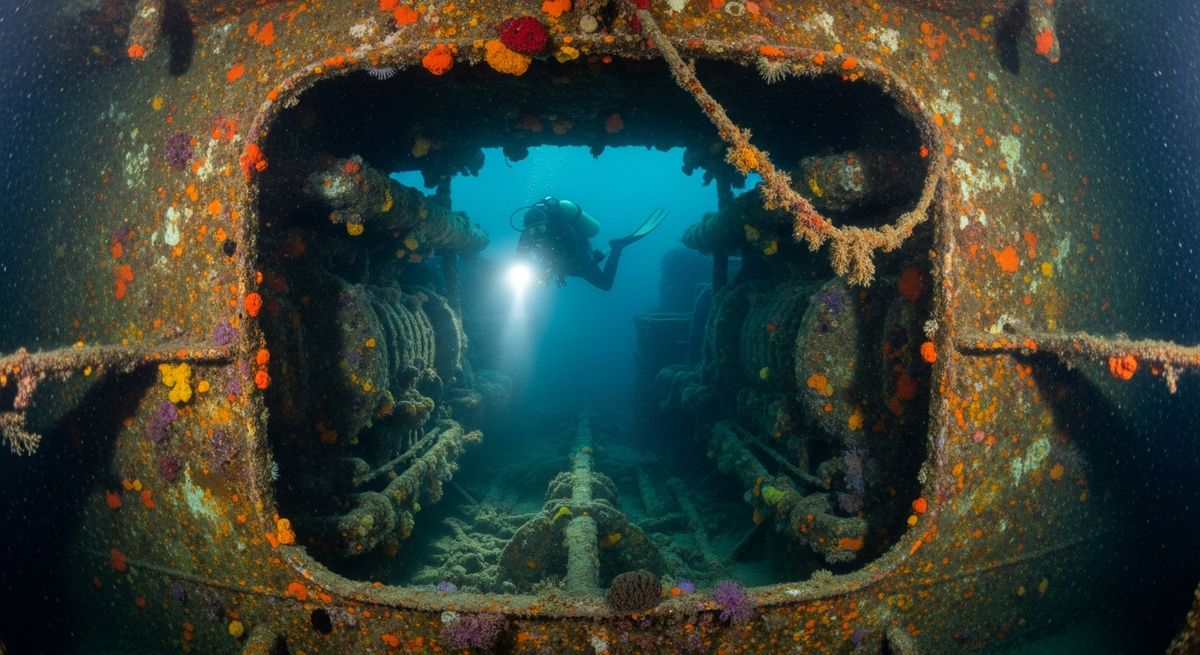
The Balkan isn't about deep exploration. This is a five-meter dive, pure and simple, and we absolutely love it for a final splash or a relaxed entry into wreck diving. Imagine this: you're practically snorkeling over a piece of history. The motor vessel Balkan, built in 1944, ran aground back in '68 and eventually settled here, just barely beneath the surface. What you get is a wreck that feels like a natural reef, thanks to decades of growth. You'll glide over the visible hull and superstructure, seeing the metal plates softened by sponges and algae. Sunlight streams right through the shallow water, illuminating schools of small damselfish darting in and out of the crevices. We often spot octopus tucked away, eyeing us from the shadows, and parrotfish munching on the algae. This site is brilliant for photographers wanting to play with ambient light and wide angles, capturing the wreck's skeletal form against the surface shimmer. It’s also an easy spot for newer divers to get a feel for a large structure without the pressure of depth or complex navigation. Go at midday when the sun is highest for the best light penetration.
Typical BALKAN Dive Profile
Illustrative profile based on site depth and type. Actual dive profiles vary - always follow your dive computer and training.
Safety Notes
Wreck site - avoid penetration without wreck diving certification. Watch for sharp metal and entanglement hazards.
BALKAN Wreck History
Year Sunk
1968
Vessel Type
cargo ship
Cause
grounding
Tonnage
7,341 GRT
The vessel known as the Balkan began its life as the 'Empire Nile', a 7,341-ton cargo ship built in Scotland in 1944 for the British Ministry of War Transport. Like many 'Empire' ships, it served diligently through the end of the war and was later sold into commercial service. By 1968, it was owned by a Bulgarian shipping company and named the Balkan, plying trade routes across the Mediterranean.
In January 1968, while on a voyage from Bourgas, Bulgaria, to Lattakia, Syria, the Balkan encountered severe weather off the coast of Cyprus. The powerful storm drove the large vessel aground on the rocks near Larnaca, where it was battered by waves and began to break apart. The ship was declared a total loss and abandoned to the sea. Resting in just 5 meters of water, the Balkan is now an easily accessible dive and snorkeling site. Years of wave action have flattened the wreck, but its massive boilers and large, scattered steel plates create a fascinating underwater landscape, teeming with fish and other marine creatures that have made the shallow wreckage their home.
Reviews for BALKAN
Conditions
Ocean conditions, forecast and tides for BALKAN
BALKAN Ocean Conditions
Monthly averages for BALKAN, sourced from Open-Meteo marine data - nearest station: Open-Meteo marine grid (35.67, 34.58) (31km away)
October Averages
Sea Temperature
26°C
79°F · Range: 23.8–28.3°C
Air Temperature
24°C
75°F
Wind Speed
4.8 m/s
9.3 knots
Atmospheric Pressure
1014.6 hPa
Based on 4 years of monitoring data · Data sources: Open-Meteo marine data
Plan & book
Ways to dive Larnaca, from day trips to liveaboards.
Day trips & courses
via GetYourGuideGuided dives, courses and snorkel trips with instant booking.
Find dive trips in LarnacaPlaces to stay
via Booking.comHotels and dive resorts near Larnaca.
Search stays in LarnacaDive insurance
Most travel insurance excludes or limits scuba. Check what you need before you go.
Dive insurance explainedPartner links: we may earn a commission if you book, at no extra cost to you. How we make money
Where to Stay near BALKAN
Prices from Booking.com. We may earn a commission at no extra cost to you.