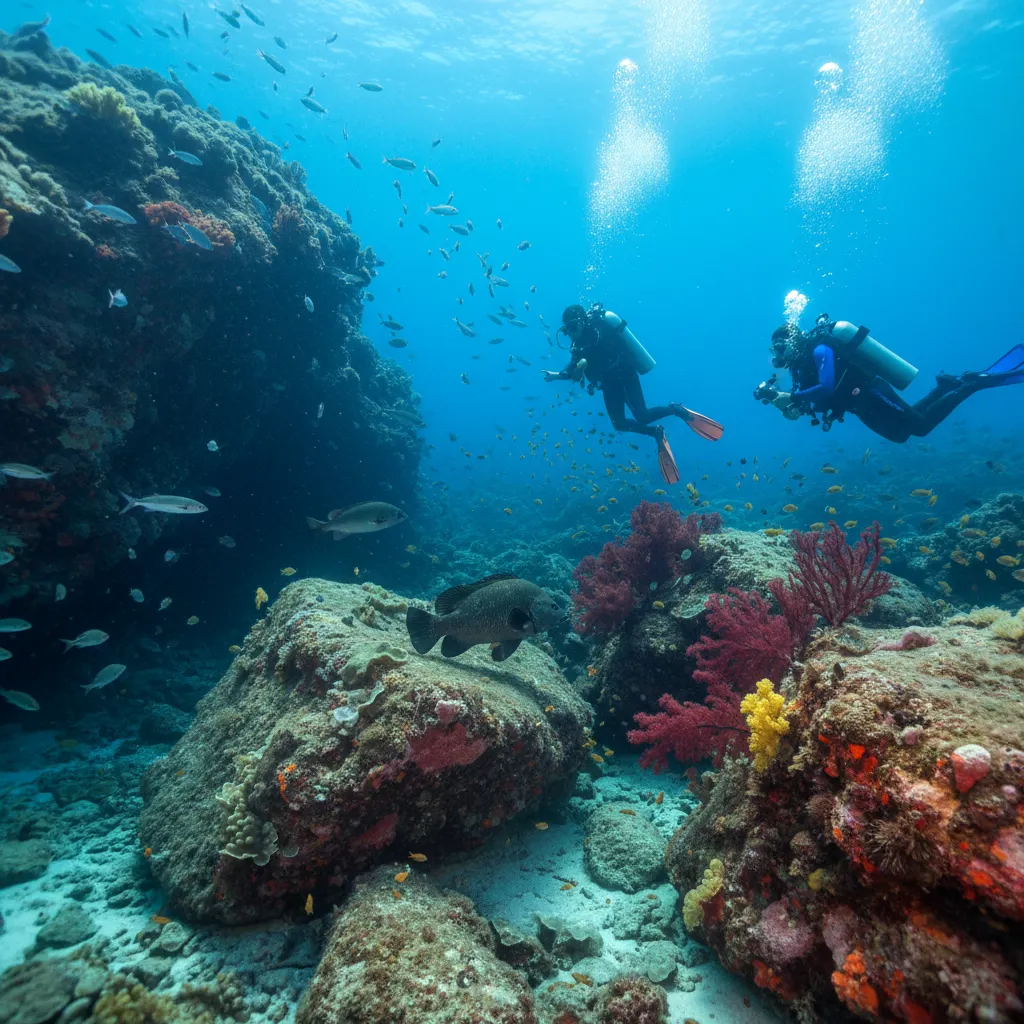
Diving in Corsica
Why dive here
Corsica offers some of France's richest diving, with 213+ marine species recorded in the area - including blue sharks, dolphins, great white sharks, hammerhead sharks and mobula rays (devil rays). Water ranges 15-28°C, warmest July, August, September.
Corsica diving, for us, is about those dramatic granite landscapes continuing right below the surface. We’re talking sheer walls plunging into the blue, riddled with grottos and overhangs, often thick with red gorgonian fans. Visibility is consistently good, usually 20m plus, especially outside of the peak summer months when the coastal waters can get a bit churned up. Our favourite spots are often found around the Scandola Nature Reserve. Here, you’ll find cracks in the rock filled with common lobsters waving their antennae and shy painted eels peeking out. Look closely, and you might spot an Odd Bobtail Squid scooting across the seabed, changing colours right before your eyes. We’ve also had some incredible encounters with grey dolphins offshore, often coming right up to the bow on the way out to a dive site. The wrecks, particularly those from WWII, are fantastic too, often encrusted with life and home to schooling bastard grunt. If you can, aim for late spring or early autumn; the water is still warm, and the dive boats are less crowded. Just watch for strong currents on some of the more exposed pinnacles.
Corsica Dive Site Map
Dive sites and dive centres in Corsica
Corsica Dive Sites
165 dive sites in Corsica
A-20 Havoc, plane wreck
The A-20 Havoc wreck is a perfect example of why we love diving Corsica. It’s sitting upright on a sandy bottom at 21 metres, almost perfectly intact, which is remarkable for a plane that ditched in 1944. As you descend, the distinct silhouette of the twin-engine bomber slowly takes shape, its wings still spread, one propeller slightly bent from impact. We often find conger eels peering from the cockpit windows, and schools of damselfish flitting around the tail section. Our favourite detail has to be the gun turret, still pointing defiantly into the blue. It’s easy to navigate, so even newer divers can spend their bottom time really exploring the various sections without feeling rushed. We'd suggest going early in the morning for the best light, when the sunbeams really highlight the plane's structure. There’s a quiet dignity to this site, a real sense of history.
A Casaïola
A Casaïola offers a shallow, protected dive, ideal for beginners or a relaxed second dive. The maximum depth of 13m means plenty of bottom time to explore the rocky seabed. We’ve spotted octopuses tucked into crevices and small schools of damselfish flitting among the rocks. It’s a gentle introduction to Corsican diving.
ADERNO
The Adorno, sunk in 1942, is one of Corsica's most atmospheric deep wrecks. It sits upright at 55 metres, a proper steamship with real presence on the seabed. We love drifting along her deck, imagining the wartime drama that brought her down. Her holds are open in places, offering glimpses into the dark interior, but it's the superstructure that really draws us in. Look for the massive propeller, often obscured by schools of damselfish that scatter as you approach. Visibility here is usually excellent, common for Corsica, but the depth means you’ll want to be comfortable with your gas management. The Adorno is a fantastic technical dive, but even advanced recreational divers can make a good, albeit brief, visit if they're careful with their bottom time. Keep an eye out for conger eels peering from every dark nook. She’s a grand old lady of the deep, providing a real sense of history.
AFRICHELLE
The Africhelle, off the coast of Corsica, is an interesting dive, and one we always enjoy for its accessibility and history. She’s a motor vessel, intentionally scuttled back in 1989 to create a fish haven. This means she’s sitting upright and relatively intact at around 45 metres, an inviting profile for advanced divers. Dropping down, the ship’s structure slowly resolves from the blue. You can navigate her deck and superstructure, which are now completely colonised by sponges and anemones. We’ve often found scorpionfish tucked into crevices and moray eels peeking from the darker recesses. The penetration isn’t extensive, but there are plenty of nooks to explore externally, and schools of damselfish often hover above the deck. It’s a peaceful dive, often with good visibility, making it a solid choice for those keen on wreck photography or just wanting to spend some quality time exploring a purpose-sunk artificial reef. Keep an eye on your bottom time; 45 metres comes quickly.
Aile
Aile is a mellow spot, just under 20 meters deep, making it a good choice for newer divers in Corsica. You’ll find a rocky seabed with scattered Posidonia, home to small groups of damselfish and often a few curious wrasse. It’s a straightforward dive, pleasant for getting comfortable with the local conditions.
ALBERI (POSSIBLY)
Alberi, or what we strongly suspect is Alberi, is an absolute standout if you’re into your history and a bit of detective work. This wreck lies shallow, around 12 metres, which means you get fantastic bottom time to really explore. We love how the story unfolds as you swim over it – a cargo ship, likely carrying timber, that went down during World War II. You can still make out the large wooden beams scattered across the seabed, almost perfectly preserved in the cooler Mediterranean water. It's a really atmospheric dive. We've spent many a dive here, finning slowly over the skeletal remains of the hull, picturing the moment it sank. The light filters down beautifully through the shallows, illuminating schooling damselfish that dart in and out of the rusted metalwork. Look closely and you'll find plenty of nudibranchs grazing on the encrusting sponges and anemones. It's a peaceful spot now, a fascinating blend of history and nature, and our pick for an easy, contemplative dive where you can truly immerse yourself in the past. It’s perfect for divers who appreciate a wreck with a real sense of narrative, rather than just an artificial reef.
Aquarium
The Aquarium in Corsica is a straightforward dive that lives up to its name. Dropping to around 19 meters, you'll find yourself in a natural amphitheatre where schools of damselfish and small bream gather, often joined by curious wrasse. It's a relaxed, intermediate dive, good for getting your bearings or for photographers wanting a calm environment to practice. Expect a pleasant, easygoing Mediterranean experience.
B-17 Bomber Wreck
The B-17 in Calvi Bay is easily our favourite Corsican wreck. We've dived it many times, and it never fails to impress. It’s a genuine piece of history, a Flying Fortress resting upright on the sandy seabed at 27m. You drop down, and suddenly, the distinct silhouette of a bomber takes shape, remarkably intact, with its wings spread and the fuselage largely complete. Swimming around it, you can make out the cockpit area and gun turrets, a poignant reminder of its wartime past. There’s a certain eeriness to it, but also a quiet beauty as the Mediterranean has reclaimed it. Cardinal fish dart through the bomb bay, and we’ve often spotted scorpionfish camouflaged on the fuselage. Green wrasse flit over the wings, and occasionally, you'll see a rough pitar burrowed into the sand nearby. It's an intermediate dive, straightforward enough for those comfortable at depth, but with enough character to keep experienced wreck divers happy. Visibility is usually excellent, often 20m plus, so you get a full view of the bomber from a distance before you descend onto it. We always recommend getting there early to avoid the afternoon boat traffic, it makes for a much more peaceful dive.
Bagheera
Bagheera is a shallow, relaxed dive, perfect for newer divers or those looking for a gentle re-entry into the water. The maximum depth of 9m means plenty of bottom time to explore. You'll often spot scorpionfish camouflaged against the rocks and small schools of damselfish darting between the boulders. It's a great spot for an easy afternoon dive, especially if you're practicing buoyancy or testing new gear.
BAGLIETTO (PROBABLY)
Baglietto, or what we’re pretty sure is the Baglietto, sits in the shallow waters of La Castagna, a favourite little spot for us in Corsica. This isn't some deep, dark mystery wreck; it's practically a pool dive at five metres, perfect for an extended bottom time, making it our pick for a relaxed afternoon. The 14-metre yacht sank in '73 after a run-in with an underwater rock, and now it’s a lovely, accessible wreck. You’ll find the hull largely intact, settled on a rocky bottom, listing slightly to one side. Sunlight dapples through the water, illuminating the small schools of damselfish that dart in and out of the cabin openings. We love exploring the nooks and crannies, peeking into the wheelhouse where a shy moray eel sometimes eyes you from a pipe. The exposed wooden decks have long since gone, leaving skeletal ribs that provide shelter for blennies and gobies. It’s a gentle dive, suited to newer wreck divers or anyone who just wants to spend an hour observing the small, vibrant life that has made this yacht its home. Go early or late to avoid the few pleasure boats that anchor nearby.
Banc provencal
Banc provencal is a dive for intermediate divers looking to go a bit deeper, with the seabed at 40m. It’s essentially a large rock formation, dropping off into the blue. You'll find a good mix of Mediterranean critters here: groupers often hang out in the crevices, and we’ve seen barracuda cruise past on the deeper edges. It's a solid choice when you want a straightforward deep dive with reliable marine life.
Benguigui
Benguigui in Corsica offers a straightforward dive, popular with local dive centers. You'll generally find good visibility here, revealing rocky seafloor and some small gorgonian patches. It's a comfortable site for newer divers looking to get comfortable in the Mediterranean, with less emphasis on rare finds and more on relaxed exploration. Expect to see typical Mediterranean reef fish like damselfish and wrasse.
Show all 165 dive sites in Corsica
- BETTOLINA (POSSIBLY)
- Cala dei Santi
- Cala dell'Alga
- Calvi plage
- Campomoro Plongée
- Canadair Wreck
- Cannelle Esterna
- Capo Rosso
- Cap Sagro
- Cinquini
- colorado
- Combat aerien
- Contessa
- COSTA CONCORDIA
- Costa Verde Loisirs
- Crique
- Cultilatta
- Danger d’Algajola
- Danger du Toro
- Elba Diving
- ELVISCOT
- E Sette Nave (Ajaccio)
- Focacciola/Gemini Rock
- Formiche della Zanca
- GALATIA
- Gemini West
- Gli Archetti
- Grand Tombant
- Grigione
- Grosse Geröllhalde
- Haut Fond de Centuri
- Iles Sanguinaires
- Il Porticciolo Sud
- Isola Argentarola
- Isola Corbella
- Isolotto dei Topi
- Jo& jo
- JOLLY GIALLO
- JONIO
- Kedidi
- Kedidi 3
- La Bibliothèque
- La Campanina
- La Crique
- La Ficajola
- LA GIRAFE
- La Grotta di Cerboli
- La Louise
- La petite Bretagne
- La petite Vallée
- La Pinella
- LA PUNTA ROSSA
- La roche bleue
- La Tortue
- La Vacca
- La vallée des mérous
- Lavasina
- Le Canadair
- Le Cerniette
- Le Coralline
- Le Danger de la Vacca
- Le Formichine
- Le Jardin
- Le Naseau
- Le Pain de sucre
- Le Roc noir
- Les aiguilles
- Les Arches
- Les arches de Riva Bella
- Le Scalette
- Le sec des congres
- Le Sec du Belge
- Le sec du clocher
- les Grottes
- Les nacres
- Les perles
- les trois frères
- Le tonneau
- L'Incantu
- Loca
- Lo Scoglione
- MarelinoSub
- Merou Grouper City
- Merouville
- Morcone Bay
- MOTOZATTERA
- MUGGINE
- NASIM
- Nasim, wreck
- NIAGARA
- Nonza
- Omnisub
- ORETTA
- P47 de Santa Severa
- P-47 Thunderbolt
- P51 "Mustang", wreck
- PAOLA TERZA
- Petra Mula
- Pianosa Boa 2
- Pianosa Boa 3
- Pianosa Boa 5
- Picchi di Pablo
- Piscine
- Plage du Mancinu
- Plage Maeva Plongée
- Pointe de campomoro
- Pte de la Revellata
- Punta della Madonna
- Punta del Nasuto
- Punta Fetovaia
- Punta Morcone
- Punta Rosa
- Punta San Francesco
- Punta Secca
- Punta Spanu
- Punta Valitone
- Relitto Aereo
- Relitto di Pomonte
- Ripalti
- Roche Marine
- Roche Nathalie
- Roche rouge
- Sagone plage
- Saint François
- Scandola
- Scandola Reserve
- Scoglietto - Cristo
- Scoglietto - Franata Nord
- Scoglio della Triglia
- Scoglio di Remaiolo
- Scogliu
- Sec 1
- Secca del Careno
- Secca del Turco
- Secca di Fetovaia
- Secca di Fonza
- Sec du Caldanu
- Senino
- SISTER ANNE
- Sottolonda
- Stareso
- Storico
- Subtortue
- Taravo island
- TEMO (POSSIBLY)
- Tete de Maure
- Torra Plongée
- Tour de la Calanca
- TRE FRATELLI F
- Triangle
- U rigonne
- Vanga
- Vickers Viking
Corsica Dive Centres
45 dive shops and operators in Corsica
ACQUASPORT di Mazzi Stefano & C.S.n.c.
A PIAGHJA DIVING CALVI
Aquadif
Aqualonde Formation
Aquanautic Elba
Aquatile Plongee
ARGENTARIO DIVERS SRL
ARGENTARIO - OBI DIVING
Show all 45 dive centres in Corsica
- A.S.D. AMICI DI NEMO
- BLUE DOLPHIN DIVING CENTER
- Blue Marine Companige - Plongee
- Bordemer
- CALVI PLONGEE
- Centro Sub Corsaro S.n.c.
- Corse
- Corsica Sub
- COSTA VERDE LOISIRS
- DIVE CENTER BLU
- DivEx
- Diving in Elba di R.Buralli e J. Zanetti e C. sas
- Dollfin
- Dune Marseille
- Easy Dive Cannes
- ELBA DIVING CENTER
- Enfola Diving Center
- Explorasub
- Il Careno Diving Center
- Into the Blue
- Isanthea Paris
- Katabasis Associazione Sportiva Dilettantistica
- La Case Marine Dive Center
- MAEVA PLONGEE
- Marine Diving Center
- OmniSub-Scuola Sub Barbarossa
- Planet Ocean
- Plongée Nature
- Propriano Plongée
- Scuba-Shop Villeneuve
- SEADIVE
- SPORTING CLUB CAVO DIVING
- SUB NOW
- Subtortue
- Toga Plongée
- TORRA PLONGEE
- ZERO MENO DIVING CENTER
Ocean Wildlife in Corsica
213 species recorded in Corsica
Corsica Daylight & Sunrise/Sunset
Sunrise and sunset times for Corsica, calculated from coordinates
Today - Sunday 11 October
Sunrise
06:30
Sunset
17:48
Daylight
11h 18m
Golden Hour
17:10
First light (dawn) at 06:02 · Last light (dusk) at 18:16
Monthly Averages
| Month | Sunrise | Sunset | Daylight |
|---|---|---|---|
| Jan | 07:50 | 17:13 | 9h 23m |
| Feb | 07:21 | 17:53 | 10h 32m |
| Mar | 06:37 | 18:27 | 11h 50m |
| Apr | 05:43 | 19:02 | 13h 18m |
| May | 05:02 | 19:35 | 14h 33m |
| JunLongest | 04:45 | 20:00 | 15h 15m |
| Jul | 04:58 | 19:58 | 15h 1m |
| Aug | 05:28 | 19:26 | 13h 58m |
| Sep | 06:01 | 18:36 | 12h 35m |
| OctNow | 06:34 | 17:43 | 11h 10m |
| Nov | 07:12 | 17:02 | 9h 51m |
| DecShortest | 07:44 | 16:50 | 9h 7m |
Times are approximate local times based on longitude. Actual times may vary slightly depending on the exact timezone observed in Corsica.
Where to Stay near Corsica
Prices from Booking.com. We may earn a commission at no extra cost to you.
Marine Protected Areas near Corsica
49 protected areas near Corsica - please respect local regulations when diving
Pelagos Sanctuary For The Conservation Of Marine Mammals
Cap Corse Et Agriate
Oiseaux marins de l'Agriate
Grands dauphins de l'Agriate
Plateau du Cap Corse
Capu Rossu , Scandola, revellata, Calvi
Iles Lavezzi, Bouches de Bonifacio
Bouches de Bonifacio, Iles des Moines
Récifs du mont sous-marin d'Ajaccio et des affleurements rocheux de Valinco
Plateau du Cap Corse
Réserve Naturelle des Bouches de Bonifacio
Bouches De Bonifacio
Showing 12 largest of 49
Getting to Corsica
Bastia
Figari
Pisa (PI)
Plan & book
Ways to dive Corsica, from day trips to liveaboards.
Day trips & courses
via GetYourGuideGuided dives, courses and snorkel trips with instant booking.
Find dive trips in CorsicaPlaces to stay
via Booking.comHotels and dive resorts near Corsica.
Search stays in CorsicaDive insurance
Most travel insurance excludes or limits scuba. Check what you need before you go.
Dive insurance explainedPartner links: we may earn a commission if you book, at no extra cost to you. How we make money