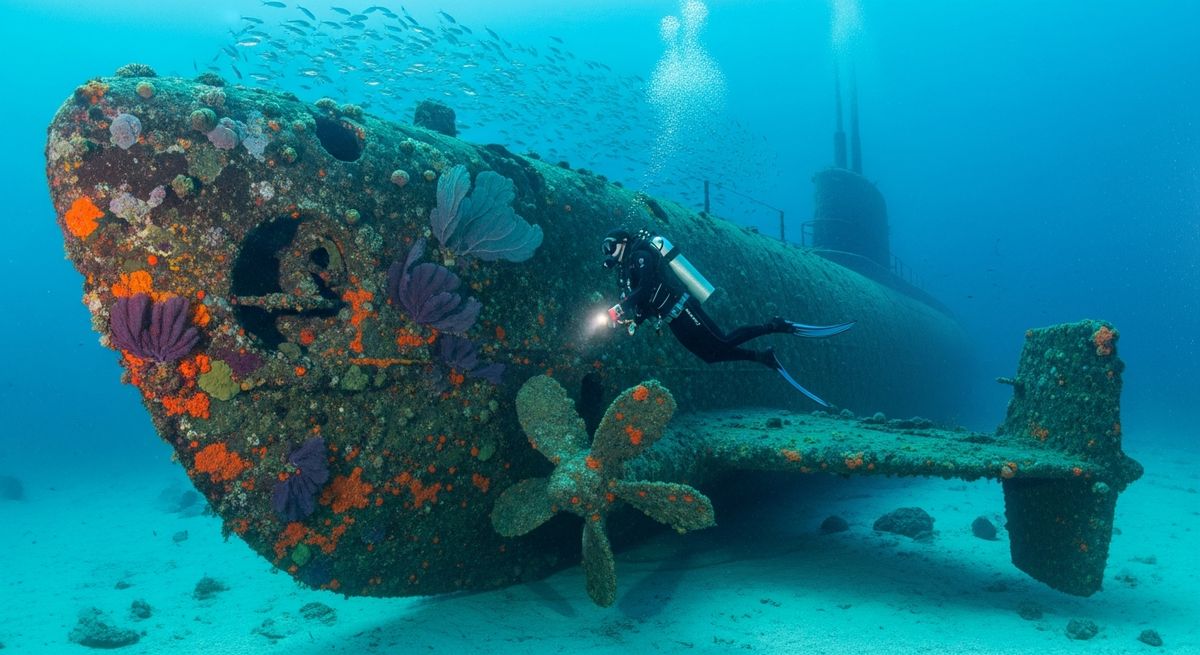
B-17 Bomber Wreck
Protected Area
Vallée du Fango
Why dive here
With 213+ marine species recorded in the area - including blue sharks, dolphins, great white sharks, hammerhead sharks and mobula rays (devil rays) - B-17 Bomber Wreck offers some of Corsica's richest wreck diving. Water ranges 15-28°C, warmest July, August, September.
The B-17 in Calvi Bay is easily our favourite Corsican wreck. We've dived it many times, and it never fails to impress. It’s a genuine piece of history, a Flying Fortress resting upright on the sandy seabed at 27m. You drop down, and suddenly, the distinct silhouette of a bomber takes shape, remarkably intact, with its wings spread and the fuselage largely complete. Swimming around it, you can make out the cockpit area and gun turrets, a poignant reminder of its wartime past. There’s a certain eeriness to it, but also a quiet beauty as the Mediterranean has reclaimed it. Cardinal fish dart through the bomb bay, and we’ve often spotted scorpionfish camouflaged on the fuselage. Green wrasse flit over the wings, and occasionally, you'll see a rough pitar burrowed into the sand nearby. It's an intermediate dive, straightforward enough for those comfortable at depth, but with enough character to keep experienced wreck divers happy. Visibility is usually excellent, often 20m plus, so you get a full view of the bomber from a distance before you descend onto it. We always recommend getting there early to avoid the afternoon boat traffic, it makes for a much more peaceful dive.
Typical B-17 Bomber Wreck Dive Profile
Illustrative profile based on site depth and type. Actual dive profiles vary - always follow your dive computer and training.
Safety Notes
Depth of 24m - Advanced Open Water certification recommended.
Wreck site - avoid penetration without wreck diving certification. Watch for sharp metal and entanglement hazards.
Always perform a 3-minute safety stop at 5m before surfacing.
B-17 Bomber Wreck Wreck History
Year Sunk
1944
Vessel Type
aircraft
Cause
unknown
The Boeing B-17 Flying Fortress was one of the most iconic heavy bombers of World War II, renowned for its ability to sustain heavy damage and still bring its crew home. This particular B-17 was returning from a bombing raid on February 14, 1944, when it was crippled by enemy fire. With one engine out and another failing, the pilot, 2nd Lt. Roswell F. Hoskings, realized he couldn't make it back to base. He skillfully performed a controlled water landing in the calm, protected Bay of Calvi, allowing all ten crew members to escape safely before the aircraft sank beneath the waves.
Today, the B-17 rests upright on a sandy seabed at a depth of around 27 meters, making it one of the most famous and best-preserved aircraft wrecks in the Mediterranean. The visibility is often superb, revealing the bomber in stunning detail. Divers can explore the remarkably intact cockpit, gaze out through the plexiglass nose cone, and swim along the enormous 32-meter wingspan, where the four powerful engines are still in place. The wreck is a poignant memorial to the aircrews of WWII and an unforgettable dive experience.
Nearest Dive Centres to B-17 Bomber Wreck
Dive shops near B-17 Bomber Wreck
CALVI PLONGEE
A PIAGHJA DIVING CALVI
Corse
Explorasub
Reviews for B-17 Bomber Wreck
Conditions
Ocean conditions, forecast and tides for B-17 Bomber Wreck
B-17 Bomber Wreck Ocean Conditions
Monthly averages for B-17 Bomber Wreck, sourced from Open-Meteo marine data - nearest station: Open-Meteo marine grid (42.38, 9.55) (2km away)
October Averages
Sea Temperature
22°C
72°F · Range: 20.1–24.6°C
Air Temperature
18°C
64°F
Wind Speed
5.12 m/s
10.0 knots
Atmospheric Pressure
1017.2 hPa
Based on 4 years of monitoring data · Data sources: Open-Meteo marine data
Plan & book
Ways to dive Corsica, from day trips to liveaboards.
Day trips & courses
via GetYourGuideGuided dives, courses and snorkel trips with instant booking.
Find dive trips in CorsicaPlaces to stay
via Booking.comHotels and dive resorts near Corsica.
Search stays in CorsicaDive insurance
Most travel insurance excludes or limits scuba. Check what you need before you go.
Dive insurance explainedPartner links: we may earn a commission if you book, at no extra cost to you. How we make money
Where to Stay near B-17 Bomber Wreck
Prices from Booking.com. We may earn a commission at no extra cost to you.