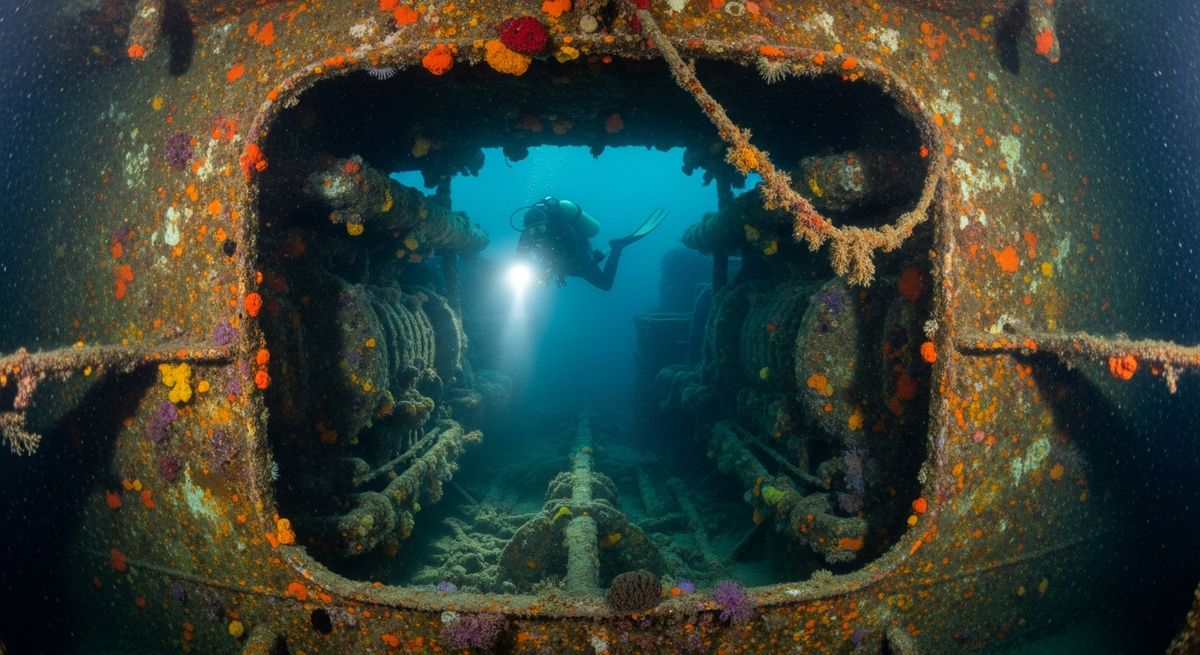
A-20 Havoc, plane wreck
Protected Area
Rivages de casinca
Why dive here
With 213+ marine species recorded in the area - including blue sharks, dolphins, great white sharks, hammerhead sharks and mobula rays (devil rays) - A-20 Havoc, plane wreck offers some of Corsica's richest wreck diving. Water ranges 15-28°C, warmest July, August, September.
The A-20 Havoc wreck is a perfect example of why we love diving Corsica. It’s sitting upright on a sandy bottom at 21 metres, almost perfectly intact, which is remarkable for a plane that ditched in 1944. As you descend, the distinct silhouette of the twin-engine bomber slowly takes shape, its wings still spread, one propeller slightly bent from impact. We often find conger eels peering from the cockpit windows, and schools of damselfish flitting around the tail section. Our favourite detail has to be the gun turret, still pointing defiantly into the blue. It’s easy to navigate, so even newer divers can spend their bottom time really exploring the various sections without feeling rushed. We'd suggest going early in the morning for the best light, when the sunbeams really highlight the plane's structure. There’s a quiet dignity to this site, a real sense of history.
Typical A-20 Havoc, plane wreck Dive Profile
Illustrative profile based on site depth and type. Actual dive profiles vary - always follow your dive computer and training.
Safety Notes
Depth of 21m - Advanced Open Water certification recommended.
Wreck site - avoid penetration without wreck diving certification. Watch for sharp metal and entanglement hazards.
Always perform a 3-minute safety stop at 5m before surfacing.
A-20 Havoc, plane wreck Wreck History
Year Sunk
1944
Vessel Type
aircraft
Cause
unknown
The Douglas A-20 Havoc was a versatile and robust American attack aircraft, a true workhorse of World War II. Thousands were deployed across every theater of the war, including the Mediterranean. During 1944, the island of Corsica was a critical Allied base, launching countless missions against German forces in Italy and supporting the invasion of Southern France. This particular A-20 Havoc was lost during one such operation, a casualty of the intense air war fought over Europe. It came to rest on the seabed, a silent memorial to the airmen who flew it.
Divers can visit this poignant piece of history at a depth of 21 meters off the Corsican coast. The aircraft wreck is remarkably well-preserved, lying upright on the sand. Its distinctive twin engines, wing sections, and parts of the fuselage are clearly identifiable, offering a direct connection to the past. The aluminum skin of the bomber is now home to a variety of marine life, with moray eels often taking up residence within the engine cowlings. Diving the A-20 Havoc is a somber yet fascinating experience, a chance to pay respects while witnessing a unique underwater habitat.
Nearest Dive Centres to A-20 Havoc, plane wreck
Dive shops near A-20 Havoc, plane wreck
COSTA VERDE LOISIRS
Corsica Sub
Toga Plongée
Corse
Dollfin
Reviews for A-20 Havoc, plane wreck
Conditions
Ocean conditions, forecast and tides for A-20 Havoc, plane wreck
A-20 Havoc, plane wreck Ocean Conditions
Monthly averages for A-20 Havoc, plane wreck, sourced from Open-Meteo marine data - nearest station: Open-Meteo marine grid (42.38, 9.55) (2km away)
October Averages
Sea Temperature
22°C
72°F · Range: 20.1–24.6°C
Air Temperature
18°C
64°F
Wind Speed
5.12 m/s
10.0 knots
Atmospheric Pressure
1017.2 hPa
Based on 4 years of monitoring data · Data sources: Open-Meteo marine data
Plan & book
Ways to dive Corsica, from day trips to liveaboards.
Day trips & courses
via GetYourGuideGuided dives, courses and snorkel trips with instant booking.
Find dive trips in CorsicaPlaces to stay
via Booking.comHotels and dive resorts near Corsica.
Search stays in CorsicaDive insurance
Most travel insurance excludes or limits scuba. Check what you need before you go.
Dive insurance explainedPartner links: we may earn a commission if you book, at no extra cost to you. How we make money
Where to Stay near A-20 Havoc, plane wreck
Prices from Booking.com. We may earn a commission at no extra cost to you.