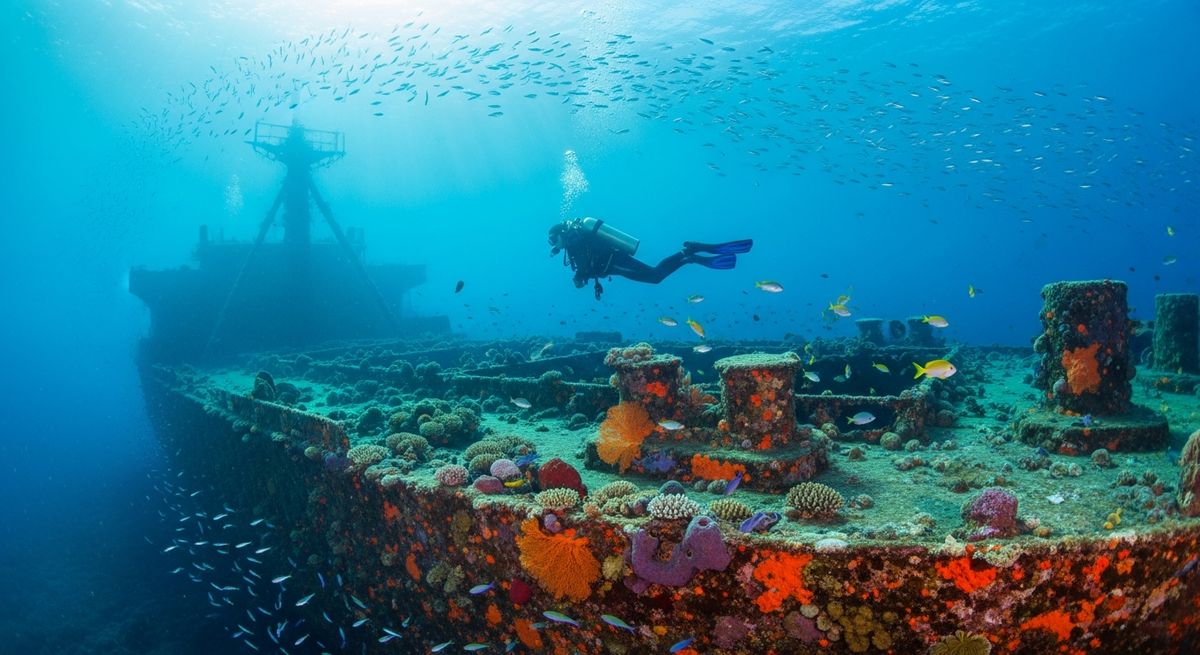
Cape Saint Fokas Shipwreck
Protected Area
LESVOS PARAKTIOI YGROTOPOI KAI KOLPOS KALLONIS
Why dive here
Cape Saint Fokas Shipwreck is a wreck dive where divers can encounter dolphins and sea turtles. Water ranges 15-26°C, warmest July, August, September.
Cape Saint Fokas is one of those Mediterranean wrecks that just *feels* ancient. You drop down, and the first thing you notice is the way the light filters through the water, illuminating fragments of amphorae scattered around the wreck. It’s believed to be an ancient merchant ship, lying broken on the seabed, and it absolutely delivers on atmosphere. We love exploring the larger sections of pottery that still hold their shape, imagining the cargo they once held. Schools of damselfish often hover over the deeper parts of the wreck, almost like they’re guarding the secrets below. Look closely in the crevices and you’ll find moray eels peeking out, while octopus are often camouflaged against the encrusted pottery. It’s a dive that rewards slow exploration, letting you soak in the history. We'd suggest going in the morning; the visibility often feels a little crisper, and the currents tend to be calmer. It's an ideal dive for anyone who appreciates a wreck with a story, rather than just a structure.
Safety Notes
Wreck site - avoid penetration without wreck diving certification. Watch for sharp metal and entanglement hazards.
Cape Saint Fokas Shipwreck Wreck History
Vessel Type
cargo ship
Cause
unknown
Diving on the Cape Saint Fokas shipwreck is like traveling back in time. Located within the protected waters of the Alonissos Marine Park, this is not a modern steel wreck but the ancient remains of a Byzantine-era merchant vessel that sank between the 9th and 12th centuries. The ship was carrying a cargo of plates and amphorae when it likely fell victim to a storm or navigational error, coming to rest on the seabed where it would remain undisturbed for nearly a thousand years.
This is a unique underwater archaeological site, often referred to as an 'underwater museum'. The wooden hull has long since disintegrated, but the ship's cargo remains, with stacks of plates and jars now concreted into the seabed by marine growth. Diving here is a privilege, conducted under strict supervision by authorized dive centers to preserve the site's integrity. For divers, it offers a rare opportunity to witness ancient history firsthand in the crystal-clear Aegean waters, connecting with the maritime traders who plied these same routes centuries ago.
Reviews for Cape Saint Fokas Shipwreck
Conditions
Ocean conditions, forecast and tides for Cape Saint Fokas Shipwreck
Cape Saint Fokas Shipwreck Ocean Conditions
Monthly averages for Cape Saint Fokas Shipwreck, sourced from Open-Meteo marine data + Copernicus Marine (EU) - nearest station: Open-Meteo marine grid (38.09, 24.15) (15km away)
October Averages
Sea Temperature
23°C
73°F · Range: 21–25.6°C
Current Speed
1.41 cm/s
Direction: SW (225°)
Chlorophyll-a
0.13 mg/m³
Clear water
Salinity
34.63 PSU
Based on 4 years of monitoring data · Data sources: Open-Meteo marine data + Copernicus Marine (EU)
Plan & book
Ways to dive Alonissos Marine Park, from day trips to liveaboards.
Day trips & courses
via GetYourGuideGuided dives, courses and snorkel trips with instant booking.
Find dive trips in Alonissos Marine ParkPlaces to stay
via Booking.comHotels and dive resorts near Alonissos Marine Park.
Search stays in Alonissos Marine ParkDive insurance
Most travel insurance excludes or limits scuba. Check what you need before you go.
Dive insurance explainedPartner links: we may earn a commission if you book, at no extra cost to you. How we make money
Where to Stay near Cape Saint Fokas Shipwreck
Prices from Booking.com. We may earn a commission at no extra cost to you.