CAMPONAVIA
Protected Area
Littoral de Jbel Moussa
Why dive here
With 140+ marine species recorded in the area - including dolphins, ocean sunfish (mola mola), octopuses, sea turtles and sperm whales - CAMPONAVIA offers some of Al Hoceima's richest wreck diving. Water ranges 16-23°C, warmest July, August, September.
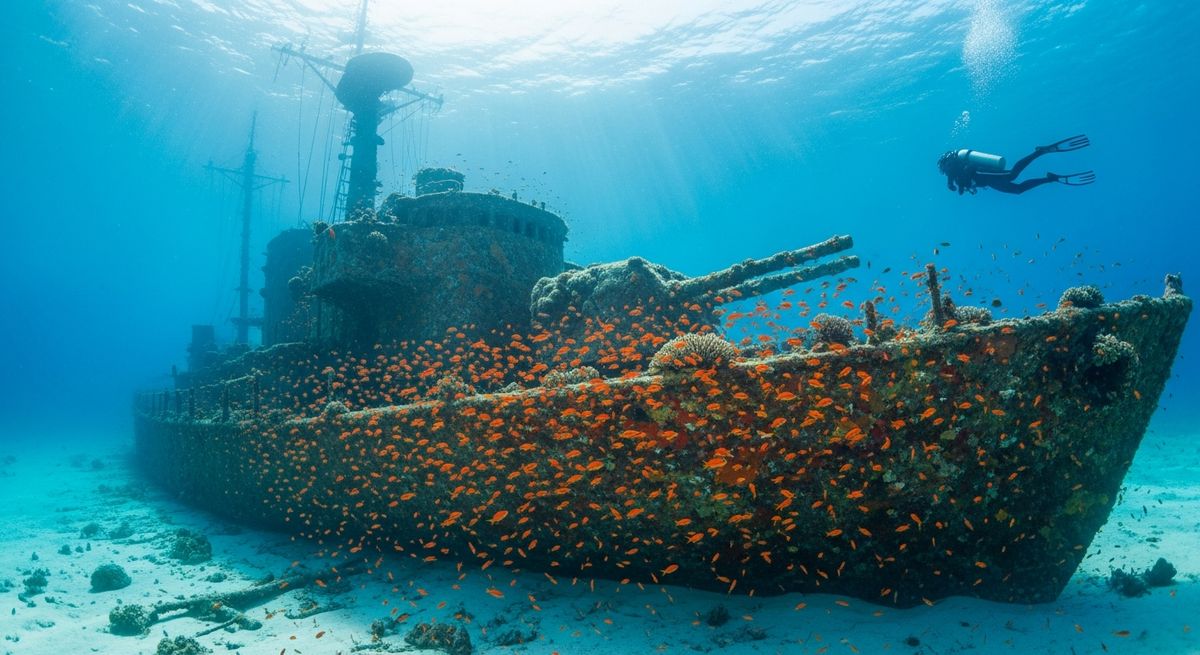
We love a wreck that still feels like a ship, and Campenovia delivers. This isn't some scattered pile of scrap; she sits upright, a proper 123-metre tanker, sunk back in '85. Descending onto her deck at 18 metres, you still get that sense of scale, the structure of it all. It’s not just a quick pass-over either; there are plenty of spots to poke around, with massive hatches and open cargo holds inviting exploration. What makes it special is how quickly the marine life has taken over. You’ll find schools of damselfish flitting through the superstructure, and we’ve spotted moray eels peeking from every crevice. Our favourite detail? The sheer density of soft corals that have blossomed along the rails and bulkheads, a surprisingly colourful garden on what was once a steel behemoth. It's a fantastic dive for anyone who enjoys the story of a wreck, not just the thrill, with enough to see for a solid hour underwater.
Typical CAMPONAVIA Dive Profile
Illustrative profile based on site depth and type. Actual dive profiles vary - always follow your dive computer and training.
Safety Notes
Wreck site - avoid penetration without wreck diving certification. Watch for sharp metal and entanglement hazards.
Always perform a 3-minute safety stop at 5m before surfacing.
CAMPONAVIA Wreck History
Year Sunk
1985
Vessel Type
tanker
Cause
unknown
The Camponavia was a relatively modern tanker, built in 1973 in Gijon, Spain, for the Spanish state-owned oil company, CAMPSA. For over a decade, it served its role in transporting petroleum products, a workhorse of the Mediterranean energy trade. Its career came to an abrupt end on May 26, 1985, in the Moroccan port of Al Hoceima.
The circumstances of its sinking are not widely documented, with records simply stating that the vessel 'sank alongside'. This suggests an incident while moored at the pier, possibly a collision with the quay, an accident during loading or unloading, or a sudden hull failure. Whatever the cause, the Camponavia went down in the harbor, coming to rest on the seabed.
Today, the Camponavia lies at a very accessible depth of 18 meters, making it a fantastic and popular dive site for all levels of divers. The wreck is largely intact, offering a chance to explore the superstructure, decks, and large cargo holds of a substantial modern vessel. Over the decades, it has transformed into a thriving artificial reef, attracting schools of fish and a variety of Mediterranean marine life that now call its steel structure home.
Nearest Dive Centres to CAMPONAVIA
Dive shops near CAMPONAVIA
Dive Charters Gibraltar
BUCEO ALGECIRAS
FAISHASUB
LEON MARINO Diving Center
Chems Diving
Burbujas
Reviews for CAMPONAVIA
Conditions
Ocean conditions, forecast and tides for CAMPONAVIA
CAMPONAVIA Ocean Conditions
Monthly averages for CAMPONAVIA, sourced from Open-Meteo marine data - nearest station: Open-Meteo marine grid (36.14, -5.33) (13km away)
October Averages
Sea Temperature
20°C
68°F · Range: 17.3–22°C
Air Temperature
21°C
70°F
Wind Speed
5.48 m/s
10.7 knots
Atmospheric Pressure
1017.8 hPa
Based on 4 years of monitoring data · Data sources: Open-Meteo marine data
Plan & book
Ways to dive Al Hoceima, from day trips to liveaboards.
Day trips & courses
via GetYourGuideGuided dives, courses and snorkel trips with instant booking.
Find dive trips in Al HoceimaPlaces to stay
via Booking.comHotels and dive resorts near Al Hoceima.
Search stays in Al HoceimaDive insurance
Most travel insurance excludes or limits scuba. Check what you need before you go.
Dive insurance explainedPartner links: we may earn a commission if you book, at no extra cost to you. How we make money
Where to Stay near CAMPONAVIA
Prices from Booking.com. We may earn a commission at no extra cost to you.