BRETWALDA
Protected Area
Sudoeste Alentejano e Costa Vicentina
Why dive here
With 116+ marine species recorded in the area - including blue sharks, blue whales, dolphins, dwarf minke whales and ocean sunfish (mola mola) - BRETWALDA offers some of Algarve & Berlengas's richest wreck diving. Water ranges 15-19°C, warmest June, October, November.
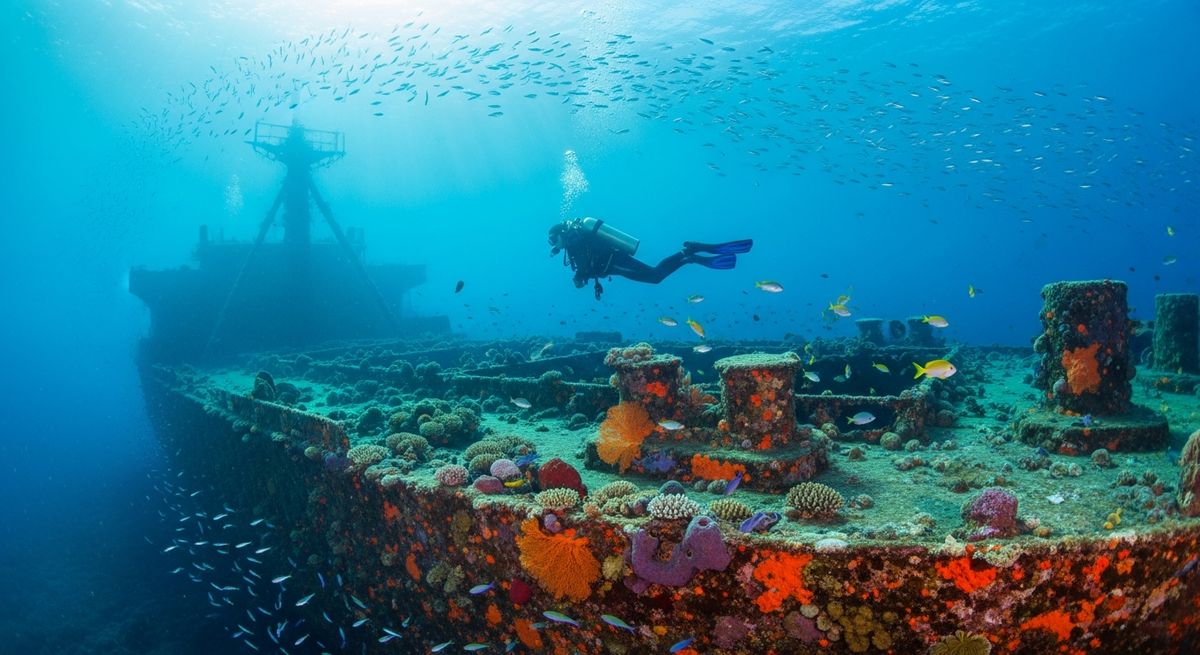
Oh, Bretwalda. She’s a proper old lady, built back in 1881, and you can feel that history the moment you drop down. Lying just north of Cape St. Vincent, she’s a steamship of some scale, around 97 metres long, which means there’s plenty to explore without feeling rushed. We love how the metalwork, even after all these decades, still holds her shape, letting you peek into cargo holds and imagine her journey from Blyth to Alexandria. The depth sits at 37 metres, so this is definitely one for experienced divers comfortable with deeper profiles. Visibility can vary, but on a good day, the light plays beautifully through the superstructure, illuminating the schools of small pelagic fish darting around. You’ll spot conger eels in the darker recesses, and octopus often cling to the more sheltered sections. Our favourite part? The bow, often adorned with colourful anemones, stands proud, a real photogenic moment if you’ve got steady hands and good buoyancy. It’s a proper wreck dive, satisfying for those who appreciate maritime history and the slow reclamation by the ocean.
Typical BRETWALDA Dive Profile
Illustrative profile based on site depth and type. Actual dive profiles vary - always follow your dive computer and training.
Safety Notes
Deep dive (37m) - monitor air consumption closely. Advanced certification recommended.
Wreck site - avoid penetration without wreck diving certification. Watch for sharp metal and entanglement hazards.
Always perform a 3-minute safety stop at 5m before surfacing.
BRETWALDA Wreck History
Year Sunk
1895
Vessel Type
cargo ship
Cause
grounding
Tonnage
2,298 GRT
The SS Bretwalda was a British steamship constructed in 1881, a sturdy collier built for transporting coal across the world. In the summer of 1895, she was on a routine voyage, carrying a full load of coal from Blyth, England, destined for the bustling port of Alexandria, Egypt. The journey took her down the Atlantic coast of Europe, towards the strategic shipping lanes of the Mediterranean.
On August 23, 1895, as she navigated the waters near Portugal's Cape St. Vincent, a thick fog descended, severely limiting visibility. The ship's crew, unable to see the dangerous coastline, ran aground on submerged rocks about three miles north of the cape. The hull was breached, and the Bretwalda quickly foundered and sank, becoming another victim of this infamous stretch of coastline.
Today, the Bretwalda rests at a depth of 37 meters, making it an exciting dive for advanced divers. The wreck is broken into several large sections, with the bow and stern still recognizable. The most impressive features are the massive boilers, which stand upright from the seabed, creating a dramatic silhouette. The surrounding debris field is home to a rich variety of marine life, including conger eels, lobsters, and large schools of bream that patrol the ghostly remains.
Nearest Dive Centres to BRETWALDA
Dive shops near BRETWALDA
PuraVida Divehouse
Blue Ocean Divers
Lagos Divers
WeDive Lagos
WeDive
Buddy Dive and Friends
Reviews for BRETWALDA
Conditions
Ocean conditions, forecast and tides for BRETWALDA
BRETWALDA Ocean Conditions
Monthly averages for BRETWALDA, sourced from Open-Meteo marine data - nearest station: Open-Meteo marine grid (37.92, -8.81) (40km away)
October Averages
Sea Temperature
19°C
65°F · Range: 16.7–20.2°C
Air Temperature
18°C
65°F
Wind Speed
8.24 m/s
16.0 knots
Atmospheric Pressure
1017.4 hPa
Based on 4 years of monitoring data · Data sources: Open-Meteo marine data
Plan & book
Ways to dive Algarve & Berlengas, from day trips to liveaboards.
Day trips & courses
via GetYourGuideGuided dives, courses and snorkel trips with instant booking.
Find dive trips in Algarve & BerlengasPlaces to stay
via Booking.comHotels and dive resorts near Algarve & Berlengas.
Search stays in Algarve & BerlengasDive insurance
Most travel insurance excludes or limits scuba. Check what you need before you go.
Dive insurance explainedPartner links: we may earn a commission if you book, at no extra cost to you. How we make money
Where to Stay near BRETWALDA
Prices from Booking.com. We may earn a commission at no extra cost to you.