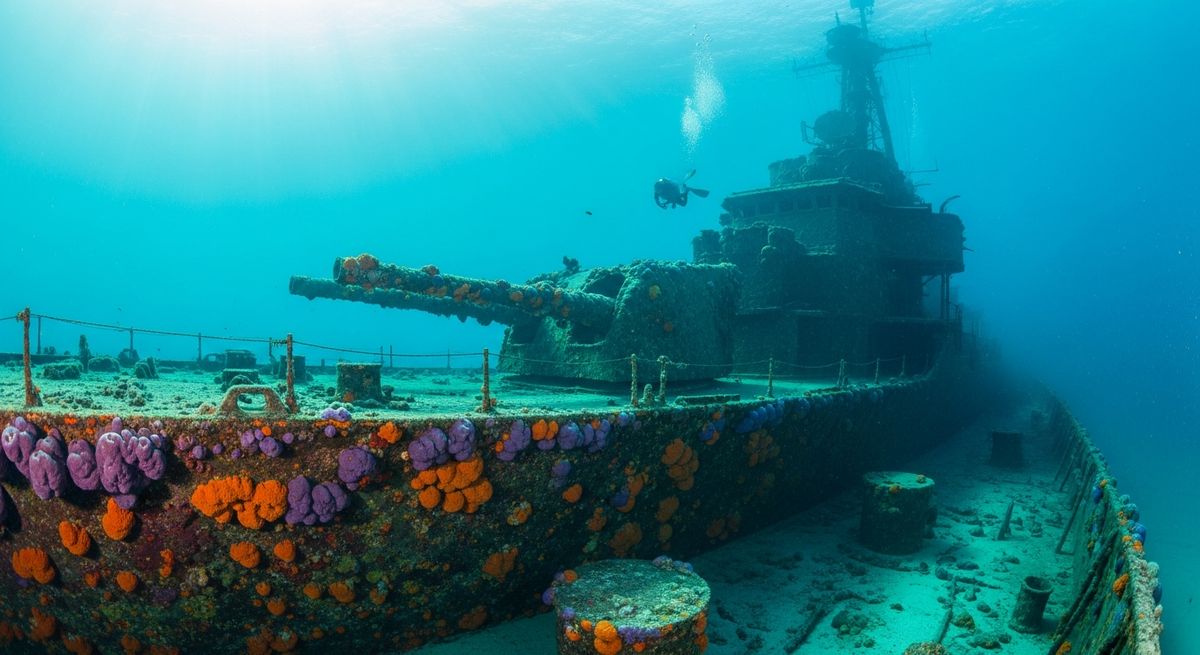
C-56 Shipwreck
Protected Area
Arrecife de Puerto Morelos
Why dive here
With 177+ marine species recorded in the area - including barracuda, bull sharks, dolphins, eagle rays and nurse sharks - C-56 Shipwreck offers some of Cozumel's richest wreck diving. Water ranges 27-30°C, warmest August, September, October.
We love a good purpose-sunk wreck, and Cozumel’s C-56 is one of our favourites. Originally a US Navy minesweeper and then a Mexican Navy patrol boat, she was deliberately sunk in 2000 and now rests upright in a sandy channel, split into two main sections. The bow half sits deeper, around 24 metres, while the stern rises to 15 metres, making it approachable for advanced open water divers. What we really enjoy here is the penetration. You can swim through the holds, past old bunks, and even out through the bridge. It’s an easy swim-through, no tight squeezes, but still gives you that thrill of being inside a wreck. Look for the massive Goliath groupers that often hang out in the deeper sections; their sheer size is always impressive. Around the superstructure, we’ve seen schools of snapper and barracuda, and the coral growth, while not ancient, is developing nicely. The current can be brisk, typical for Cozumel, so we always suggest an early morning dive before the crowds arrive and the winds pick up.
Safety Notes
Wreck site - avoid penetration without wreck diving certification. Watch for sharp metal and entanglement hazards.
Strong currents typical this month (avg 79 cm/s). Good buoyancy control essential.
C-56 Shipwreck Wreck History
Year Sunk
2000
Vessel Type
warship
Cause
scuttled
Tonnage
650 tons
Originally commissioned as the USS Scuffle (AM-298) in 1943, this Admirable-class minesweeper served the US Navy with distinction during World War II, earning two battle stars for its service in the Pacific theater. After the war, she was transferred to the Mexican Navy in 1962 and renamed the ARM Felipe Xicoténcatl (C-56). She served for decades as a patrol and rescue vessel, safeguarding the waters of the Mexican Caribbean.
In 2000, after a long and storied career, the C-56 was given a final, noble mission: to become an underwater haven for marine life. She was carefully prepared and intentionally sunk just off Cozumel's coast, settling upright on a sandy bottom at a depth of around 80 feet (24 meters). Today, the C-56 is one of Cozumel's premier wreck dives. Divers can explore its intact structure, penetrate the main cargo holds, and visit the bridge. The wreck is teeming with life, from massive green moray eels in the engine room to schools of jacks and barracuda that patrol its decks, making it a spectacular artificial reef.
Nearest Dive Centres to C-56 Shipwreck
Dive shops near C-56 Shipwreck
Dive with Ruben
Dorado Buceo
Tolok Divers Mexico
Aquanauts
Deportes Acuáticos/Aquatic Sports
Scuba Total
Reviews for C-56 Shipwreck
Conditions
Ocean conditions, forecast and tides for C-56 Shipwreck
C-56 Shipwreck Ocean Conditions
Monthly averages for C-56 Shipwreck, sourced from NOAA NDBC + Copernicus Marine (EU) - nearest station: Yucatan Basin - 120 NM ESE of Cozumel, MX (227km away)
October Averages
Sea Temperature
30°C
85°F · Range: 28.7–32.3°C
Air Temperature
29°C
84°F
Current Speed
78.6 cm/s
Direction: NE (36.7°)
Chlorophyll-a
0.046 mg/m³
Very clear (oligotrophic)
Salinity
35.99 PSU
Wave Height
1.1m
6.7s period
Wind Speed
5.5 m/s
10.7 knots
Atmospheric Pressure
1010.7 hPa
Visibility
24.1 nmi
Based on 5 years of monitoring data · Data sources: NOAA NDBC + Copernicus Marine (EU)
Plan & book
Ways to dive Cozumel, from day trips to liveaboards.
Day trips & courses
via GetYourGuideGuided dives, courses and snorkel trips with instant booking.
Find dive trips in CozumelPlaces to stay
via Booking.comHotels and dive resorts near Cozumel.
Search stays in CozumelDive insurance
Most travel insurance excludes or limits scuba. Check what you need before you go.
Dive insurance explainedPartner links: we may earn a commission if you book, at no extra cost to you. How we make money
Where to Stay near C-56 Shipwreck
Prices from Booking.com. We may earn a commission at no extra cost to you.