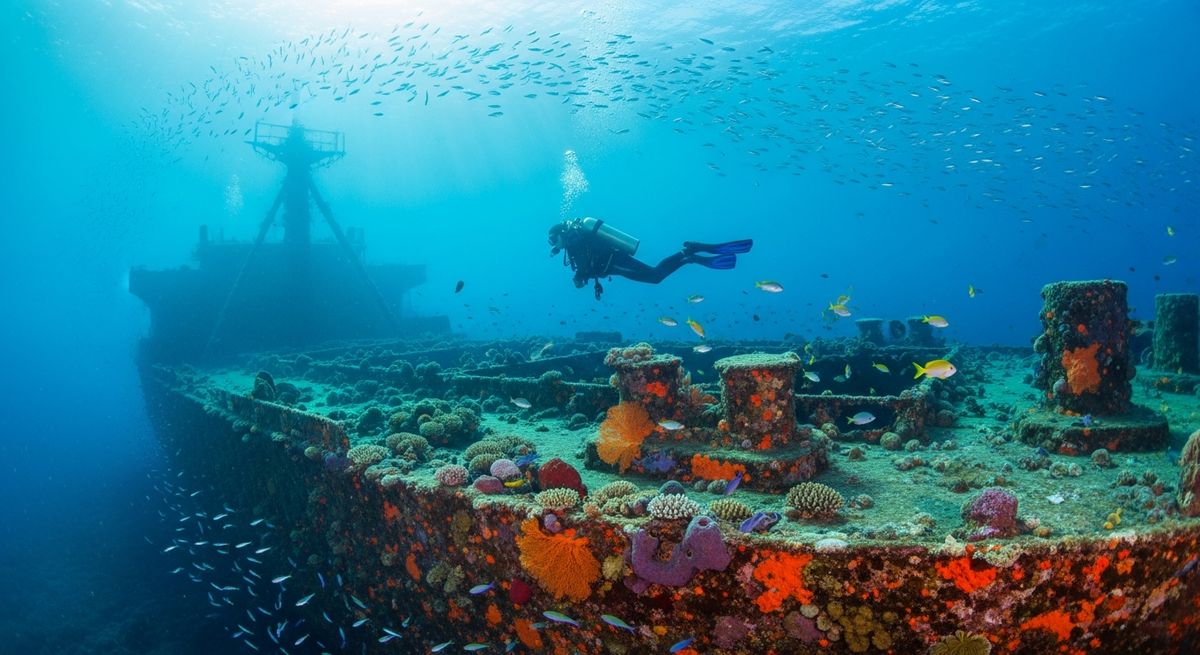
S.S. Inchulva / Delray Wreck (Wrack)
Protected Area
Lofthus Underwater Archaeological Preserve
Why dive here
With 87+ marine species recorded in the area - including bull sharks, dolphins, hammerhead sharks, seahorses and sea turtles - S.S. Inchulva / Delray Wreck (Wrack) offers some of Florida Keys's richest wreck diving. Water ranges 19-32°C, warmest July, August, September.
The S.S. Inchulva, often called the Delray Wreck, sits in just 25 feet of water, making it a proper shallow playground. We love it for how accessible it is, right off Delray’s municipal beach. You’re not getting vast, cathedral-like holds here; instead, it’s a broken-up hull, scattered and spread out, perfect for poking around in the sand between the larger pieces. This wreck acts like a natural magnet for fish. Expect to see big schools of snapper and grunt milling about the larger metal sections, often with solitary ocean triggerfish eyeing you from a distance. Look closely, and you might spot a wary coral scorpionfish tucked into a crevice, almost invisible against the encrusted metal. The real joy here is the sheer number of blennies and gobies. We’ve spent whole dives just watching the redlip blennies dart in and out of holes. It’s an easy dive, often with good visibility, but watch for a bit of surge if there’s any swell. It’s ideal for new wreck divers or anyone who just wants a relaxed dive with plenty to observe without the pressure of depth or strong currents.
Safety Notes
Wreck site - avoid penetration without wreck diving certification. Watch for sharp metal and entanglement hazards.
Nearest Dive Centres to S.S. Inchulva / Delray Wreck (Wrack)
Dive shops near S.S. Inchulva / Delray Wreck (Wrack)
Starfish Scuba
Force-E Scuba Centers
Hydrotherapy Dive Charters LLC
Gold Coast Scuba
AQUI Water Sports
The Scuba Store
Reviews for S.S. Inchulva / Delray Wreck (Wrack)
Conditions
Ocean conditions, forecast and tides for S.S. Inchulva / Delray Wreck (Wrack)
S.S. Inchulva / Delray Wreck (Wrack) Ocean Conditions
Monthly averages for S.S. Inchulva / Delray Wreck (Wrack), sourced from NOAA NDBC + Copernicus Marine (EU) - nearest station: 8725520 - Fort Myers, FL (28km away)
October Averages
Sea Temperature
27°C
81°F · Range: 20.9–31.1°C
Air Temperature
26°C
79°F
Current Speed
0 cm/s
Direction: S (180°)
Salinity
35.98 PSU
Wind Speed
2.7 m/s
5.2 knots
Atmospheric Pressure
1014.5 hPa
Based on 5 years of monitoring data · Data sources: NOAA NDBC + Copernicus Marine (EU)
Plan & book
Ways to dive Florida Keys, from day trips to liveaboards.
Day trips & courses
via GetYourGuideGuided dives, courses and snorkel trips with instant booking.
Find dive trips in Florida KeysPlaces to stay
via Booking.comHotels and dive resorts near Florida Keys.
Search stays in Florida KeysDive insurance
Most travel insurance excludes or limits scuba. Check what you need before you go.
Dive insurance explainedPartner links: we may earn a commission if you book, at no extra cost to you. How we make money
Where to Stay near S.S. Inchulva / Delray Wreck (Wrack)
Prices from Booking.com. We may earn a commission at no extra cost to you.