BERTRAM RICKMERS
Why dive here
With 74+ marine species recorded in the area - including sea turtles, spinner dolphins and pufferfish - BERTRAM RICKMERS offers some of Dahlak Archipelago's richest wreck diving. Water ranges 27-33°C, warmest July, August, September.
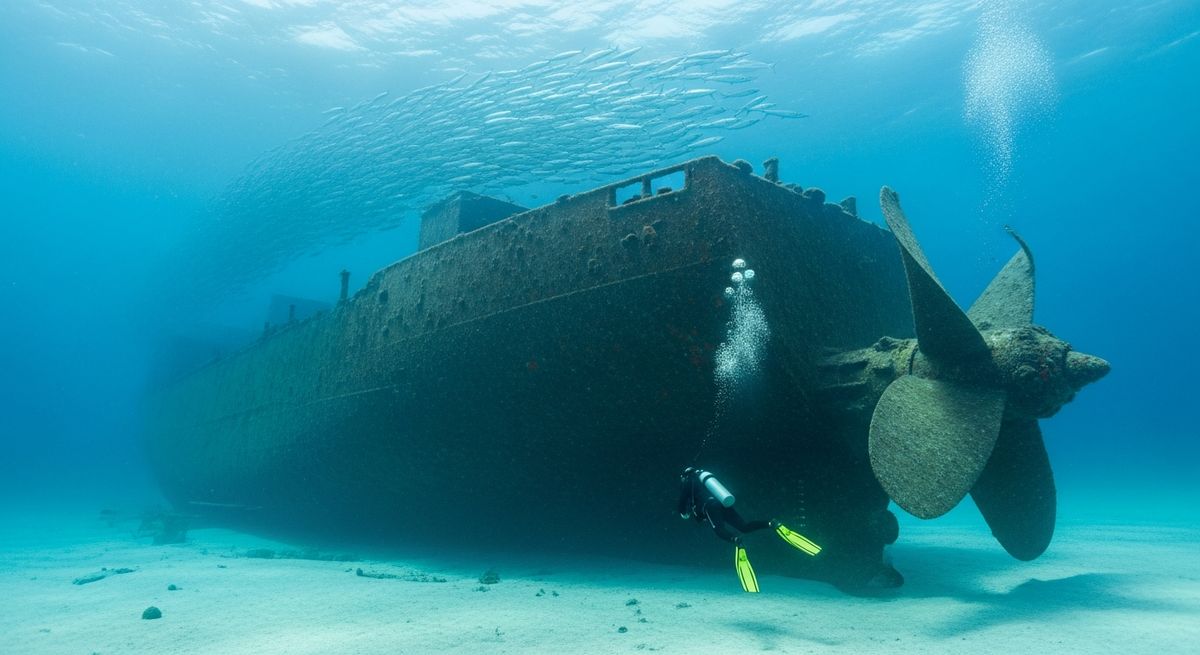
The Bertram Rickmers in Eritrea's Dahlak Archipelago is a real time capsule. We think it’s one of the most atmospheric wrecks in the Red Sea, sitting perfectly upright at a comfortable 17 metres. You drop down onto the main deck, often with schooling fusiliers swirling around the superstructure. The bow section is our favourite, still quite intact, with the anchor chains spilling out into the sand. You can spend a good chunk of your dive exploring the open cargo holds, where sunlight streaks through, illuminating the internal structure. Look closely, and you’ll spot crocodilefish camouflaged on the deck plates and moray eels peeking from beneath twisted metal. It’s a great site for photographers because of the shallow depth and generally good visibility. We've found the early morning dives here are often the calmest, with fewer currents. It’s a wreck that tells a story, rather than just being a pile of metal, perfect for divers who appreciate a bit of history with their reef.
Typical BERTRAM RICKMERS Dive Profile
Illustrative profile based on site depth and type. Actual dive profiles vary - always follow your dive computer and training.
Safety Notes
Wreck site - avoid penetration without wreck diving certification. Watch for sharp metal and entanglement hazards.
Always perform a 3-minute safety stop at 5m before surfacing.
BERTRAM RICKMERS Wreck History
Year Sunk
1941
Vessel Type
cargo ship
Cause
scuttled
The Bertram Rickmers is a ghost of the Second World War's East African Campaign, sunk not by enemy action, but by a deliberate act of denial. In early 1941, the Italian Red Sea Flotilla and other Axis ships were trapped in the port of Massawa, Eritrea, by the Royal Navy. As British and Commonwealth forces closed in on the port, the Italian commander gave the order to scuttle the fleet to prevent the ships and harbor facilities from falling into Allied hands. In April 1941, the German freighter Bertram Rickmers was one of more than thirty vessels intentionally sent to the bottom.
Today, the Bertram Rickmers rests at a depth of 17 meters in the Dahlak Archipelago, a premier wreck diving destination in the Red Sea. The ship is a highlight of liveaboard trips exploring the 'ghost fleet' of Massawa. Divers can explore the largely intact structure, which has become a thriving artificial reef, colonized by corals and home to a vast array of Red Sea fish. Swimming through its historic remains offers a direct connection to a lesser-known chapter of WWII maritime history.
Reviews for BERTRAM RICKMERS
Conditions
Ocean conditions, forecast and tides for BERTRAM RICKMERS
BERTRAM RICKMERS Ocean Conditions
Monthly averages for BERTRAM RICKMERS, sourced from Open-Meteo marine data - nearest station: Open-Meteo marine grid (15.67, 40.12) (15km away)
October Averages
Sea Temperature
33°C
91°F · Range: 31–34.1°C
Air Temperature
32°C
90°F
Wind Speed
5.8 m/s
11.3 knots
Atmospheric Pressure
1009 hPa
Based on 4 years of monitoring data · Data sources: Open-Meteo marine data
Plan & book
Ways to dive Dahlak Archipelago, from day trips to liveaboards.
Day trips & courses
via GetYourGuideGuided dives, courses and snorkel trips with instant booking.
Find dive trips in Dahlak ArchipelagoPlaces to stay
via Booking.comHotels and dive resorts near Dahlak Archipelago.
Search stays in Dahlak ArchipelagoDive insurance
Most travel insurance excludes or limits scuba. Check what you need before you go.
Dive insurance explainedPartner links: we may earn a commission if you book, at no extra cost to you. How we make money
Where to Stay near BERTRAM RICKMERS
Prices from Booking.com. We may earn a commission at no extra cost to you.