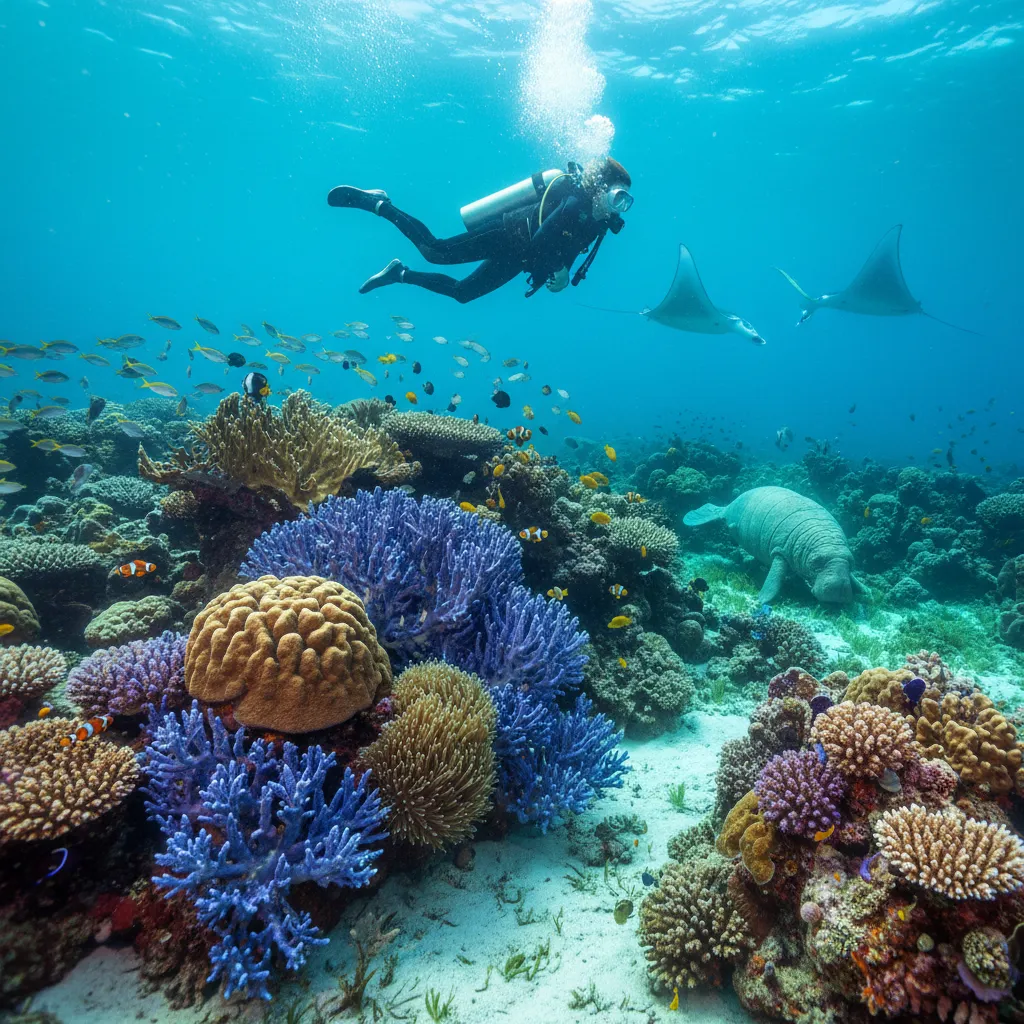
Diving in Dahlak Archipelago
Why dive here
Dahlak Archipelago offers some of Eritrea's richest diving, with 74+ marine species recorded in the area - including sea turtles, spinner dolphins and pufferfish. Water ranges 27-33°C, warmest July, August, September.
The Dahlak Archipelago isn't for the casual diver. There are no dive centres, you’ll be on a liveaboard, charting your own course through some seriously remote waters. But that’s precisely why we love it. These reefs feel truly untouched, a rarity in the Red Sea. We’ve found ourselves drifting past enormous fields of hard corals, healthy and colourful, the likes of which are hard to come by elsewhere. Keep an eye out for Ehrenberg’s snapper and the playful dusky wrasse flitting between the coral heads. Our favourite moments here are often the unexpected encounters - a solitary cloth-of-gold cone snail inching along the sand, or a school of Indian scad flashing silver in the sunlight. Current can be a factor, so bring your advanced cert and be ready for some exhilarating drift dives. We always suggest keeping a sharp lookout for the larger pelagics in the deeper blue, though it’s the sheer health of the reef itself that truly sets Dahlak apart.
Dahlak Archipelago Dive Site Map
Dive sites and dive centres in Dahlak Archipelago
Dahlak Archipelago Dive Sites
28 dive sites in Dahlak Archipelago
ADUA
The Adua, a substantial Italian steamship, lies scuttled just below the surface in the Dahlak Archipelago. We’re talking about three metres of depth, tops, making it an ideal spot for those who prefer to keep things shallow or are looking for an extended safety stop with something genuinely interesting to look at. This isn't a site for pushing depth limits, it’s about slow exploration. The wreck itself, sunk by the Italians in 1941 to prevent its capture, has become a home for countless smaller reef fish. You'll find schools darting through the superstructure, a real treat for photographers wanting to capture both history and marine life in excellent natural light.
ALBERONI
Alberoni isn't a deep dive, sitting at a shallow 9 metres, but that just means more bottom time to really soak it in. This site is a dangerous wreck, though we think that adds to its charm. It’s an evocative dive, a ghostly silhouette against the blue. You’ll weave through the skeletal remains of the hull, observing the way the light plays on the rusty metal. We love the way the wreck has become a home, a thriving artificial reef where the structure itself tells a story. Look for the schools of cardinalfish darting in and out of the darker sections, and keep an eye out for larger pelagics cruising by in the deeper blue. It’s perfect for photographers seeking dramatic backdrops or anyone who enjoys the quiet contemplation of history beneath the waves. The visibility here is usually excellent, making for some truly striking visuals. We'd suggest going early in the morning, before any potential surface chop picks up, for the calmest conditions and best light.
ALBERTO TREVES
Alberto Treves isn't your average wreck dive. Its depth, or lack thereof, makes it an anomaly. We’re talking 0m here, which essentially means it’s poking out of the water, a skeletal finger pointing skyward from the Dahlak shallows. This isn't one for the BCD-wearing, fin-kicking crowd, but it's our pick for snorkelers, freedivers, and even just photographers with a good telephoto lens. The wreck itself is a WWI Italian cargo ship, run aground. Its rusted frame, baked by the Red Sea sun, offers a dramatic contrast to the turquoise water. Peering down into the flooded holds, you can make out ghostly machinery, a strange world of shadow and light. We love how the fish don't care about the historical significance; parrotfish graze on algae-coated metal and small reef sharks patrol the deeper shadows beneath the hull. It’s a compelling, eerie spot, proof that not all the best sites are deep down.
ANTONIO C
The Antonio C is a proper time capsule, a casualty of World War II, resting upright and surprisingly intact at 17 metres. We love how the historical significance hits you immediately; this isn't just metal on the seabed, it’s a story. We’ve finned through her holds, imagining the cargo, and peered into the bridge where ghost commands still seem to linger. What makes this wreck special isn't just the history, though. It’s the way the Red Sea has reclaimed her. Schools of snapper often hold position in the open holds, unbothered by divers, and we’ve seen barracuda circling the mast structure, looking very much at home. The coral growth isn't overwhelming, but it’s enough to add colour and texture to the rusted steel. Our favourite spot is usually around the stern, where light filters in beautifully, illuminating the structural integrity. It's an easy dive, perfect for anyone who appreciates a bit of history with their reef life, especially those who prefer a shallower wreck with plenty to explore without deep penetration.
ANTONIOS H
The ANTONIOS H is a proper Red Sea wreck, one of our favourites in the Dahlaks. This carrier, sunk in ‘72, sits upright and shallow enough that even newer wreck divers can get a real sense of its scale, all 141 metres of it. We love dropping onto the stern and working our way forward, letting the sheer size of the hull impress us as parrotfish graze on the encrusted metal. Visibility here is often ridiculously good, sometimes 30 metres plus, so you get these sweeping vistas of the entire ship emerging from the blue. The superstructure is particularly fun to explore, with light shafts cutting through the old bridge windows, illuminating schools of fusiliers that duck and weave as you pass. Keep an eye out for the resident groupers lurking in the cargo holds; they’re enormous and always worth a pause. It’s a compelling dive for anyone with a love for maritime history and wrecks you can actually get *inside*.
ARMANTAN
Armantan is easily one of our favourite Red Sea wrecks, precisely because it’s not the usual crowded, pristine dive you might expect. This isn’t a quick dip; it’s an expedition. The ship lies in the shallows, which can be a bit tricky to find if you don't know the exact GPS, but that just adds to its allure. As you descend, the sheer size of the hull becomes apparent, a shadow stretching across the sandy bottom. We love how the shallow depth allows for long bottom times, giving you plenty of opportunity to pick apart the details – the twisted metal, the ghostly outline of the superstructure, and the way the light filters through the gaps. You’ll find schools of snapper and fusiliers weaving through the interior, while moray eels peek from behind rusted plating. It’s a site for those who appreciate history and the slow reclamation of man-made objects by the ocean. Definitely pack a torch for exploring the darker recesses; the light plays tricks inside.
BERTRAM RICKMERS
The Bertram Rickmers in Eritrea's Dahlak Archipelago is a real time capsule. We think it’s one of the most atmospheric wrecks in the Red Sea, sitting perfectly upright at a comfortable 17 metres. You drop down onto the main deck, often with schooling fusiliers swirling around the superstructure. The bow section is our favourite, still quite intact, with the anchor chains spilling out into the sand. You can spend a good chunk of your dive exploring the open cargo holds, where sunlight streaks through, illuminating the internal structure. Look closely, and you’ll spot crocodilefish camouflaged on the deck plates and moray eels peeking from beneath twisted metal. It’s a great site for photographers because of the shallow depth and generally good visibility. We've found the early morning dives here are often the calmest, with fewer currents. It’s a wreck that tells a story, rather than just being a pile of metal, perfect for divers who appreciate a bit of history with their reef.
BOLESLAW KRZYWOUSTY
The Boleslaw Krzywousty is less a dive and more a snorkel, but don't let that fool you into thinking it's not worth the journey. This hulking motor vessel, struck by rockets in 1990 and run aground, lies so shallow you can almost reach out and touch her superstructure from the surface. We love how the light plays across the twisted metal, reflecting off schools of snapper that dart in and out of the skeletal remains of the bridge. The depth, or lack thereof, means you can spend ages just floating, tracing the outline of the decks, spotting angelfish picking at the coral crusting the railings. It’s an almost eerie experience, seeing such a massive ship so completely exposed. Our favourite moments are often spent just drifting silently, watching the reef sharks glide past the bow, seemingly unfazed by the wreck's dramatic history. This site suits anyone looking for a unique, historical snorkel, where the drama of the past is still palpable in the shallows.
BRENTA
Brenta is a wreck that just hits different in the Dahlaks. She’s not deep, just 13 metres, but that shallow depth means sunlight floods the whole scene, painting the metal in an almost ethereal glow. We love her for the way the light plays through the skeletal remains, illuminating the schools of glassfish that shimmer in the shadowy holds. You can weave through the superstructure, imagining her final moments, and then take a slow turn around the deck, watching the parrotfish graze on the encrusted hull. This isn’t a wreck for penetration, she’s too far gone and too unstable for that, but it’s perfect for divers who appreciate history and the way nature reclaims man-made objects. We've seen some absolutely massive groupers lurking in the nooks, and the resident sweetlips are always a joy to watch. Dive her mid-morning for the best light, before the sun gets too high and washes things out. Just keep an eye on your buddy; it’s easy to get lost in the reverie of this place.
CAPTAIN PANAGOS DP
Okay, let's talk about the *Captain Panagos DP*. This isn't your deep, penetrable wreck site. Not even close. At a maximum depth of 5m, this bulk carrier is practically sunbathing, and that's precisely why we love it. We’re talking about a massive hull, over 180 metres long, just breaking the surface in places. Imagine gliding over the deck, barely getting your fins wet, and seeing the entire structure laid out below you. It’s like an archaeological dig in miniature. Sunlight streams down, illuminating the rusted metal, and the coral growth is surprisingly robust, particularly on the shallower sections. You'll see schools of fusiliers darting in and out of the skeletal superstructure, and the occasional parrotfish grazing on the encrusted hull. Our favourite moments here are at slack tide, when the water goes completely still, letting you trace the ship's outline from bow to stern with perfect clarity. It’s a fantastic spot for snorkelers or newer divers who want the thrill of a wreck without the depth or complexity.
COLOMBO
The Colombo wreck sits upright in just 13 metres of water, a fantastic relic that tells a story. We love that it’s so accessible, almost like a museum piece you can swim right up to. You’ll find the bow section completely gone, a gaping maw where the ship once met the waves, but the stern remains surprisingly intact. Look for the prop shaft and the steering gear, often swarming with silversides – it’s quite a sight when the sun catches them just right. This isn’t a rummage-through-the-hull kind of dive; the Colombo is a dangerous wreck, classification-wise, and quite broken up in places, so stick to the exterior and enjoy the structure. We’ve seen groupers lurking in the shadows and nudibranchs grazing on the coral growth. It’s a photographer’s dream on a clear day, with the light penetrating all the way down. Our favourite part? Cruising over the scattered debris field around the wreck, a surprisingly good spot for finding smaller critters that have made a home there. It’s perfect for a relaxed dive, suitable for anyone comfortable exploring a historical wreck in shallow water.
CREFELD
CREFELD isn't just a wreck; it's a silent testament to a moment in history, resting peacefully in the Eritrean Red Sea. We love this site for its incredible atmosphere, a bomb-damaged cargo ship, now entirely reclaimed by the ocean. Descending to a shallow 19 metres, you’re greeted by the ghostly silhouette of its bow, completely detached from the main hull and lying on its side, a scene straight out of a dive magazine. Swimming through the separated sections, you can almost hear the echoes of its past. The bomb blast has opened up the vessel, allowing easy penetration into its cargo holds, which are now home to schools of snapper and fusiliers. Sunlight filters through the gaps in the twisted metal, illuminating glassfish that dart amongst the decaying structure. It’s a site that suits divers who appreciate historical wrecks and the unique ecosystems they create. Our favourite spot is the stern, where a massive resident grouper often lurks, a real character of the wreck. The currents here are generally mild, making for a relaxed exploration, but we'd suggest going in the morning for the best light penetration into the holds.
Dahlak Archipelago Dive Centres
No dive centres listed in Dahlak Archipelago yet. Browse all dive centres.
Ocean Wildlife in Dahlak Archipelago
74 species recorded in Dahlak Archipelago
Dahlak Archipelago Daylight & Sunrise/Sunset
Sunrise and sunset times for Dahlak Archipelago, calculated from coordinates
Today - Sunday 11 October
Sunrise
06:12
Sunset
18:03
Daylight
11h 51m
Golden Hour
17:34
First light (dawn) at 05:50 · Last light (dusk) at 18:25
Monthly Averages
| Month | Sunrise | Sunset | Daylight |
|---|---|---|---|
| Jan | 06:51 | 18:09 | 11h 18m |
| Feb | 06:46 | 18:24 | 11h 38m |
| Mar | 06:29 | 18:31 | 12h 2m |
| Apr | 06:06 | 18:35 | 12h 29m |
| May | 05:52 | 18:42 | 12h 51m |
| JunLongest | 05:50 | 18:52 | 13h 3m |
| Jul | 05:57 | 18:55 | 12h 58m |
| Aug | 06:06 | 18:45 | 12h 39m |
| Sep | 06:09 | 18:23 | 12h 14m |
| OctNow | 06:12 | 18:00 | 11h 48m |
| Nov | 06:23 | 17:48 | 11h 25m |
| DecShortest | 06:39 | 17:52 | 11h 13m |
Times are approximate local times based on longitude. Actual times may vary slightly depending on the exact timezone observed in Dahlak Archipelago.
Where to Stay near Dahlak Archipelago
Prices from Booking.com. We may earn a commission at no extra cost to you.
Marine Protected Areas near Dahlak Archipelago
3 protected areas near Dahlak Archipelago - please respect local regulations when diving
Dahlak Island PA
Buri-Irrori Hawakil
Marsa Ibrahim
Getting to Dahlak Archipelago
Massawa
Asmara
Abha
Plan & book
Ways to dive Dahlak Archipelago, from day trips to liveaboards.
Day trips & courses
via GetYourGuideGuided dives, courses and snorkel trips with instant booking.
Find dive trips in Dahlak ArchipelagoPlaces to stay
via Booking.comHotels and dive resorts near Dahlak Archipelago.
Search stays in Dahlak ArchipelagoDive insurance
Most travel insurance excludes or limits scuba. Check what you need before you go.
Dive insurance explainedPartner links: we may earn a commission if you book, at no extra cost to you. How we make money