MARIA (POSSIBLY)
Why dive here
With 139+ marine species recorded in the area - including humpback whales, octopuses, sea turtles, spinner dolphins and whale sharks - MARIA (POSSIBLY) offers some of Eilat's richest wreck diving. Water ranges 18-29°C, warmest July, August, September.
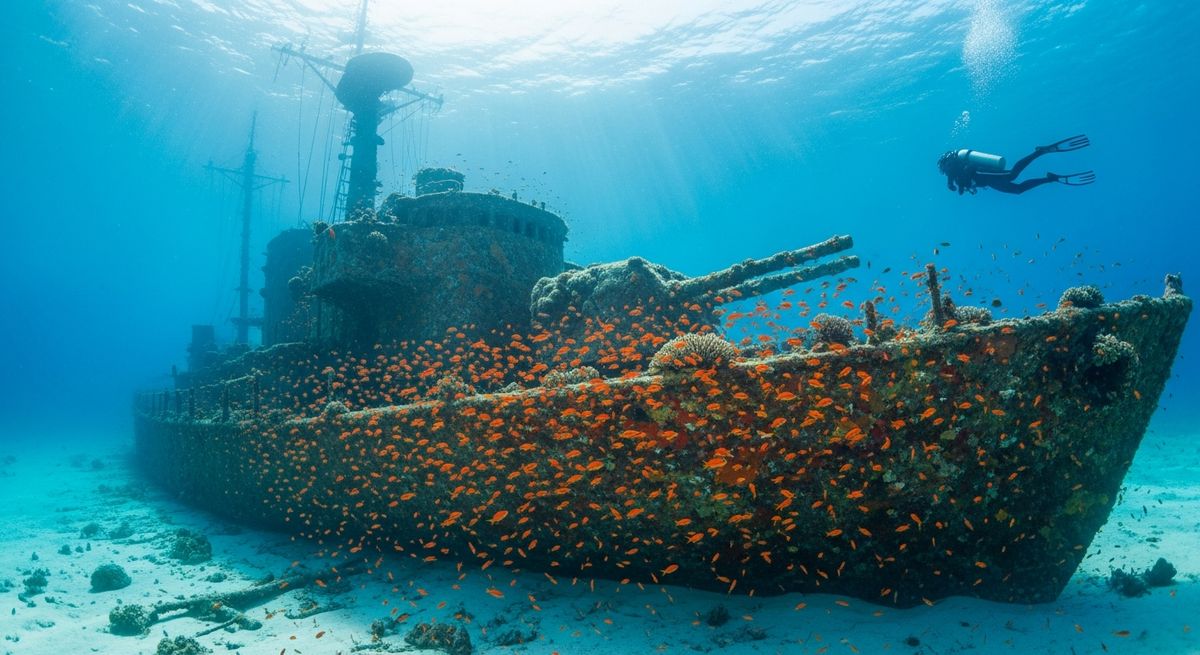
The Maria, or what we believe is the Maria, is one of Eilat’s truly unique shallow dives. She’s a big wreck, well over 100 meters, though most of her lies below recreational limits. What we get to explore, and what we love about her, is the very top of her superstructure, sitting at a comfortable five meters. It's a fantastic spot for a long, relaxed dive, especially if you’re into the historical context of a wreck. You’ll spend your time investigating the twisted metal, the ghostly remains of what was once a large cargo ship. Schools of yellowfin goatfish often drift over the decking, and if you look closely, you can spot cleaner shrimp darting into anemones that have taken root on the rusting hull. We often find lionfish tucked into the crevices, their venomous fins fanned out. Because it's so shallow, the light here is often incredible, really bringing out the subtle blues and greens of the algae and corals. It's a proper wreck dive without the depth, perfect for extending bottom time or for divers getting comfortable with overhead environments. Our pick for an afternoon dive, particularly when the sun is lower in the sky and casts long shadows across the deck.
Typical MARIA (POSSIBLY) Dive Profile
Illustrative profile based on site depth and type. Actual dive profiles vary - always follow your dive computer and training.
Safety Notes
Wreck site - avoid penetration without wreck diving certification. Watch for sharp metal and entanglement hazards.
Reviews for MARIA (POSSIBLY)
Conditions
Ocean conditions, forecast and tides for MARIA (POSSIBLY)
MARIA (POSSIBLY) Ocean Conditions
Monthly averages for MARIA (POSSIBLY), sourced from Open-Meteo marine data - nearest station: Open-Meteo marine grid (29.59, 32.72) (82km away)
October Averages
Sea Temperature
26°C
79°F · Range: 23.9–27.7°C
Air Temperature
28°C
82°F
Wind Speed
6.78 m/s
13.2 knots
Atmospheric Pressure
1013.2 hPa
Based on 4 years of monitoring data · Data sources: Open-Meteo marine data
Plan & book
Ways to dive Eilat, from day trips to liveaboards.
Day trips & courses
via GetYourGuideGuided dives, courses and snorkel trips with instant booking.
Find dive trips in EilatPlaces to stay
via Booking.comHotels and dive resorts near Eilat.
Search stays in EilatDive insurance
Most travel insurance excludes or limits scuba. Check what you need before you go.
Dive insurance explainedPartner links: we may earn a commission if you book, at no extra cost to you. How we make money
Where to Stay near MARIA (POSSIBLY)
Prices from Booking.com. We may earn a commission at no extra cost to you.