ADMIRAL GRAF SPEE
Why dive here
With 33+ marine species recorded in the area - including sperm whales - ADMIRAL GRAF SPEE offers some of Mar del Plata's richest wreck diving. Water ranges 10-21°C, warmest January, February, March.
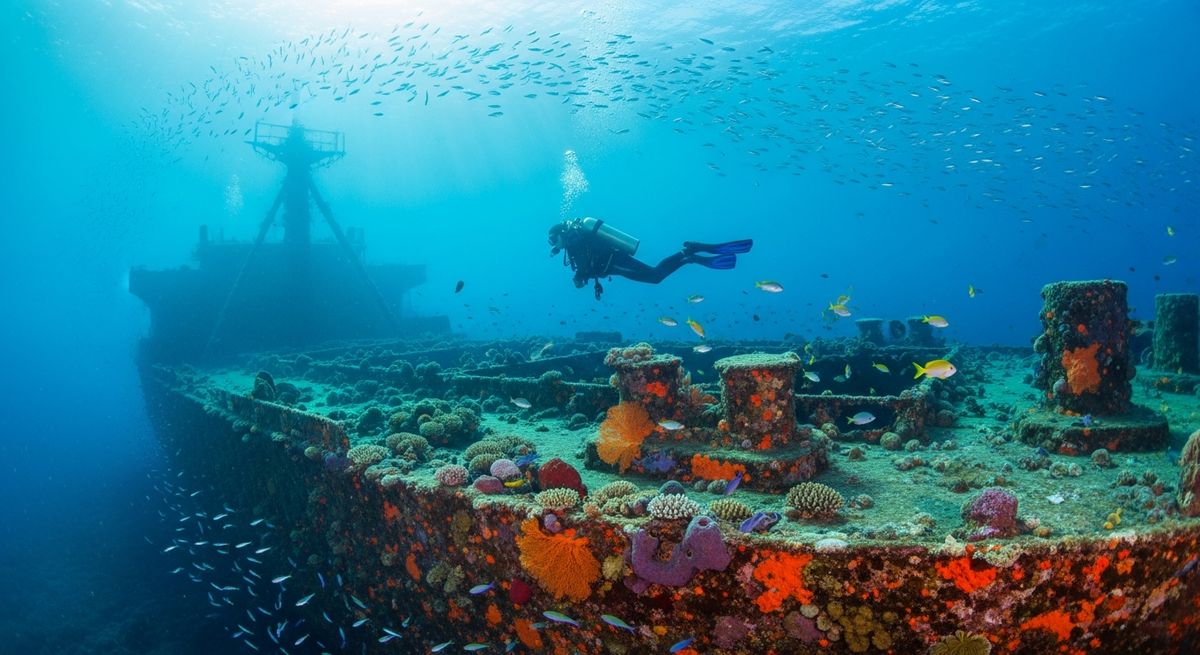
When we talk about the Graf Spee, we’re not talking about a pristine, intact warship. This isn't one of those wrecks you swim into with ease. What’s left of the German pocket battleship, scuttled by its own crew after the Battle of the River Plate, lies in pieces just eight metres down off Mar del Plata. The sheer scale, even in its broken state, is what grabs you. Think enormous, twisted plates of steel, a massive gun turret – one of the 11-inch monsters – practically intact on the seabed, and sections of the superstructure scattered like giant’s building blocks. Our favourite time to dive it is when there's a good southerly swell running, which surprisingly clears the water a bit. Visibility here can be tricky, often settling around five to eight metres, sometimes less. But that low visibility just adds to the atmosphere, really. You’re navigating these vast, shadowy metal forms. We love how the local marine life has really taken over. Patches of anemones cling to the gun mounts, crabs scuttle between the buckling decks, and schools of silversides shimmer through the gloom. It’s a powerful experience, a tangible piece of history reclaimed by the sea. It's best suited for divers who appreciate the historical weight of a site and don't mind a bit of a low-vis adventure. You’ll be exploring a debris field more than an intact vessel, but the sheer size of the components makes it compelling.
Typical ADMIRAL GRAF SPEE Dive Profile
Illustrative profile based on site depth and type. Actual dive profiles vary - always follow your dive computer and training.
Safety Notes
Wreck site - avoid penetration without wreck diving certification. Watch for sharp metal and entanglement hazards.
Cold water this month (avg 14°C). Drysuit or thick wetsuit (7mm+) recommended.
ADMIRAL GRAF SPEE Wreck History
Year Sunk
1939
Vessel Type
warship
Cause
scuttled
Tonnage
16,020 long tons
The Admiral Graf Spee was one of the most famous German warships of the Second World War. A Deutschland-class "pocket battleship," she was designed to be faster than more powerful enemy ships and more powerful than faster ones. At the outbreak of war in 1939, she was tasked with raiding Allied merchant shipping in the South Atlantic, sinking nine ships before being hunted down by a British squadron consisting of the cruisers HMS Exeter, HMS Ajax, and HMNZS Achilles.
On December 13, 1939, the Graf Spee engaged the British hunters in the Battle of the River Plate. Though she inflicted heavy damage on the Exeter, the German ship also sustained critical hits. She retreated to the neutral port of Montevideo, Uruguay, for repairs. Trapped by international law, which limited her stay, and fooled by British intelligence into believing a massive naval force was waiting for her, Captain Hans Langsdorff made a fateful decision. Rather than risk his crew in a hopeless battle or allow his technologically advanced ship to be captured, he sailed the Graf Spee just outside the harbor on December 17, 1939, and scuttled her in the shallow estuary.
Today, the remains of the legendary pocket battleship lie in just 8 meters of water. The wreck is heavily broken up, a result of the powerful scuttling charges and decades of salvage operations. Key artifacts, such as its massive rangefinder and iconic bronze eagle from the stern, have been recovered and are now in museums. For divers, the site is a scattered field of historic naval armor and machinery. Visibility can be challenging in the silty waters of the River Plate estuary, but the sheer scale of the wreckage and its monumental place in WWII history make it a compelling and unforgettable dive.
Nearest Dive Centres to ADMIRAL GRAF SPEE
Dive shops near ADMIRAL GRAF SPEE
View all dive centres in Mar del PlataReviews for ADMIRAL GRAF SPEE
Conditions
Ocean conditions, forecast and tides for ADMIRAL GRAF SPEE
ADMIRAL GRAF SPEE Ocean Conditions
Monthly averages for ADMIRAL GRAF SPEE, sourced from Open-Meteo marine data + Copernicus Marine (EU) - nearest station: Open-Meteo marine grid (-38.05, -57.5) (0km away)
October Averages
Sea Temperature
14°C
56°F · Range: 11.1–16.9°C
Current Speed
2.83 cm/s
Direction: SE (135°)
Salinity
0 PSU
Based on 4 years of monitoring data · Data sources: Open-Meteo marine data + Copernicus Marine (EU)
Plan & book
Ways to dive Mar del Plata, from day trips to liveaboards.
Day trips & courses
via GetYourGuideGuided dives, courses and snorkel trips with instant booking.
Find dive trips in Mar del PlataPlaces to stay
via Booking.comHotels and dive resorts near Mar del Plata.
Search stays in Mar del PlataDive insurance
Most travel insurance excludes or limits scuba. Check what you need before you go.
Dive insurance explainedPartner links: we may earn a commission if you book, at no extra cost to you. How we make money
Where to Stay near ADMIRAL GRAF SPEE
Prices from Booking.com. We may earn a commission at no extra cost to you.