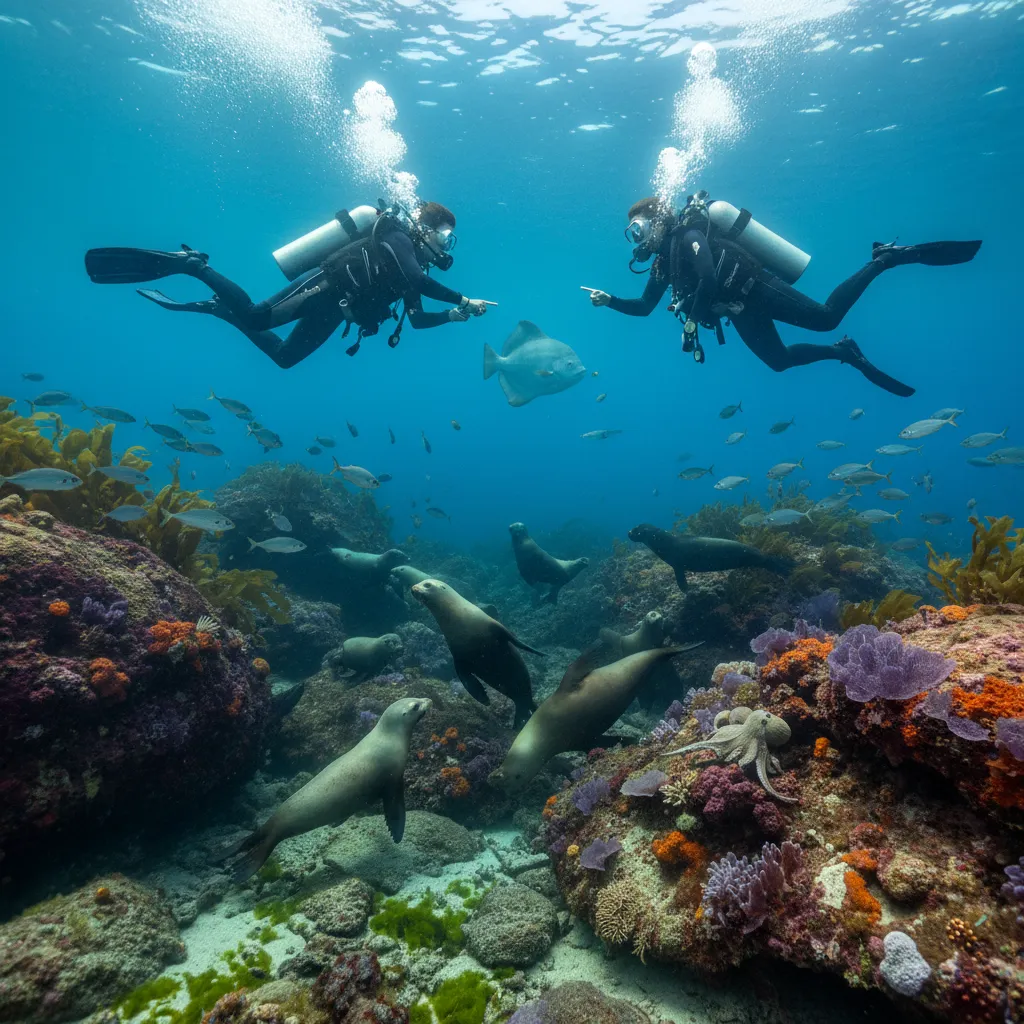
Diving in Lima & Palomino Islands
Why dive here
Lima & Palomino Islands offers some of Peru's richest diving, with 40+ marine species recorded in the area - including blue whales, hammerhead sharks, humpback whales, sea turtles and sperm whales. Water sits around 23°C.
Diving near Lima? Yeah, you heard right. It's not your typical tropical getaway, and that’s precisely why we love it. The Palomino Islands are a short boat ride from Callao, and the main draw is undeniably the colossal sea lion colony. Imagine descending into the cool Humboldt Current waters, the visibility often a decent 10-15 metres, and then encountering hundreds, sometimes thousands, of playful sea lions. They’re curious, they nip at your fins, and they zoom past with surprising speed. This isn’t about colourful corals; it's about the sheer energy of these animals and the unique kelp forests they inhabit. We've seen Atlantic yellow-nosed albatross circling above, diving for anchovies, while below, schools of bumper and jack swirl through the kelp. Keep an eye out for jewel morays tucked into rocky crevices. The currents can be moderate, nothing too wild, but enough to make it feel like an ocean dive. We’d suggest going in the morning; the sea lions seem more active, and the light penetration through the kelp is something else. It's a raw, exciting experience, far from the polished reefs, and our pick for something truly different in South America.
Lima & Palomino Islands Dive Site Map
Dive sites and dive centres in Lima & Palomino Islands
Lima & Palomino Islands Dive Sites
29 dive sites in Lima & Palomino Islands
AMORUSO SECONDO
The Amoruso Secondo isn't deep, but don't let that fool you. This 43-meter fishing trawler, run aground and burned in 1969, sits in just 5 meters of water. It’s perfect for a long, relaxed exploration, especially for those who enjoy poking around rusty metal without worrying about narcosis. We love how the shallow depth means fantastic natural light, making the colours of the encrusting life really pop. The wreck itself is well broken up, but you can still make out the bow and stern sections, with ribs and plating scattered across the sandy bottom. Expect to see plenty of comber fish darting through the wreckage, and if you look closely, you'll spot several kinds of crabs scuttling amongst the growth. The main draw for us, though, is the sheer number of sea lions that often hang around the area. They're curious, playful, and completely unbothered by divers, often zipping past close enough to hear them bark. Our favourite time to dive it is mid-morning, just after the first tourist boats have cleared out, leaving us with the wreck and its resident pinnipeds in relative peace. It's a proper adventure for divers who appreciate history and wildlife in equal measure.
Baja Huaman
Baja Huaman, off Pucusana, is a proper kick. We love a site that makes you work for it, and this one certainly does. The boat ride out, especially if the Pacific is feeling feisty, gets the adrenaline going. The current description says "quick entry and descent", and they aren't kidding. This is one for advanced divers who appreciate a bit of surge and aren’t afraid to get straight down. Once you’re settled, usually between 10 to 22 metres, it’s a whole different world from the surface chop. The visibility averages around 5 metres, so you’re always diving in that slightly green, plankton-rich water, which just adds to the atmosphere. We're not talking Caribbean colours here, but what you lose in distance, you gain in the density of life right in front of your mask. The rocky sections are draped in various algae, like shaggy underwater carpets, and they’re absolute magnets for the smaller stuff. We’ve spent ages just watching the Pacific speckled crabs scuttling over the rocks, their colours muted but still fascinating in that light. Keep an eye out for Pacific cornetfish, too, just hanging in the water column, almost invisible until you’re right on them. Our favourite moment has to be finning slowly along the rock formation that divides the sand from the rock, just watching the bumper fish schools dart in and out of the shadows. It’s raw, it’s real, and it feels genuinely wild.
Baja Huaman
Baja Huaman, off Pucusana, is a proper kick. We love a site that makes you work for it, and this one certainly does. The boat ride out, especially if the Pacific is feeling feisty, gets the adrenaline going. The current description says "quick entry and descent", and they aren't kidding. This is one for advanced divers who appreciate a bit of surge and aren’t afraid to get straight down. Once you’re settled, usually between 10 to 22 metres, it’s a whole different world from the surface chop. The visibility averages around 5 metres, so you’re always diving in that slightly green, plankton-rich water, which just adds to the atmosphere. We're not talking Caribbean colours here, but what you lose in distance, you gain in the density of life right in front of your mask. The rocky sections are draped in various algae, like shaggy underwater carpets, and they’re absolute magnets for the smaller stuff. We’ve spent ages just watching the Pacific speckled crabs scuttling over the rocks, their colours muted but still fascinating in that light. Keep an eye out for Pacific cornetfish, too, just hanging in the water column, almost invisible until you’re right on them. Our favourite moment has to be finning slowly along the rock formation that divides the sand from the rock, just watching the bumper fish schools dart in and out of the shadows. It’s raw, it’s real, and it feels genuinely wild.
Baja Loca
Baja Loca is where things get really interesting around the Palomino Islands, a site we'd suggest for divers with a bit more experience under their belts. You're dropping down onto a rocky reef that transitions into sand, hitting depths around 22 metres, often with a decent surge kicking things around. We've seen Pacific speckled crabs here, almost perfectly camouflaged against the rocks, and it's a good spot to catch Pacific cornetfish hovering motionless. Our favourite part has to be the sheer numbers of anchovies, moving in shimmering, pulsing clouds that occasionally get chased by bigger fish – a real sensory overload. It's a proper dive, not a gentle drift, so be prepared for some work. This spot truly comes alive when the currents are running, bringing in those schools of bumper and even the occasional barred pipefish tucked away in the crevices.
Baja Loca
Baja Loca is where things get really interesting around the Palomino Islands, a site we'd suggest for divers with a bit more experience under their belts. You're dropping down onto a rocky reef that transitions into sand, hitting depths around 22 metres, often with a decent surge kicking things around. We've seen Pacific speckled crabs here, almost perfectly camouflaged against the rocks, and it's a good spot to catch Pacific cornetfish hovering motionless. Our favourite part has to be the sheer numbers of anchovies, moving in shimmering, pulsing clouds that occasionally get chased by bigger fish – a real sensory overload. It's a proper dive, not a gentle drift, so be prepared for some work. This spot truly comes alive when the currents are running, bringing in those schools of bumper and even the occasional barred pipefish tucked away in the crevices.
Carbón
Carbón is one of those surprisingly tranquil spots, a pleasant escape from the city bustle. We're not talking vibrant coral here, but rather a sandy expanse that, for the observant diver, delivers a quiet charm. Our pick for a relaxed afternoon dive, especially for those new to temperate waters or photographers who like to slow down. Don't come expecting wall-to-wall fish; Carbón is more about the details. We've spent easy dives here, finning slowly over the rippled sand, spotting barred pipefish blending perfectly with the bottom. Keep your eyes peeled for the Pacific speckled crabs scuttling past, and we've often seen small schools of anchovy shimmering overhead, creating a silver ceiling. The max depth of 13m and general lack of current make it an ideal site for stretching out your bottom time, giving you ample opportunity to really hunt for those smaller critters. Visibility averages a modest 4m, so it’s not a site for grand vistas, but it’s perfect for focusing on macro life and enjoying the calm.
Cerro Partido
Cerro Partido, just a short boat ride from La Tiza, often gets overlooked in favor of the sea lions. We think that’s a mistake. This site is classic Peruvian kelp forest diving, and it’s genuinely different. Drop down and you’re immediately enveloped by the towering kelp fronds, a golden-brown cathedral swaying gently with the surge. Light filters through the canopy in dancing shafts, creating a moody, ethereal atmosphere. Visibility averages around 5 meters, which isn't huge, but it's perfect for this kind of intimate exploration. It forces you to slow down and really look. We always find ourselves peering into the shadows, spotting Pacific speckled crabs scuttling over the rocky bottom and barred pipefish doing their best impersonation of a kelp strand. Keep an eye out for patrolling Pacific cornetfish, too, sleek hunters blending into the background. The real thrill here is the sheer density of schooling fish, particularly the anchovy. Sometimes, the shoals are so thick they block out the sun, a shimmering, living curtain that pulses around you. It’s a truly immersive experience, and at a max depth of 16m, it’s a calm, accessible dive for pretty much any comfort level. We'd suggest going in the morning; the light can be magical as it pierces the kelp.
CHILE
The Chile wreck lies at a shallow 7 metres, making it an accessible dive for many. It's the remains of a steamship, broken up over time but still retaining enough structure to make for an interesting exploration. We usually find it fairly silty inside, so buoyancy control is key if you want to poke around without kicking up a cloud. Expect to see plenty of crabs scuttling over the plates and a good number of silversides darting through the openings. It’s a solid pick for a second dive, especially if the viz isn't stellar elsewhere, offering a different kind of underwater landscape.
CHIMBOTE (POSSIBLY)
Chimbote, off the Palomino Islands, is an intriguing dive, particularly because it’s a landing craft. Most wrecks around here are fishing vessels, so this one offers something a bit different. She sits upright in about 10 metres of water, her hull still largely intact. We love how accessible it is; even newer divers can explore the deck and the surprisingly open cargo hold without feeling overwhelmed. Inside, you’ll find a bustling ecosystem of crabs scuttling across the bulkheads and the occasional octopus peeking from a dark corner. Schools of hake often swirl above the superstructure, creating a beautiful, silvery canopy. Our favourite is exploring the bow ramp, which lies slightly open, offering a dramatic entry point into the hold itself. Visibility can be a bit variable, but on a good day, the natural light filtering through the open deck sections is quite something. We’d suggest going in the late morning when the sun is high for the best light penetration. It’s a super relaxed dive, perfect for a long bottom time just soaking it all in.
DONA AMELIA
Diving the *Dona Amelia* is a real treat off Lima, especially if you’re into local history. This old fishing trawler, built in '69, went down in a thick fog back in '89, coming back to Chancay with its catch. You can still imagine the chaos, even thirty-odd years later. We love how much of the wreck is still intact at 15m; the hull is a solid structure, not just scattered debris. It’s an easy dive, mostly because it’s shallow. We’ve found the best light in the mornings, cutting through the typical Lima haze and really bringing out the rust colours. Inside the wheelhouse, you'll see a thick carpet of anemones and some decent-sized crabs scuttling about. Look for schools of Peruvian silversides flashing through the superstructure. Our favourite part? The stern, where the propeller is still mostly there, acting like a little apartment block for blennies and small scorpionfish. It’s a site that tells a story, perfect for wreck enthusiasts who appreciate the atmosphere over big pelagics.
El Chuncho
El Chuncho, just a short boat ride from Pucusana, is where many Lima divers cut their teeth, and we can see why it’s so popular. It’s a shallow, protected bay, rarely deeper than 13m, making it ideal for those new to kelp forests. Despite the average 4m visibility, which means you’re often diving in a green glow, it truly is an incredible place. We love the feeling of drifting through the thick kelp fronds, almost like an underwater jungle. Sunlight filters down in shafts, and you’re constantly peering around stalks to spot what’s hiding. We’ve seen Pacific speckled crabs scuttling across the holdfasts and long, elegant Pacific cornetfish hanging motionless in the water column. Bumper fish school here too, their silver flashes catching the dim light. Look closely for barred pipefish, they’re masters of camouflage amongst the blades. It’s not about grand vistas here; it’s about the intimacy of the kelp and the hunt for the smaller, fascinating creatures that call it home. We’d suggest going slow, really taking your time to explore the nooks and crannies of the kelp.
El Dado
El Dado is a punchy dive, perfect for those who like a bit of a challenge and a lot of peculiar marine life. We’re talking about a site that demands respect from the moment you hit the water, with the Pacific swell often making for an exhilarating entry. You drop quickly onto a rocky wall that slopes down to a sandy bottom around 22 meters, a landscape covered in interesting algae – not the typical colourful corals, but a unique, almost alien ecosystem. This isn’t a leisurely cruise; it's a dive for those who appreciate the subtle beauty of a less-explored coastline. We love spotting the Pacific speckled crabs scuttling across the rocks, their colours blending perfectly with the encrusting life. Look closely in the crevices and you might find a barred pipefish, almost invisible against the backdrop. The schooling bumper fish here are particularly impressive, often forming shimmering walls that break and reform as you approach. We’d suggest going on a calm day if you can, though even then, expect a bit of a ride. Visibility usually sits around 18 meters, good enough to take in the unique textures of the wall and the surprisingly diverse, albeit subtle, cast of characters that call El Dado home. It's a dive that rewards keen eyes and a willingness to explore beyond the usual tropical reef.
Show all 29 dive sites in Lima & Palomino Islands
Lima & Palomino Islands Dive Centres
7 dive shops and operators in Lima & Palomino Islands
Ocean Wildlife in Lima & Palomino Islands
40 species recorded in Lima & Palomino Islands
Lima & Palomino Islands Daylight & Sunrise/Sunset
Sunrise and sunset times for Lima & Palomino Islands, calculated from coordinates
Today - Sunday 11 October
Sunrise
05:46
Sunset
18:05
Daylight
12h 18m
Golden Hour
17:37
First light (dawn) at 05:25 · Last light (dusk) at 18:26
Monthly Averages
| Month | Sunrise | Sunset | Daylight |
|---|---|---|---|
| Jan | 05:55 | 18:41 | 12h 46m |
| Feb | 06:08 | 18:38 | 12h 30m |
| Mar | 06:13 | 18:24 | 12h 11m |
| Apr | 06:14 | 18:04 | 11h 50m |
| May | 06:18 | 17:52 | 11h 34m |
| JunShortest | 06:27 | 17:52 | 11h 25m |
| Jul | 06:30 | 17:58 | 11h 28m |
| Aug | 06:23 | 18:04 | 11h 42m |
| Sep | 06:04 | 18:05 | 12h 1m |
| OctNow | 05:44 | 18:05 | 12h 21m |
| Nov | 05:33 | 18:13 | 12h 40m |
| DecLongest | 05:39 | 18:29 | 12h 50m |
Times are approximate local times based on longitude. Actual times may vary slightly depending on the exact timezone observed in Lima & Palomino Islands.
Where to Stay near Lima & Palomino Islands
Prices from Booking.com. We may earn a commission at no extra cost to you.
Marine Protected Areas near Lima & Palomino Islands
2 protected areas near Lima & Palomino Islands - please respect local regulations when diving
Sistema de Islas, Islotes y Puntas Guaneras
Ancón
Getting to Lima & Palomino Islands
Lima
Pisco
Pucallpa
Plan & book
Ways to dive Lima & Palomino Islands, from day trips to liveaboards.
Day trips & courses
via GetYourGuideGuided dives, courses and snorkel trips with instant booking.
Find dive trips in Lima & Palomino IslandsPlaces to stay
via Booking.comHotels and dive resorts near Lima & Palomino Islands.
Search stays in Lima & Palomino IslandsDive insurance
Most travel insurance excludes or limits scuba. Check what you need before you go.
Dive insurance explainedPartner links: we may earn a commission if you book, at no extra cost to you. How we make money