Warahnus
Protected Area
TAMAN WISATA PERAIRAN KEPULAUAN RAJA AMPAT
Why dive here
With 236+ marine species recorded in the area - including blacktip reef sharks, manta rays, mobula rays (devil rays), pygmy seahorses and sea turtles - Warahnus offers some of Raja Ampat's richest wreck diving. Water ranges 29-30°C, warmest May, November, December.
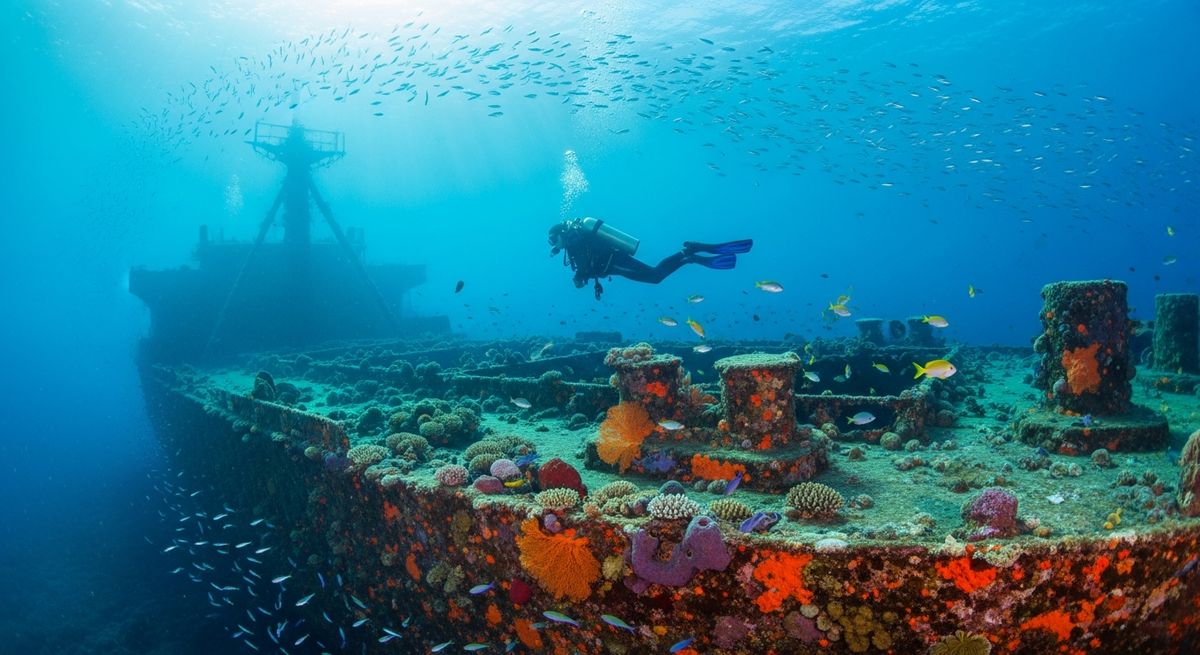
Warahnus, right off the homestay jetty, isn’t about big pelagics for us. It’s a macro dream. We love dropping onto those sloping soft coral gardens, really taking our time. You’ll find yourself just hovering, picking out critters like the tiny Eyebar Spinygoby, or a perfectly camouflaged Seastar Shrimp on its host. We’ve even spent entire dives just watching the antics of Flame Cardinalfish darting through the coral branches. The reef here is gorgeous, big coral structures, and it’s shallow enough that the light just drenches everything. Groups of fusiliers often hang around the 12-meter mark, a silver cloud against the blue. Visibility usually sits around 18m, making it easy to spot those subtle details. It’s a site for photographers, for those who love a slow dive, for anyone who enjoys really looking. Forget racing around, this is a slow-motion exploration.
Safety Notes
Wreck site - avoid penetration without wreck diving certification. Watch for sharp metal and entanglement hazards.
Strong currents typical this month (avg 35 cm/s). Good buoyancy control essential.
Warahnus Wreck History
Year Sunk
1916
Vessel Type
cargo ship
Cause
grounding
The SS Alondra was a steamship built in 1899, operated by the Yeoward Brothers' shipping line out of Liverpool. For years she plied the trade routes, a workhorse of the British merchant fleet. Her career came to a tragic and abrupt end during the height of World War I, not from enemy action, but from the raw power of the sea itself.
On December 29, 1916, while battling the fierce winter seas of the North Atlantic, the Alondra was driven aground on the treacherous Kedge Rock, near Baltimore in County Cork. The ship was battered by the waves and broke apart, leading to the loss of seventeen crew members in the icy water. In a testament to the bravery of the local community and surviving crew, twenty-three men were rescued from the disaster.
Lying in just 15 meters of water, the remains of the Alondra are now a fascinating and accessible dive site. The shallow depth and the violence of its sinking mean the wreck is extensively broken up, scattered across the seabed. Divers can easily identify the ship's massive boilers and the triple-expansion engine, which stand proud of the wreckage. Exploring the scattered plates and machinery offers a poignant reminder of the 1916 tragedy and provides a superb habitat for the vibrant marine life of Ireland's south coast.
Nearest Dive Centres to Warahnus
Dive shops near Warahnus
Mangkur Kodong
Lumba Lumba
Delvin
Koranu Fyak Homestay
Wobegong Dive Center
Yenkoranu Homestay
Reviews for Warahnus
Conditions
Ocean conditions, forecast and tides for Warahnus
Warahnus Ocean Conditions
Monthly averages for Warahnus, sourced from Open-Meteo marine data + Copernicus Marine (EU) - nearest station: Open-Meteo marine grid (-0.5, 130.6) (0km away)
October Averages
Sea Temperature
30°C
86°F · Range: 29.2–30.9°C
Current Speed
34.71 cm/s
Direction: NW (311.5°)
Chlorophyll-a
0.138 mg/m³
Clear water
Salinity
34.33 PSU
Based on 4 years of monitoring data · Data sources: Open-Meteo marine data + Copernicus Marine (EU)
Plan & book
Ways to dive Raja Ampat, from day trips to liveaboards.
Day trips & courses
via GetYourGuideGuided dives, courses and snorkel trips with instant booking.
Find dive trips in Raja AmpatPlaces to stay
via Booking.comHotels and dive resorts near Raja Ampat.
Search stays in Raja AmpatDive insurance
Most travel insurance excludes or limits scuba. Check what you need before you go.
Dive insurance explainedPartner links: we may earn a commission if you book, at no extra cost to you. How we make money
Where to Stay near Warahnus
Prices from Booking.com. We may earn a commission at no extra cost to you.