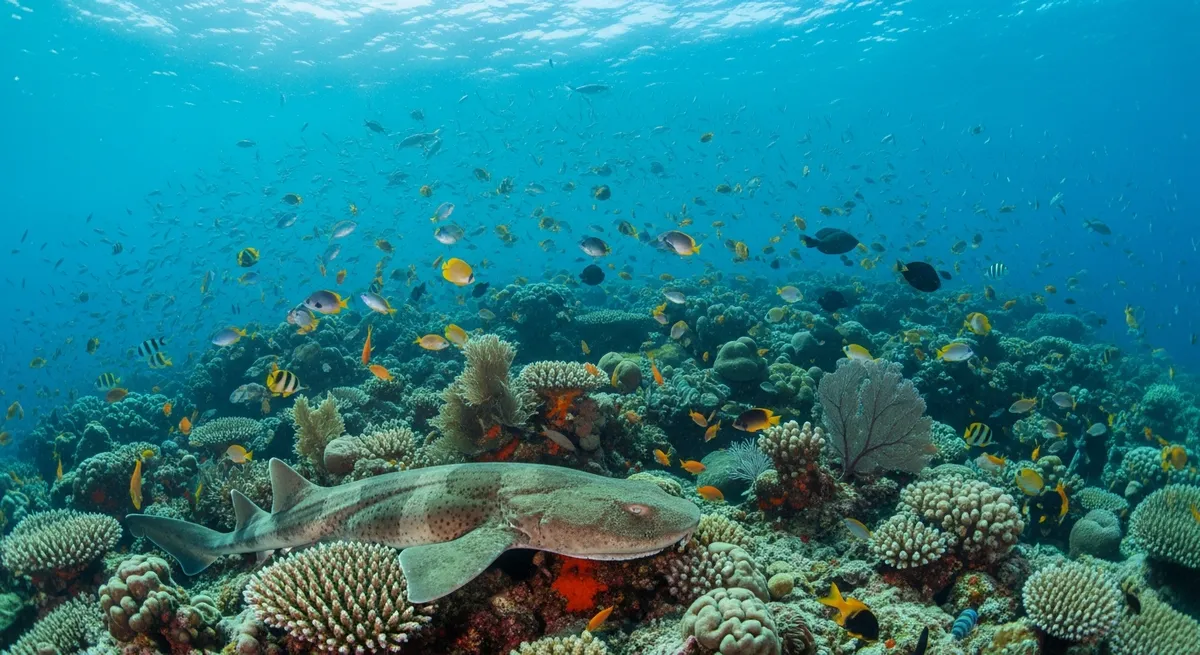
Diving in Raja Ampat
Why dive here
Raja Ampat offers some of Indonesia's richest diving, with 236+ marine species recorded in the area - including blacktip reef sharks, manta rays, mobula rays (devil rays), pygmy seahorses and sea turtles. Water ranges 29-30°C, warmest May, November, December.
Raja Ampat is an opinion-splitter, but we think it’s absolutely worth the journey. We’ve been a few times now, and each trip peels back another layer. Forget the sheer number of species; what’s really special is the *density* of it all. You’ll be finning along a reef, maybe at Melissa's Garden, and the fusiliers are so thick you practically have to push through them. Then, out of the blue, a Napoleon wrasse cruises by, completely unfazed. We’re big fans of the northern islands, particularly around Kawe and Wayag, where the pinnacles are just bursting with life. Currents can be properly feisty here, no doubt about it, but that’s what brings in the action. Think blacktip reef sharks circling out in the blue, or schools of barracuda forming a shimmering wall. Our favourite spot for mantas has to be Manta Ridge; we’ve seen them stacked up at the cleaning station, sometimes seven or eight at a time, just hovering there. For macro, a good guide will find you pipefish and pygmy seahorses tucked into every nook. It’s a place that demands respect for the ocean, but the rewards are immense. Go in the shoulder seasons, April or October, to avoid the slightly busier peak.
Raja Ampat Dive Site Map
Dive sites and dive centres in Raja Ampat
Raja Ampat Dive Sites
177 dive sites in Raja Ampat
Aerborek Jetty
Aeroborek Jetty is exactly what it sounds like, a jetty, and a pretty good one for a dive. You'll find it off Aeroborek Island, a small village that buzzes with local life. Below the wooden pilings, the light plays in interesting ways, especially in the late morning. We’ve seen juvenile fusiliers here, thick schools that dart in and out of the shadows. Keep an eye out for Denise's pygmy seahorse if you’ve got a sharp spotter, they’re tricky to find. This site is a relaxed dive, good for a second or third dip of the day, with a chance to spot something unusual in the shallows.
Aerborek Jetty Dive Site
The Aerborek Jetty is a solid option if you’re looking for a relaxed dive in Raja Ampat. It’s a pretty easy site, starting shallow at 5m and dropping to around 20m. We’ve seen a good mix of stuff here, from Denise’s pygmy seahorses tucked into gorgonians to reef mantas gliding past. Look closely at the jetty pylons themselves – they're often covered in fluted clams and you might even spot an olive ridley turtle cruising through the seagrass beds nearby. It’s a nice, calm dive, great for photographers or if you just want to take it easy.
Agusta Reef
Agusta Reef sits pretty shallow, peaking around 10-12m, but don’t let that fool you. This spot usually serves up a stiff current, so we'd suggest bringing a reef hook and being comfortable with some energetic drifting. When that water's moving, the place really lights up. You’ll often find schools of redtooth triggerfish dancing in the flow, and both blacktip and whitetip reef sharks patrol the edges. We’ve even spotted a few Pygmy seahorses tucked away when the current eases enough to search. Keep an eye out for Jumping Blennies too, they’re always a fun find here.
Agusta Reef
Agusta Reef sits pretty shallow, peaking around 10-12m, but don’t let that fool you. This spot usually serves up a stiff current, so we'd suggest bringing a reef hook and being comfortable with some energetic drifting. When that water's moving, the place really lights up. You’ll often find schools of redtooth triggerfish dancing in the flow, and both blacktip and whitetip reef sharks patrol the edges. We’ve even spotted a few Pygmy seahorses tucked away when the current eases enough to search. Keep an eye out for Jumping Blennies too, they’re always a fun find here.
Algae Patch 1
Algae Patch 1 is one of those muck sites we often hit when transiting between Sorong and Raja Ampat proper. Don't let the name fool you, there’s plenty more than just algae here. Maximum depth hits 22m, with average visibility around 18m, which is decent for a sandy bottom. You’re really here for the small stuff. We’ve found everything from Opossum Pipefish to the Crazy Fish, hunkering down near the scattered coral blocks and patches of staghorn. It's an excellent spot for photographers keen on macro subjects, especially if you enjoy a slower, more deliberate dive. Just make sure your guide knows the tide chart, as currents in the channel can pick up surprisingly quickly.
Algae Patch 1
Algae Patch 1 is one of those muck sites we often hit when transiting between Sorong and Raja Ampat proper. Don't let the name fool you, there’s plenty more than just algae here. Maximum depth hits 22m, with average visibility around 18m, which is decent for a sandy bottom. You’re really here for the small stuff. We’ve found everything from Opossum Pipefish to the Crazy Fish, hunkering down near the scattered coral blocks and patches of staghorn. It's an excellent spot for photographers keen on macro subjects, especially if you enjoy a slower, more deliberate dive. Just make sure your guide knows the tide chart, as currents in the channel can pick up surprisingly quickly.
Alyui Bay
Alyui Bay, tucked into the western side of Waigeo, is where we head when the mission is small stuff. Forget the big pelagics here; this is critter territory. We’ve spent hours finning slowly along its walls and slopes, spotting pygmy seahorses clinging to gorgonians and ghost pipefish swaying in the current. It’s a macro photographer's dream, a place where patience really pays off. The max depth usually hovers around 25 metres, making it approachable for most divers, though keeping an eye on your buoyancy is key when you’re hovering over delicate subjects. Currents can pick up, especially near the mouth, so it’s not always a completely placid drift.
Andrea's Point
Andrea’s Point gives you a good slice of Raja Ampat’s smaller residents, especially if you’re into the macro stuff. We’ve had good luck here finding Denise’s pygmy seahorses tucked into gorgonians, and it’s a reliable spot for various gobies like the Scaly-nape Tentacle Goby. Look closely at the anemones, as you’ll often find clown anemonefish tending their homes. It’s not the thumping action of some other sites, but we’d suggest it for divers who enjoy a slower pace, hovering to really observe. Good for photographers with a keen eye for the tiny things.
Anita's Garden
Anita's Garden often gets overlooked, tucked away as it is, but it’s a lovely spot for a relaxed drift. We’ve found it best to drop in when the current is mild, letting it carry you gently over the sloping reef. Keep an eye out for the small stuff here. We regularly see Denise's pygmy seahorse clinging to gorgonians and a dozen different pygmy gobies flitting around, like the pudgy and palebarred varieties. It's a calmer dive, perfect for photographers or anyone wanting to slow down and really appreciate the smaller residents of Raja Ampat.
Arborek shark point
Arborek Shark Point often gets overshadowed by its flashier Raja Ampat neighbors, but we think it’s a solid dive, especially for those who appreciate a relaxed pace. We typically find the site to be a gentle slope, starting shallow and gradually dropping, making it great for longer bottom times. Keep your eyes peeled for those Bristle-tailed Leatherjackets; they’re often hanging around the reef edges. While the name suggests sharks, and we’ve certainly seen blacktips cruising, it’s also a good spot for spotting Reef Manta Rays if you hit it right. It’s a pleasant afternoon dive, not too challenging, and good for a second dive of the day.
Arefi Reef
We often hit Arefi Reef as the second stop on a Batanta trip, a good hour from our base. It's a shallow spot, topping out around 21 metres, and tends to be a relaxed drift. Visibility averages around 17 metres here, so things are clear enough to spot the resident Freycinet’s epaulette sharks tucked under ledges. You'll likely see a few ghost cardinalfish darting about too, along with halfmoon triggerfish cruising past. It’s a solid, easy dive, perfect for warming up or winding down after the P-47 wreck.
Arefi Reef
We often hit Arefi Reef as the second stop on a Batanta trip, a good hour from our base. It's a shallow spot, topping out around 21 metres, and tends to be a relaxed drift. Visibility averages around 17 metres here, so things are clear enough to spot the resident Freycinet’s epaulette sharks tucked under ledges. You'll likely see a few ghost cardinalfish darting about too, along with halfmoon triggerfish cruising past. It’s a solid, easy dive, perfect for warming up or winding down after the P-47 wreck.
Show all 177 dive sites in Raja Ampat
- Arno’s Underwater Reef
- Bag Island
- Barracuda East
- Barracuda West
- Batu Laut
- Batu Lima
- Batu Rufas Dive Site
- Batu Rufus
- Biodiversity House Reef
- Biodiversity House Reef
- Blue Magic
- Blue Magic
- Boo Island
- BUDI
- Candy Store
- Cape Kri
- Cape Mansuar
- Cave Lagoon
- CHAHAYA HIKMA
- Chicken Reef
- Chicken Reef
- Citrus Ridge
- Citrus Ridge Dive Site
- Cross Over
- Dayang
- Deep Rock
- Dilaut
- Eagle Nest
- Erens New
- Fabiacet
- Fam Slope
- Fam Slope
- Fam Wall
- Fam Wall
- Farondi
- Felici garden
- Francisco
- Francisco Reef
- Friwen Bonda
- Friwen garden
- Friwen Garden
- Friwen Laut
- Friwen Wall
- FRIWEN WALL
- Fuzzy Rock
- Gamfi Damu
- Gam Ridge
- GA's Flash
- Gladden Spit
- Gosong Nelayan
- Harto's Reef
- Ikan Party (My Reef)
- Imbekwan Bommies
- Imbekwan wall
- Irvin's Mantas
- Kabui
- Kabui Reef
- Kakatua reef
- Kalaeidoskop
- Kaleidoscope
- Kampung Baru Corner
- Kanim
- Karang Bais
- Karang Bata
- Karang Ulin
- Kawe Island
- Keruo Channel
- Keruo Night Dive
- Koh
- Koi island
- Kri Island
- Lalosi
- Lao lao
- Lao Lao
- Leo s Reef
- Living Colours
- Magic Mountain
- Magic Mountain
- Mambetron
- Mangrove
- Mangrove and Slope
- Mangrove Ridge
- Manta Point
- Manta Ridge
- Manta Ridge
- Manta Sandy
- Manta Sandy
- Manta Wai
- Mayhem
- Mayhem
- Mayhem Dive Site
- Melissa's Garden
- Menara Telkomsel
- Meti Meti
- Mike's Point
- Mioskun
- Misool House Reef
- MULIA JAYA
- Myoskon
- My Reef
- New Reef (Dom Te Te)
- Nudi Rock Raja Ampat
- Ot Di Ma
- Ot Di Ma
- Otdima Reef
- P-47 Plane Wreck
- Pasir Kolam
- Pasir Timbul
- Pulau Dua
- Pulau Dua Express
- Pulau Memyai
- Pulau Yum
- Puri Pinnacle
- Raja Ampat
- Ransiwor
- Ransiwor
- Ronnysa and Dwi
- Saonek Mondei
- Saporken Dive Site
- Sardine Reef
- Sardine Reef
- Sauwandarek
- Sauyador
- Sawandarek Jetty
- Sawandarek Jetty
- Scuba Republic House Reef
- Seamount
- Selat Kabui
- Shark Point Raja Ampat
- Soft corals in the passage
- Sorido Wall
- Soul Scuba Reef
- South Penemu
- Swallope
- Swarm
- Telma
- The Cathedral
- The Lagoon
- The Passage
- The Passage
- Turtle House Reef
- Underwater cave
- Urai
- Uri
- Wai FPW
- Waigeo
- Warahnus
- Wayag Archipelago
- Way Pretty Shallows
- West Mansuar
- West Mensuar
- West Penemu
- West Reef's End
- White Arrow
- Yanggelo
- Yeben Shallows
- Yellow Coco
- Yembuba Diving
- Yenbuba Jetty
- Yenkoranu Jetty
- Yenmnuk
- Yilliet
- Yulen s Bay
- Yulliet Besar
- Yulliet Kecil
Raja Ampat Dive Centres
28 dive shops and operators in Raja Ampat
Ambon Dive Explore
Andau Dive Resort
Coralia Liveaboards
Delvin
Dive Bluemotion
Dive into Raja Ampat
Gurara
Koranu Fyak Homestay
Show all 28 dive centres in Raja Ampat
- Lamima
- Lumba Lumba
- Mahu Lodge and Diving
- Maluku Divers
- Mangkur Kodong
- Mantastic Scuba Paradise
- Meridian Adventure Dive
- Misool Resort
- Naira Dive
- Papua Diving - Kri Eco Resort
- Papua Explorers Resort
- Raja Ampat Aggressor
- Raja Ampat Biodiversity Resort
- Raja Ampat dive resort
- Scuba republic
- Tarzan-Diving
- Wai Resort
- Wobegong Dive Center
- Yenkoranu Homestay
- Zanclus Dive Center
Ocean Wildlife in Raja Ampat
236 species recorded in Raja Ampat
Raja Ampat Daylight & Sunrise/Sunset
Sunrise and sunset times for Raja Ampat, calculated from coordinates
Today - Sunday 11 October
Sunrise
06:02
Sunset
18:09
Daylight
12h 7m
Golden Hour
17:41
First light (dawn) at 05:41 · Last light (dusk) at 18:30
Monthly Averages
| Month | Sunrise | Sunset | Daylight |
|---|---|---|---|
| Jan | 06:23 | 18:32 | 12h 10m |
| Feb | 06:29 | 18:37 | 12h 8m |
| Mar | 06:24 | 18:31 | 12h 7m |
| Apr | 06:16 | 18:21 | 12h 6m |
| May | 06:12 | 18:17 | 12h 5m |
| JunShortest | 06:17 | 18:21 | 12h 5m |
| Jul | 06:22 | 18:27 | 12h 5m |
| Aug | 06:21 | 18:26 | 12h 5m |
| Sep | 06:11 | 18:17 | 12h 6m |
| OctNow | 06:00 | 18:08 | 12h 8m |
| Nov | 05:59 | 18:08 | 12h 9m |
| DecLongest | 06:08 | 18:18 | 12h 10m |
Times are approximate local times based on longitude. Actual times may vary slightly depending on the exact timezone observed in Raja Ampat.
Where to Stay near Raja Ampat
Prices from Booking.com. We may earn a commission at no extra cost to you.
Marine Protected Areas near Raja Ampat
18 protected areas near Raja Ampat - please respect local regulations when diving
KK Kepulauan Raja Ampat
TAMAN WISATA PERAIRAN KEPULAUAN RAJA AMPAT
KK Seribu Satu Sungai Teoenobikia di Perairan Sorong Selatan
Misool Timur Selatan (Raja Ampat)
KK Misool Utara
Selat Dampier (Raja Ampat)
KK Kepulauan Waigeo Sebelah Barat
KKP-13 Makbon
Kepulauan Kofiau dan Boo (Raja Ampat)
Kawe / Kep. Wayag Sayang / Kep. Panjang
Teluk Lelintah
SUAKA ALAM PERAIRAN KEPULAUAN RAJA AMPAT DAN LAUT SEKITARNYA
Showing 12 largest of 18
Getting to Raja Ampat
Sorong
Ambon
Fakfak
Plan & book
Ways to dive Raja Ampat, from day trips to liveaboards.
Day trips & courses
via GetYourGuideGuided dives, courses and snorkel trips with instant booking.
Find dive trips in Raja AmpatPlaces to stay
via Booking.comHotels and dive resorts near Raja Ampat.
Search stays in Raja AmpatDive insurance
Most travel insurance excludes or limits scuba. Check what you need before you go.
Dive insurance explainedPartner links: we may earn a commission if you book, at no extra cost to you. How we make money