Royal Dalton
Why dive here
With 231+ marine species recorded in the area - including barracuda, blacktip reef sharks, blue sharks, grey reef sharks and manta rays - Royal Dalton offers some of Cocos (Keeling) Islands's richest reef diving. Water ranges 27-29°C, warmest January, February, March.
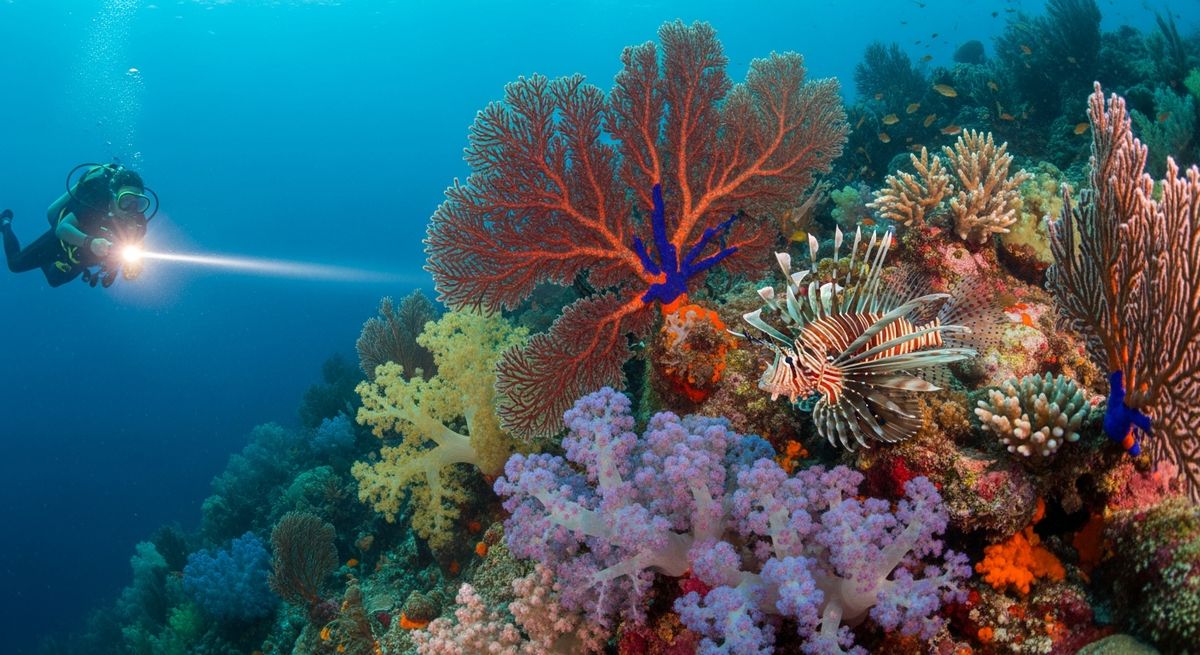
Royal Dalton feels like a living museum, if museums had a gentle current to push you along. We love dropping down the wall here, sinking to about 20 metres, and just gazing upwards into those enormous plate corals. Some are ancient, showing their age, while others are clearly new growth, a testament to the reef’s resilience. It’s a peaceful drift, the kind where you can really slow down and appreciate the details, like the delicate structures of lesser star coral or the way the light filters through the big plates. Visibility here is usually excellent, so you get a clear view of clown butterflyfish flitting between coral heads and big-eye trevallies cruising the deeper sections. If you hit it during the summer months, you might just find yourself surrounded by a swirling cloud of juvenile fusiliers, so thick they almost block out the sun – it’s quite a spectacle. Our favourite approach is to stay deep until you’re nudging your no-decompression limits, then slowly ascend and let the current carry you back towards the boat, a serene mid-water drift over the top of the reef. This site is perfect for those who appreciate the quiet beauty of a healthy reef and enjoy a relaxed drift dive.
Nearest Dive Centres to Royal Dalton
Dive shops near Royal Dalton
View all dive centres in Cocos (Keeling) IslandsReviews for Royal Dalton
Conditions
Ocean conditions, forecast and tides for Royal Dalton
Royal Dalton Ocean Conditions
Monthly averages for Royal Dalton, sourced from Open-Meteo marine data - nearest station: Open-Meteo marine grid (-12.09, 96.86) (1km away)
October Averages
Sea Temperature
27°C
81°F · Range: 25.6–27.8°C
Air Temperature
26°C
79°F
Wind Speed
9.53 m/s
18.5 knots
Atmospheric Pressure
1012.9 hPa
Based on 4 years of monitoring data · Data sources: Open-Meteo marine data
Plan & book
Ways to dive Cocos (Keeling) Islands, from day trips to liveaboards.
Day trips & courses
via GetYourGuideGuided dives, courses and snorkel trips with instant booking.
Find dive trips in Cocos (Keeling) IslandsPlaces to stay
via Booking.comHotels and dive resorts near Cocos (Keeling) Islands.
Search stays in Cocos (Keeling) IslandsDive insurance
Most travel insurance excludes or limits scuba. Check what you need before you go.
Dive insurance explainedPartner links: we may earn a commission if you book, at no extra cost to you. How we make money
Where to Stay near Royal Dalton
Prices from Booking.com. We may earn a commission at no extra cost to you.