Diving in Cocos (Keeling) Islands
Why dive here
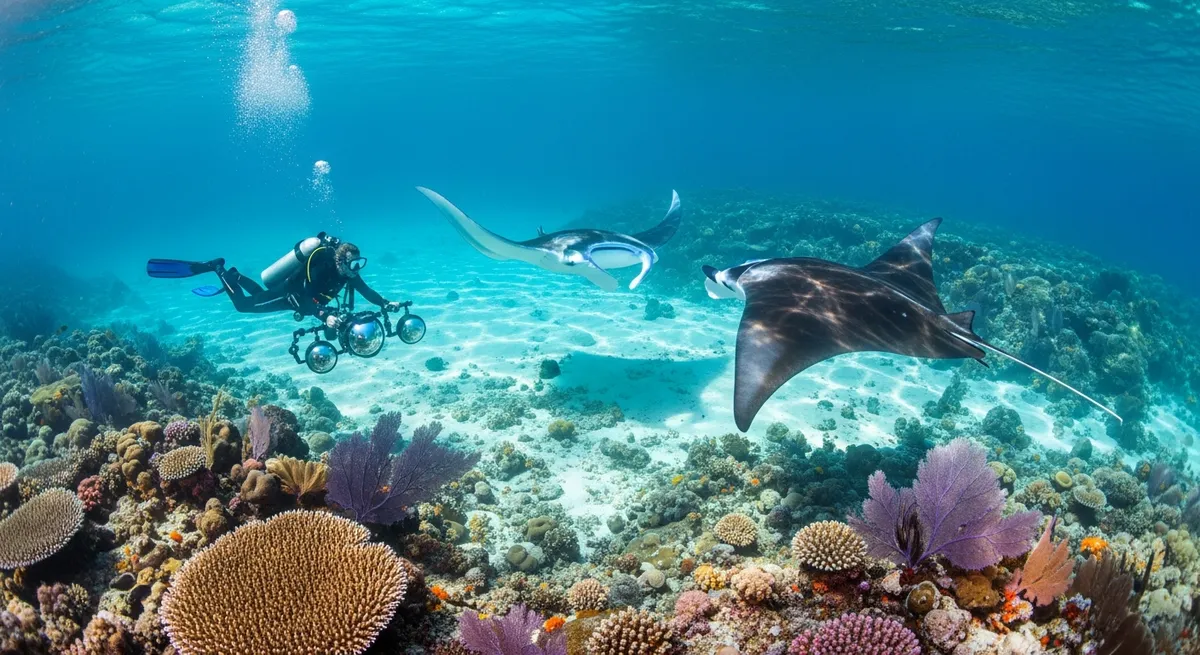
Cocos (Keeling) Islands offers some of Australia's richest diving, with 231+ marine species recorded in the area - including barracuda, blacktip reef sharks, blue sharks, grey reef sharks and manta rays. Water ranges 27-29°C, warmest January, February, March.
Cocos Keeling. You’ll say it with a sigh after you’ve been. This isn't your everyday Australian dive trip; it's a commitment, a journey into true Indian Ocean remoteness. With just one dive centre and 37 sites, you get a real sense of exclusivity. We love the drift dives here, a gentle push over reef walls where lineated butterflyfish and two-tone wrasse flit past in impressive numbers. Visibility holds strong, often pushing past 25 metres, giving you ample time to spot the more unusual residents like the black spotted garden eels swaying in unison from the sand flats. Our favourite moments often involve the manta rays gliding silently overhead or the playful dolphins that sometimes join your safety stop. The stony corals here, particularly the staghorn and leaf varieties, are remarkably healthy, painting the reef in subtle, earthy tones. It’s a place to slow down, to really observe. Be aware, strong currents can pick up, so listen to the local guides; they know the eddies and the best times to hit a site for a relaxed drift. It’s a real frontier feeling, without the crowds.
Cocos (Keeling) Islands Dive Site Map
Dive sites and dive centres in Cocos (Keeling) Islands
Cocos (Keeling) Islands Dive Sites
43 dive sites in Cocos (Keeling) Islands
Aquarium Wall
Aquarium Wall feels exactly like its name suggests: a massive fish tank you can swim inside. We love dropping in here, particularly on a morning dive when the light hits just right, illuminating the wall that drops down to our max depth of 21m. It’s a gentle drift, usually, allowing you to just float and watch the show. The big story here is the sheer density of small reef fish, especially around the rocky ledges and coral overhangs. You’ll spot Jansen's wrasse and Exquisite wrasse darting in and out of the staghorn and honeycomb coral. Our favourite is looking for the Freckled Anglerfish, which blends in perfectly if you’re not paying attention – take your time on this one. Parrotfish are everywhere, chomping away, and we often see schools of Big-eye Trevally cruising by the deeper sections. It’s a relaxed dive, perfect for photographers wanting to capture macro subjects and juveniles, or anyone who enjoys a slow, observational drift.
Aquarium Wall
Aquarium Wall feels exactly like its name suggests: a massive fish tank you can swim inside. We love dropping in here, particularly on a morning dive when the light hits just right, illuminating the wall that drops down to our max depth of 21m. It’s a gentle drift, usually, allowing you to just float and watch the show. The big story here is the sheer density of small reef fish, especially around the rocky ledges and coral overhangs. You’ll spot Jansen's wrasse and Exquisite wrasse darting in and out of the staghorn and honeycomb coral. Our favourite is looking for the Freckled Anglerfish, which blends in perfectly if you’re not paying attention – take your time on this one. Parrotfish are everywhere, chomping away, and we often see schools of Big-eye Trevally cruising by the deeper sections. It’s a relaxed dive, perfect for photographers wanting to capture macro subjects and juveniles, or anyone who enjoys a slow, observational drift.
Barry’s Pool
Barry’s Pool is a standout on the northwestern side of Horsburgh Island. We’d classify it as a wall dive, but that doesn't quite capture the experience. You drop over the edge, maybe 20 metres down, and the scale is immediate. Huge rose wall corals cling to the vertical face, and the sea fans are just enormous, swaying gently in the current. The real show, though, is the reef itself. We’ve spotted Leopard Blennies flitting about and plenty of Two-tone Wrasse darting through the Staghorn and Montipora. Keep an eye out into the blue for Blacktip Reef Sharks, especially if you’re doing this as an early morning dive. The sharks are usually there, patrolling just beyond the reef edge. It’s a site that rewards patience and a good eye for the smaller things, while still giving you that big animal thrill. Our favourite part is the shallow ocean pool at the end. After the deep wall, finning into that nine-meter-deep natural pool, with the light filtering down, it’s a lovely way to finish. It’s a site for those with a few dives under their belt, comfortable with a bit of depth and keen to really soak in the coral architecture and the passing pelagics.
Barry’s Pool
Barry’s Pool is a standout on the northwestern side of Horsburgh Island. We’d classify it as a wall dive, but that doesn't quite capture the experience. You drop over the edge, maybe 20 metres down, and the scale is immediate. Huge rose wall corals cling to the vertical face, and the sea fans are just enormous, swaying gently in the current. The real show, though, is the reef itself. We’ve spotted Leopard Blennies flitting about and plenty of Two-tone Wrasse darting through the Staghorn and Montipora. Keep an eye out into the blue for Blacktip Reef Sharks, especially if you’re doing this as an early morning dive. The sharks are usually there, patrolling just beyond the reef edge. It’s a site that rewards patience and a good eye for the smaller things, while still giving you that big animal thrill. Our favourite part is the shallow ocean pool at the end. After the deep wall, finning into that nine-meter-deep natural pool, with the light filtering down, it’s a lovely way to finish. It’s a site for those with a few dives under their belt, comfortable with a bit of depth and keen to really soak in the coral architecture and the passing pelagics.
Broccoli Patch
The Broccoli Patch often gets pigeonholed as a beginner site, and yes, it’s a lovely, gentle introduction to Cocos diving. But we think that does it a disservice. It’s a perfect chill-out dive, a place where you can really slow down and appreciate the details without fighting current or depth. Dropping down to that 5m sandy bottom, the light filtering through the shallow water is just gorgeous. You’ll weave through fields of coral, particularly some huge formations of common mushroom coral and those intricate papyrus and honeycomb corals, all gently swaying. We love spotting the little blackfin squirrelfish tucked into the crevices and the vibrant Cocos angelfish darting about. Keep an eye out for bridled gobies perched on the coral heads. It’s a site for lingering, for macro photography, and for just enjoying the sheer peace of the reef. We’ve had some cracking encounters with whitetip reef sharks here, just cruising past, completely unbothered. It’s ideal for less experienced divers building confidence, but also for anyone who appreciates a relaxed, visually rich exploration.
Broccoli Patch
The Broccoli Patch often gets pigeonholed as a beginner site, and yes, it’s a lovely, gentle introduction to Cocos diving. But we think that does it a disservice. It’s a perfect chill-out dive, a place where you can really slow down and appreciate the details without fighting current or depth. Dropping down to that 5m sandy bottom, the light filtering through the shallow water is just gorgeous. You’ll weave through fields of coral, particularly some huge formations of common mushroom coral and those intricate papyrus and honeycomb corals, all gently swaying. We love spotting the little blackfin squirrelfish tucked into the crevices and the vibrant Cocos angelfish darting about. Keep an eye out for bridled gobies perched on the coral heads. It’s a site for lingering, for macro photography, and for just enjoying the sheer peace of the reef. We’ve had some cracking encounters with whitetip reef sharks here, just cruising past, completely unbothered. It’s ideal for less experienced divers building confidence, but also for anyone who appreciates a relaxed, visually rich exploration.
Cabbage Patch Cocos Keeling
The Cabbage Patch is a site we always make time for when we're on Cocos. It’s exactly what it sounds like – a vast field of plate-like stony corals, mostly Pavona and cauliflower corals, spreading out from about 5 to 20 metres. We love how the light plays on those overlapping plates, creating these amazing shadows and sunbeams, particularly in the mid-morning. It’s recovering really well from some past storm damage, you can see the new growth pushing through. You’ll spend most of your time gliding over this coral garden, spotting things like the colourful Princess Parrotfish nibbling on the edges and little Blackspot pygmy wrasse darting between the crevices. Keep an eye out for the distinctive Snakehead Cowrie, often clinging to the underside of a coral plate. While the coral is the star, don't miss the nearby swim-through canyon, it’s a fun little detour. We’ve often found sleeping white tip reef sharks tucked away in the sand channels or cruising the deeper drop-off with Black Surgeonfish and the occasional Hexagon Grouper. Visibility here is usually excellent, around 20 metres, making it a great site for photographers and anyone who enjoys a relaxed, detailed exploration. It suits divers who appreciate intricate coral formations and the smaller, more subtle reef inhabitants.
Cabbage Patch Cocos Keeling
The Cabbage Patch is a site we always make time for when we're on Cocos. It’s exactly what it sounds like – a vast field of plate-like stony corals, mostly Pavona and cauliflower corals, spreading out from about 5 to 20 metres. We love how the light plays on those overlapping plates, creating these amazing shadows and sunbeams, particularly in the mid-morning. It’s recovering really well from some past storm damage, you can see the new growth pushing through. You’ll spend most of your time gliding over this coral garden, spotting things like the colourful Princess Parrotfish nibbling on the edges and little Blackspot pygmy wrasse darting between the crevices. Keep an eye out for the distinctive Snakehead Cowrie, often clinging to the underside of a coral plate. While the coral is the star, don't miss the nearby swim-through canyon, it’s a fun little detour. We’ve often found sleeping white tip reef sharks tucked away in the sand channels or cruising the deeper drop-off with Black Surgeonfish and the occasional Hexagon Grouper. Visibility here is usually excellent, around 20 metres, making it a great site for photographers and anyone who enjoys a relaxed, detailed exploration. It suits divers who appreciate intricate coral formations and the smaller, more subtle reef inhabitants.
Cable Bommie
Cable Bommie is one of our favourites in the Cocos, and it’s not just for the rusty bits. Yes, there are actual cables running from Direction Island, plus a couple of hefty winches that look like they’ve been slowly melting into the seafloor for a century. It's a surreal backdrop, like an underwater museum exhibit nobody curated. But the real magic happens around the bommie itself, a dense coral pinnacle pushing up from the sand. We love drifting along here, keeping an eye out for the Black-lined Blennies darting into their coral homes. Look closely, and you might spot a well-camouflaged Common Lionfish tucked under a ledge, fanning its venomous fins. The visibility here is often spectacular, sometimes pushing 30 metres, giving you a clear view of cruising Gray Reef Sharks patrolling the nearby ridge, especially when the current picks up. We’ve had some cracking encounters with mantas gliding through, too, though they tend to make their own schedule. It’s a gentle dive, generally, but that ridge current can be lively, so it suits divers who are comfortable with a bit of movement.
Cable Bommie
Cable Bommie is one of our favourites in the Cocos, and it’s not just for the rusty bits. Yes, there are actual cables running from Direction Island, plus a couple of hefty winches that look like they’ve been slowly melting into the seafloor for a century. It's a surreal backdrop, like an underwater museum exhibit nobody curated. But the real magic happens around the bommie itself, a dense coral pinnacle pushing up from the sand. We love drifting along here, keeping an eye out for the Black-lined Blennies darting into their coral homes. Look closely, and you might spot a well-camouflaged Common Lionfish tucked under a ledge, fanning its venomous fins. The visibility here is often spectacular, sometimes pushing 30 metres, giving you a clear view of cruising Gray Reef Sharks patrolling the nearby ridge, especially when the current picks up. We’ve had some cracking encounters with mantas gliding through, too, though they tend to make their own schedule. It’s a gentle dive, generally, but that ridge current can be lively, so it suits divers who are comfortable with a bit of movement.
Caits Reef
Caits Reef is our absolute favourite spot for easing into Cocos diving, especially if you're new to the island's unique rhythms or even just getting your fins wet as an Open Water student. We love that gentle sandy bottom, a perfect reassurance as you fin out. Keep your eyes peeled for those blacktip reef sharks, often gliding past with a quiet confidence that's infectious. It's a shallow dive, maxing out around 7 metres, making it incredibly relaxed. Visibility usually hovers around 10 metres, which feels ample when you're exploring the branching staghorn corals or spotting a curious common octopus tucked into a crevice. You’ll see plenty of Blue Surgeonfish darting around, and if you’re lucky, a big Bumphead Parrotfish might cruise by, completely unfazed by your presence. We always suggest taking your time here; it's not about big pelagics, but about the intricate details and the sheer joy of easy, unhurried exploration.
Caits Reef
Caits Reef is our absolute favourite spot for easing into Cocos diving, especially if you're new to the island's unique rhythms or even just getting your fins wet as an Open Water student. We love that gentle sandy bottom, a perfect reassurance as you fin out. Keep your eyes peeled for those blacktip reef sharks, often gliding past with a quiet confidence that's infectious. It's a shallow dive, maxing out around 7 metres, making it incredibly relaxed. Visibility usually hovers around 10 metres, which feels ample when you're exploring the branching staghorn corals or spotting a curious common octopus tucked into a crevice. You’ll see plenty of Blue Surgeonfish darting around, and if you’re lucky, a big Bumphead Parrotfish might cruise by, completely unfazed by your presence. We always suggest taking your time here; it's not about big pelagics, but about the intricate details and the sheer joy of easy, unhurried exploration.
Show all 43 dive sites in Cocos (Keeling) Islands
- Canons
- Celestes
- Chocolate Flow
- Claires Corner
- Coconut Gun Point
- Cologne Gardens
- Eden
- Enterprise
- Fan Wall
- Garden of Eelden
- Hooters
- Kat’s Kables
- Kellys Patch
- Lane Cove
- Lynnies Leap
- Manta Cleaning Station
- Noritaki
- Prison Gardens
- Ripper
- Rose Wall
- Royal Dalton
- Ski Run
- Spanish Eyes
- The Rip
- Turk Reef
- Turk Reef
- Turtle Beach
- Two Caves (Wreck)
- Two Ridges
- Two Trees
- Winter Wall
Cocos (Keeling) Islands Dive Centres
1 dive shop and operator in Cocos (Keeling) Islands
Ocean Wildlife in Cocos (Keeling) Islands
231 species recorded in Cocos (Keeling) Islands
Cocos (Keeling) Islands Daylight & Sunrise/Sunset
Sunrise and sunset times for Cocos (Keeling) Islands, calculated from coordinates
Today - Sunday 11 October
Sunrise
05:11
Sunset
17:29
Daylight
12h 19m
Golden Hour
17:01
First light (dawn) at 04:49 · Last light (dusk) at 17:51
Monthly Averages
| Month | Sunrise | Sunset | Daylight |
|---|---|---|---|
| Jan | 05:20 | 18:05 | 12h 45m |
| Feb | 05:33 | 18:02 | 12h 29m |
| Mar | 05:37 | 17:48 | 12h 11m |
| Apr | 05:38 | 17:28 | 11h 50m |
| May | 05:43 | 17:17 | 11h 34m |
| JunShortest | 05:51 | 17:16 | 11h 25m |
| Jul | 05:55 | 17:23 | 11h 28m |
| Aug | 05:47 | 17:29 | 11h 42m |
| Sep | 05:28 | 17:30 | 12h 1m |
| OctNow | 05:08 | 17:30 | 12h 21m |
| Nov | 04:58 | 17:38 | 12h 40m |
| DecLongest | 05:03 | 17:53 | 12h 50m |
Times are approximate local times based on longitude. Actual times may vary slightly depending on the exact timezone observed in Cocos (Keeling) Islands.
Where to Stay near Cocos (Keeling) Islands
Prices from Booking.com. We may earn a commission at no extra cost to you.
Marine Protected Areas near Cocos (Keeling) Islands
699 protected areas near Cocos (Keeling) Islands - please respect local regulations when diving
La Grande Barrière
Coral Sea
Macquarie Island
Freycinet
South-west Corner
Argo-Rowley Terrace
South Tasman Rise
Arafura
Tasman Fracture
Zeehan
Western Eyre
Coral Sea Reserves (Coringa-Herald and Lihou Reefs and Cays)
Showing 12 largest of 699
Getting to Cocos (Keeling) Islands
West Island
Plan & book
Ways to dive Cocos (Keeling) Islands, from day trips to liveaboards.
Day trips & courses
via GetYourGuideGuided dives, courses and snorkel trips with instant booking.
Find dive trips in Cocos (Keeling) IslandsPlaces to stay
via Booking.comHotels and dive resorts near Cocos (Keeling) Islands.
Search stays in Cocos (Keeling) IslandsDive insurance
Most travel insurance excludes or limits scuba. Check what you need before you go.
Dive insurance explainedPartner links: we may earn a commission if you book, at no extra cost to you. How we make money