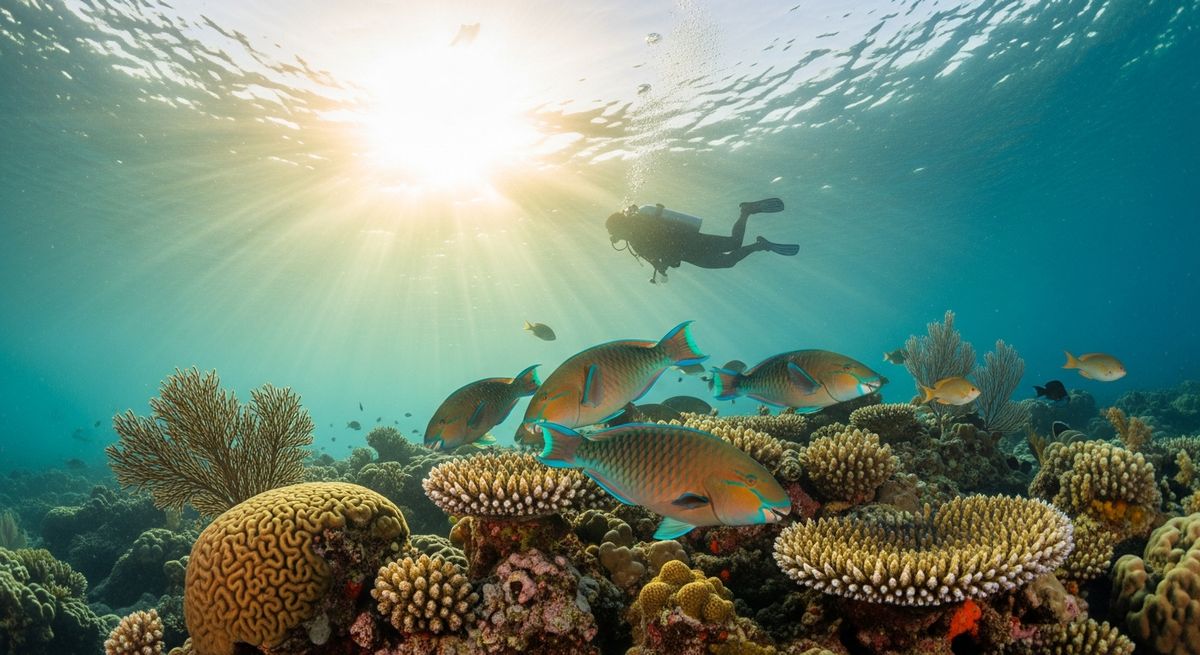
Great Barrier Reef - Ribbon Reefs
Why dive here
With 154+ marine species recorded in the area - including hammerhead sharks, sea turtles, tiger sharks and napoleon wrasse - Great Barrier Reef - Ribbon Reefs offers some of Great Barrier Reef's richest reef diving. Water ranges 24-30°C, warmest January, February, March.
The Ribbon Reefs. Where do we even start? For us, these ten skinny reefs on the outer edge of the Great Barrier Reef represent some of Australia's best diving, full stop. Forget the crowded day boats; this is liveaboard territory, and worth every penny. We love the dramatic topography, those huge coral pinnacles like Steve’s Bommie, absolutely smothered in stony corals. Drift along, and you’ll find yourself surrounded by schools of fusiliers so thick they momentarily block the sun, only to part for a passing yellow-spotted trevally. Our favourite, though, has to be the Cod Hole. Seriously, diving with those enormous potato cod, sometimes seven or eight of them at once, is an experience that never gets old. Their sheer size is impressive, but it’s their curious, almost dog-like nature that makes it special. We’d suggest getting in early for your first dive here, before too many other boats arrive, just to soak it all in. Keep an eye out for dwarf minke whales during the winter months, too. Hearing their calls underwater before you even see them is pure magic. It’s accessible for most certified divers, but some experience with currents is a plus here.
Safety Notes
Strong currents typical this month (avg 30 cm/s). Good buoyancy control essential.
Reviews for Great Barrier Reef - Ribbon Reefs
Conditions
Ocean conditions, forecast and tides for Great Barrier Reef - Ribbon Reefs
Great Barrier Reef - Ribbon Reefs Ocean Conditions
Monthly averages for Great Barrier Reef - Ribbon Reefs, sourced from Open-Meteo marine data + Copernicus Marine (EU) - nearest station: Open-Meteo marine grid (-15.65, 145.72) (5km away)
October Averages
Sea Temperature
26°C
80°F · Range: 24.5–29°C
Current Speed
30.07 cm/s
Direction: S (183.8°)
Chlorophyll-a
0.057 mg/m³
Very clear (oligotrophic)
Salinity
35.08 PSU
Based on 4 years of monitoring data · Data sources: Open-Meteo marine data + Copernicus Marine (EU)
Plan & book
Ways to dive Great Barrier Reef, from day trips to liveaboards.
Day trips & courses
via GetYourGuideGuided dives, courses and snorkel trips with instant booking.
Find dive trips in Great Barrier ReefPlaces to stay
via Booking.comHotels and dive resorts near Great Barrier Reef.
Search stays in Great Barrier ReefDive insurance
Most travel insurance excludes or limits scuba. Check what you need before you go.
Dive insurance explainedPartner links: we may earn a commission if you book, at no extra cost to you. How we make money
Where to Stay near Great Barrier Reef - Ribbon Reefs
Prices from Booking.com. We may earn a commission at no extra cost to you.