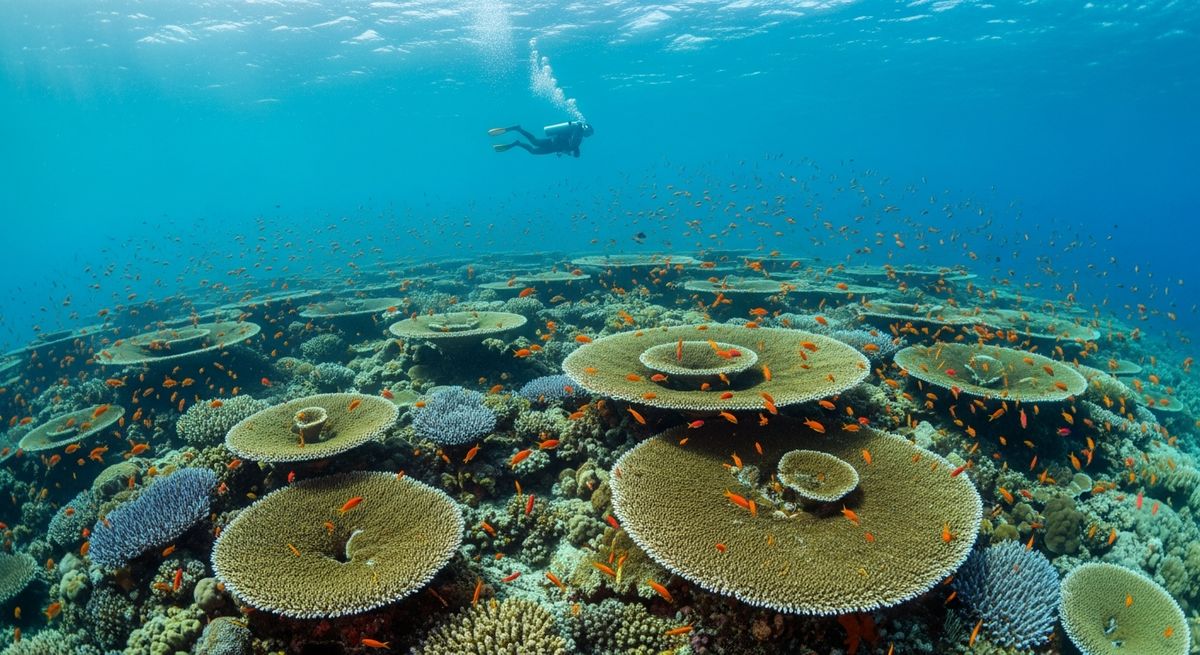
Hastings Reef - Fish Bowl
Protected Area
Michaelmas and Upolu Cays
Why dive here
With 154+ marine species recorded in the area - including hammerhead sharks, sea turtles, tiger sharks and napoleon wrasse - Hastings Reef - Fish Bowl offers some of Great Barrier Reef's richest reef diving. Water ranges 24-30°C, warmest January, February, March.
We’ve always had a soft spot for Hastings Reef, and the Fish Bowl really shows off what it does best. It’s not about grand pelagics or deep wrecks here; it’s about sheer fish density, hence the name. Drop in on the southern edge and you’re immediately enveloped. Schools of fusiliers are so thick they can genuinely block out the sun, and the wall itself, while not plummeting to insane depths, is just plastered with coral. Our favourite time to dive it is mid-morning, after the initial rush, when the light really punches through the shallows. You’ll spot parrotfish everywhere, the Batavian and Princess varieties are particularly colourful, along with big schools of spangled emperor and sweetlips. We often find giant clams embedded in the coral, their mantles a vibrant blue or green. Keep an eye out for cleaner mimics flitting around the bommies. It’s an easy dive, maxing out around 13 metres, so you can really take your time observing the smaller details. If you love just immersing yourself in a cloud of reef fish, this is your spot.
Safety Notes
Strong currents typical this month (avg 30 cm/s). Good buoyancy control essential.
Nearest Dive Centres to Hastings Reef - Fish Bowl
Dive shops near Hastings Reef - Fish Bowl
Dive Centre
Horseshoe
Blue-Cruise Pty.Ltd
Octopus Dive
Reef Daytripper
Ocean Free & Ocean Freedom
Reviews for Hastings Reef - Fish Bowl
Conditions
Ocean conditions, forecast and tides for Hastings Reef - Fish Bowl
Hastings Reef - Fish Bowl Ocean Conditions
Monthly averages for Hastings Reef - Fish Bowl, sourced from Open-Meteo marine data + Copernicus Marine (EU) - nearest station: Open-Meteo marine grid (-15.65, 145.72) (5km away)
October Averages
Sea Temperature
26°C
80°F · Range: 24.5–29°C
Current Speed
30.07 cm/s
Direction: S (183.8°)
Chlorophyll-a
0.057 mg/m³
Very clear (oligotrophic)
Salinity
35.08 PSU
Based on 4 years of monitoring data · Data sources: Open-Meteo marine data + Copernicus Marine (EU)
Plan & book
Ways to dive Great Barrier Reef, from day trips to liveaboards.
Day trips & courses
via GetYourGuideGuided dives, courses and snorkel trips with instant booking.
Find dive trips in Great Barrier ReefPlaces to stay
via Booking.comHotels and dive resorts near Great Barrier Reef.
Search stays in Great Barrier ReefDive insurance
Most travel insurance excludes or limits scuba. Check what you need before you go.
Dive insurance explainedPartner links: we may earn a commission if you book, at no extra cost to you. How we make money
Where to Stay near Hastings Reef - Fish Bowl
Prices from Booking.com. We may earn a commission at no extra cost to you.