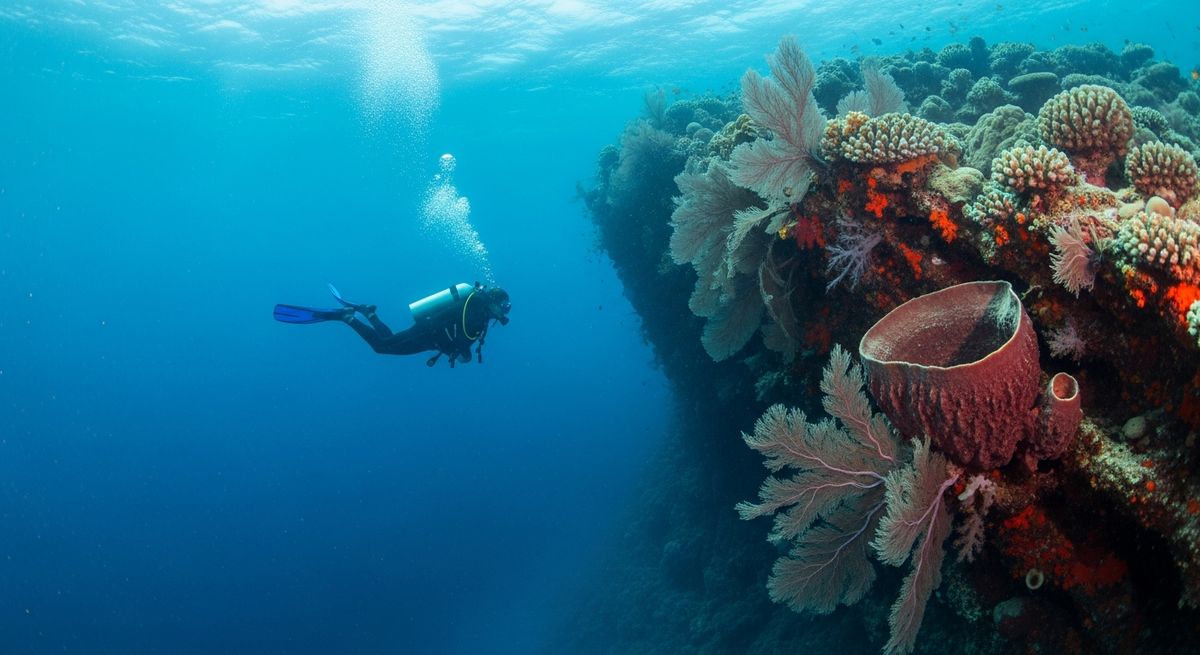
pointe de Dumbéa
Protected Area
Passe de Dumbéa
Why dive here
With 73+ marine species recorded in the area - including dugongs, great white sharks, humpback whales and sperm whales - pointe de Dumbéa offers some of Prony Bay's richest wall diving. Water ranges 22-27°C, warmest January, February, March.
Pointe de Dumbéa, right at the mouth of the Dumbéa pass, is a strong contender for our favourite drift dive in Prony Bay. We aim for an incoming current, letting it carry us towards the ‘Mur aux Loches’. The plateau at 14 metres makes for a comfortable start, then it drops away to 40 metres. But our maximum depth here is usually 24m. The main event when the current is running? The grey reef sharks. They hang out in the channel, often in good numbers. You feel the current pull you past, and they’re just there, stoic. Beyond the sharks, we frequently spot schools of unicornfish, their horns catching the light, and those little Arc-eye Hawkfish always seem to be perched, watching. Keep an eye out for dogtooth tuna too, slicing through the blue. Visibility typically holds at 22 metres. It’s a good spot for those who enjoy a bit of current and the thrill of bigger fish encounters without needing extreme depths.
Typical pointe de Dumbéa Dive Profile
Illustrative profile based on site depth and type. Actual dive profiles vary - always follow your dive computer and training.
Safety Notes
Always perform a 3-minute safety stop at 5m before surfacing.
Nearest Dive Centres to pointe de Dumbéa
Dive shops near pointe de Dumbéa
Abyss Plongée
IATOK DIVING PARADISE
STIM - Plongée
Reviews for pointe de Dumbéa
Conditions
Ocean conditions, forecast and tides for pointe de Dumbéa
pointe de Dumbéa Ocean Conditions
Monthly averages for pointe de Dumbéa, sourced from Open-Meteo marine data + Copernicus Marine (EU) - nearest station: Open-Meteo marine grid (-22.43, 166.43) (4km away)
October Averages
Sea Temperature
23°C
74°F · Range: 21.8–26.2°C
Current Speed
6.71 cm/s
Direction: SW (206.6°)
Chlorophyll-a
0.061 mg/m³
Very clear (oligotrophic)
Salinity
35.39 PSU
Based on 4 years of monitoring data · Data sources: Open-Meteo marine data + Copernicus Marine (EU)
Plan & book
Ways to dive Prony Bay, from day trips to liveaboards.
Day trips & courses
via GetYourGuideGuided dives, courses and snorkel trips with instant booking.
Find dive trips in Prony BayPlaces to stay
via Booking.comHotels and dive resorts near Prony Bay.
Search stays in Prony BayDive insurance
Most travel insurance excludes or limits scuba. Check what you need before you go.
Dive insurance explainedPartner links: we may earn a commission if you book, at no extra cost to you. How we make money
Where to Stay near pointe de Dumbéa
Prices from Booking.com. We may earn a commission at no extra cost to you.