Diving in Prony Bay
Why dive here
Prony Bay offers some of New Caledonia's richest diving, with 73+ marine species recorded in the area - including dugongs, great white sharks, humpback whales and sperm whales. Water ranges 22-27°C, warmest January, February, March.
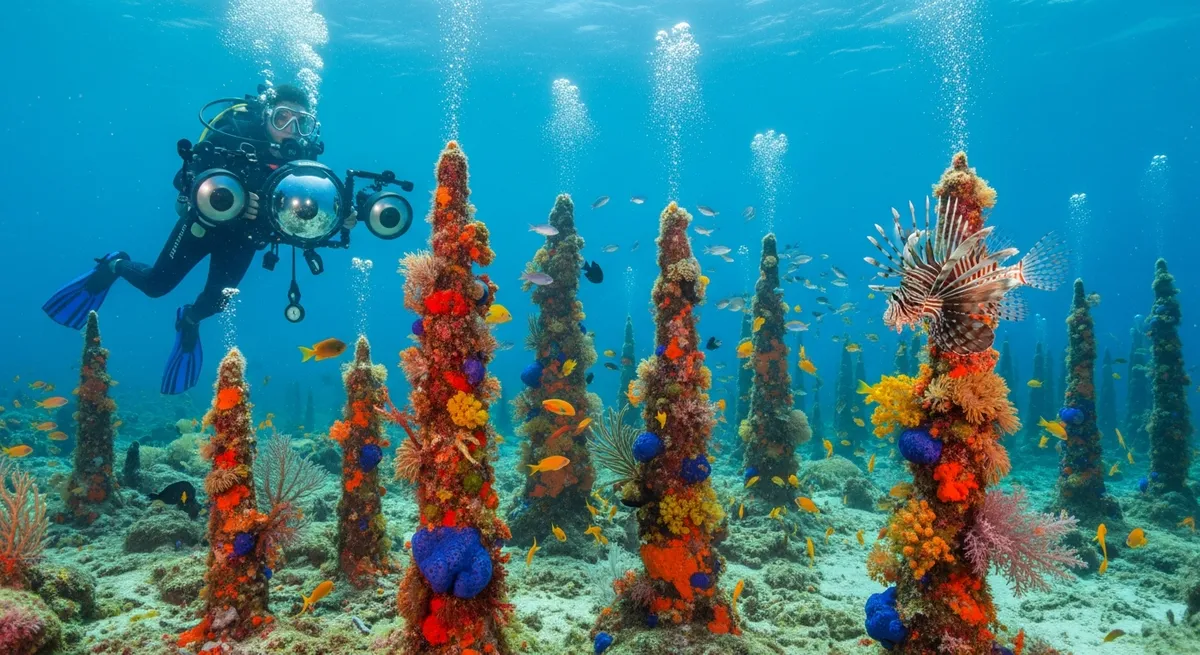
Prony Bay. We love it. It's got this truly unique vibe, a bit eerie, a bit wild, definitely not your average Pacific postcard. Our favourite? Without a doubt, the hydrothermal chimneys. Imagine diving alongside plumes of warm, mineral-rich water rising from the seabed, creating this ethereal, shimmering effect. You feel the temperature shifts as you pass them, a strange warmth against your cheek. And then there's the Needle of Prony, a massive pillar that just shoots up from the depths. Diving around it, you’re often surrounded by schools of fusiliers, sometimes so thick they practically blot out the sun. The killer alga is a local curiosity, a strange green carpet in places, and you'll spot plenty of Redfin Butterflyfish darting in and out of the crevices. Keep an eye out for the Lemon Peel and those vivid Schlegel's Parrotfish munching away. Currents can be a factor here, especially around the Needle, so good buoyancy is key. We’d suggest going in the drier months, May to November, for the best visibility, but even in the "wetter" season, the unique geology makes it worthwhile. It's not about pristine corals here; it’s about the raw, volcanic energy of the place.
Prony Bay Dive Site Map
Dive sites and dive centres in Prony Bay
Prony Bay Dive Sites
46 dive sites in Prony Bay
Aiguille de Prony
Dropping onto the Aiguille de Prony, you’re looking at a distinctive pinnacle formation in Prony Bay. It's a solid, interesting structure that draws in a good variety of reef fish. The site is generally straightforward, making it a good pick for those comfortable with deeper dives but not seeking a strong current challenge. Expect a pleasant, unhurried exploration.
Aiguille du Prony
Right, the Aiguille du Prony. It’s not your typical deep dive, not even close. This is a genuinely unique spot, a true standout in Prony Bay. You’re essentially diving the very top of a towering needle of rock that surfaces in the middle of the bay, hence “Aiguille.” The depth listed, 1 meter, that’s its peak. We’re talking a snorkel or a very shallow free dive, maybe even just peering over the side of the boat on a calm day. What makes it special, though, is what happens right there, just below the surface. This little pinnacle acts like a magnet for pelagics, sometimes bringing them into impossibly shallow water. We’ve seen dugongs here, incredibly, just grazing on the seagrass nearby, and even oceanic manta rays gliding through, their wingtips almost breaking the surface. It feels surreal to watch a manta in water so shallow you can practically stand up. The coral growth is impressive for such an exposed spot; we're particularly fond of the dense patches of staghorn coral, creating little mazes for smaller fish. Look closely, and you might spot a Martin's cowrie tucked away. It’s a site that rewards patience and a keen eye, best enjoyed when the bay is glassy calm, usually early mornings before the breeze picks up. This isn't a site for ticking off species, it’s for experiencing something truly different.
Boulari Plateau Manta
Boulari Plateau Manta in Prony Bay is exactly what it sounds like, a manta ray magnet. We're talking proper reef mantas, not just a passing glimpse. This plateau, sitting at a comfortable 13 metres, acts as a cleaning station, so you settle in and watch the show. We’ve had dives here where we barely moved, just observing these gentle giants glide in, hover over the coral heads, and get serviced by the smaller fish. The current can be stiff, sometimes really ripping, so it’s a drift dive for sure. You’ll be swept along the edge of the plateau, eyes peeled, then you hit the sweet spot. When the mantas are here, they're the main event. But don’t forget to look around. Schools of blue and gold fusiliers are everywhere, and we’ve seen some hefty grey reef sharks patrolling the deeper edges. Keep an eye out for orbicular batfish too, they often hang around the reef crest. Our pick for timing is definitely early morning, before any boat traffic picks up. The water generally holds 19 metres of visibility, a clear, warm blue that just feels like New Caledonia. This site is for divers who appreciate a reliable big animal encounter and don't mind a bit of a current. It's a drift that delivers.
Boulari Plateau Manta
Boulari Plateau Manta in Prony Bay is exactly what it sounds like, a manta ray magnet. We're talking proper reef mantas, not just a passing glimpse. This plateau, sitting at a comfortable 13 metres, acts as a cleaning station, so you settle in and watch the show. We’ve had dives here where we barely moved, just observing these gentle giants glide in, hover over the coral heads, and get serviced by the smaller fish. The current can be stiff, sometimes really ripping, so it’s a drift dive for sure. You’ll be swept along the edge of the plateau, eyes peeled, then you hit the sweet spot. When the mantas are here, they're the main event. But don’t forget to look around. Schools of blue and gold fusiliers are everywhere, and we’ve seen some hefty grey reef sharks patrolling the deeper edges. Keep an eye out for orbicular batfish too, they often hang around the reef crest. Our pick for timing is definitely early morning, before any boat traffic picks up. The water generally holds 19 metres of visibility, a clear, warm blue that just feels like New Caledonia. This site is for divers who appreciate a reliable big animal encounter and don't mind a bit of a current. It's a drift that delivers.
Corne de Tenia
Corne de Tenia in Prony Bay offers a gentle introduction to New Caledonia's coastal diving. It’s a shallower site, perfect for newer divers or those looking for a relaxed multi-level profile. You'll find schools of fusiliers here, often sheltering amongst the soft corals, with the occasional reef shark gliding past in the blue. We'd suggest it for an easy afternoon dive, particularly if the wind is up elsewhere.
Epave du Snark
Prony Bay’s Epave du Snark isn't one of those massive warships, but it's got a quiet charm. This small wreck, possibly a fishing boat or a yacht, sits upright on the sandy bottom, pretty much intact. We found schools of bannerfish fluttering around the mast, and inside the holds, it’s common to spot cardinalfish sheltering in the gloom. It’s a comfortable dive, usually with mild current, making it a good option for those newer to wreck diving or anyone looking for a relaxed exploration rather than a technical challenge. Keep an eye out for nudibranchs making their way across the hull.
épave du snark
The Snark wreck in Prony Bay feels like a proper treasure hunt, even if it’s only at 11 metres. It’s not some perfectly intact ship; instead, you get a sprawling debris field, big metal plates and ribs scattered across the sandy bottom. We love how the Snark has become a home, every nook and cranny occupied. Look closely and you’ll find freckled anglerfish pretending to be part of the rusty structure, or little post horn squid jetting between the fragments. It’s an ideal spot for newer divers, or anyone who just wants a really relaxed dive without worrying about depth or complex navigation. While the visibility can be a bit hit-or-miss sometimes, when it’s good, the schools of fusiliers and trumpetfish really put on a show. We’ve even spotted leopard sharks cruising by on occasion. Our favourite part? Peeking under the bigger pieces of hull, where you often find honeycomb groupers lurking, perfectly camouflaged. It’s less about one grand structure and more about the micro-habitats within the wreckage.
épave du Umbolt
The Umbolt in Prony Bay is one of those wrecks we keep coming back to. It’s a fishing boat, purposefully sunk, and it's settled nicely on its starboard side at about 21 metres. We’ve found the visibility here is usually excellent, often pushing 20 metres, so you get a full view of the structure as you descend. What we really appreciate about the Umbolt is the way marine life has completely taken it over. You'll spot scorpionfish tucked into every crevice, and we’ve seen schools of bigeye trevally circling the mast, occasionally joined by barracuda. Inside, the cabins are still largely intact, making for some fascinating swim-throughs if you're comfortable with a bit of overhead environment. We always take our time exploring the bridge and the engine room, where you can often find moray eels peeking out. It's a fantastic spot for macro enthusiasts too; look for those tiny leopard blennies and even colourful nudibranchs on the hull. We think it’s a brilliant dive for anyone comfortable exploring a wreck, and it offers plenty for both wide-angle and macro photographers.
Ever Propérity
The Ever Propérity isn't your typical shipwreck dive. Forget descending onto a grand, intact vessel; this is about the reef that’s reclaimed a vessel’s bones. The ship itself lies high and dry, a rusted monument on the shore, but the underwater action happens at its feet. We love the dramatic topography here, a plateau around 10 meters deep that’s riddled with natural arches, swim-throughs, and small caves. It feels like exploring a submerged labyrinth. Drop over the edge of the plateau and the reef plunges down, a stunning wall that keeps us coming back. We’ve found huge schools of five-lined snapper here, darting through the light, and always keep an eye out for cleaner mimic blennies near the anemones. Look closely, and you’ll spot leopard cones and the vibrant hues of bird wrasse against the coral. Our favourite discovery? A blood-stained frog shell tucked into a crevice. It’s definitely a site to take slow, exploring the nooks and crannies. Just be aware, it can get bumpy in a swell, so check the forecast before you go.
EVER PROSPERITY
The Ever Prosperity, resting in Prony Bay, offers a truly unique dive. We don't often get to explore wrecks that were once such impressive vessels, built in '52 and stretching over 137 metres. It went down in 1970, running aground on Abore Reef, and now sits as a fragmented but fascinating structure. What we love about this wreck is how the bay’s calm, almost lake-like conditions have preserved it, at least in parts, while also allowing nature to reclaim it. We’ve finned through schools of fusiliers so thick they momentarily blocked out the light filtering down from above, a truly immersive sensation. Look out for the resident moray eels peeking from crevices; they’re often quite bold here. The sheer scale of the ship is what really grabs you – imagining it sailing from Sydney to Noumea puts its current state into perspective. We’d suggest focusing on the bow and stern sections; they tend to be the most intact and offer the best nooks for spotting smaller critters. While it's fragmented, the accessible areas make it an ideal wreck dive for those comfortable navigating larger structures and who appreciate the blend of history and marine life.
EVER PROSPERITY
The Ever Prosperity isn’t just a wreck; it’s a colossal, open invitation to explore. This old steamship, grounded in 1965, spans an impressive 134 metres, and our favourite part is how much of it remains accessible, even at shallow depths. We’ve spent hours weaving through the superstructure, where the sheer size of the boilers and engine room really hits you, especially with shafts of sunlight cutting through the gloom. Visibility here is often very good, letting you appreciate the scale from afar before you get up close to the detail. We love the resident batfish schools that swarm around the bow, and the smaller critters, nudibranchs and flatworms, tucked into the holds. It’s a fantastic site for photographers, with so many compositional possibilities, and because much of it sits in relatively shallow water, you get ample bottom time to really soak it all in. Just keep an eye on your buoyancy; it’s a big wreck with plenty to bump into.
Extasy
Extasy isn't a morning wake-up call, but it’s worth the 90-minute boat ride from Noumea. It’s got that remote feel, not many boats out here, which we always appreciate. The main event is a proper wall, a real vertical drop that goes down to at least 32 metres, possibly more, and it’s usually humming with activity. You’ll want to drift along, letting the current do some of the work, keeping an eye on the blue for bigger pelagics. We’ve seen grey sharks cruise by here, often just shadows at the edge of visibility, and the occasional eagle ray makes a graceful pass. Closer to the wall, huge gorgonians fan out, sometimes with long-nosed parrotfish nibbling around their bases, and plenty of giant morays peek from crevices. Visibility averages 21m, so you get a good sense of the scale. This spot is best for experienced divers comfortable with a bit of current and ready to explore a less-trodden path. It’s a site for those who appreciate dramatic topography and the chance of a bigger animal encounter.
Show all 46 dive sites in Prony Bay
- Fausse passe de Uitoé
- Forêt du Snark
- Grotte a Jean-Claude
- Îlot Maître
- Ilot Signal
- Jardin de Marc
- La Dieppoise
- La Diéppoise, wreck
- La Passe de Dumbea
- Le Caledonie Toho 5
- Le Humboldt
- Le Sournois
- Le Sournois
- Les Roses
- MATIPO
- Mur Aux lôches
- Passe de Boulari
- Passe de Mato
- Passe de Mato
- Passe de Uation
- Passe exterieure Boulari
- Passe intérieure de Boulari
- Patate VACH
- pointe de Dumbéa
- récif intérieur de Dumbéa
- Récif Prony
- Récif Tabu
- sea horse
- Sèche Croissant
- Spot aux surfeurs
- Tépava
- Toho II, wreck
- Toho V (Wreck)
- Wreck of Japanese submarine I-17
Prony Bay Dive Centres
4 dive shops and operators in Prony Bay
Ocean Wildlife in Prony Bay
73 species recorded in Prony Bay
Prony Bay Daylight & Sunrise/Sunset
Sunrise and sunset times for Prony Bay, calculated from coordinates
Today - Sunday 11 October
Sunrise
05:27
Sunset
17:57
Daylight
12h 30m
Golden Hour
17:27
First light (dawn) at 05:04 · Last light (dusk) at 18:20
Monthly Averages
| Month | Sunrise | Sunset | Daylight |
|---|---|---|---|
| Jan | 05:23 | 18:45 | 13h 22m |
| Feb | 05:44 | 18:35 | 12h 51m |
| Mar | 05:57 | 18:12 | 12h 15m |
| Apr | 06:07 | 17:43 | 11h 35m |
| May | 06:20 | 17:23 | 11h 3m |
| JunShortest | 06:33 | 17:19 | 10h 46m |
| Jul | 06:35 | 17:27 | 10h 52m |
| Aug | 06:20 | 17:40 | 11h 19m |
| Sep | 05:53 | 17:49 | 11h 56m |
| OctNow | 05:24 | 17:58 | 12h 35m |
| Nov | 05:05 | 18:15 | 13h 11m |
| DecLongest | 05:05 | 18:35 | 13h 30m |
Times are approximate local times based on longitude. Actual times may vary slightly depending on the exact timezone observed in Prony Bay.
Where to Stay near Prony Bay
Prices from Booking.com. We may earn a commission at no extra cost to you.
Marine Protected Areas near Prony Bay
43 protected areas near Prony Bay - please respect local regulations when diving
Parc Naturel de la Mer de Corail
Parc du Grand Lagon Sud
Nekoro
Parc de la Zone Côtière Ouest
Parc de la Côte Oubliée
L’île de Bailly
Yves Merlet
L’îlot Ténia
Grand récif Aboré et de la passe de Boulari
Casy Islet
Parc du lagon de Bourail: Roche Percee and Baie des tortues
Parc du lagon sud: Ilot Amédée et Grand Récif Aboré
Showing 12 largest of 43
Getting to Prony Bay
Nouméa
Nouméa (La Tontouta)
Île des Pins
Plan & book
Ways to dive Prony Bay, from day trips to liveaboards.
Day trips & courses
via GetYourGuideGuided dives, courses and snorkel trips with instant booking.
Find dive trips in Prony BayPlaces to stay
via Booking.comHotels and dive resorts near Prony Bay.
Search stays in Prony BayDive insurance
Most travel insurance excludes or limits scuba. Check what you need before you go.
Dive insurance explainedPartner links: we may earn a commission if you book, at no extra cost to you. How we make money