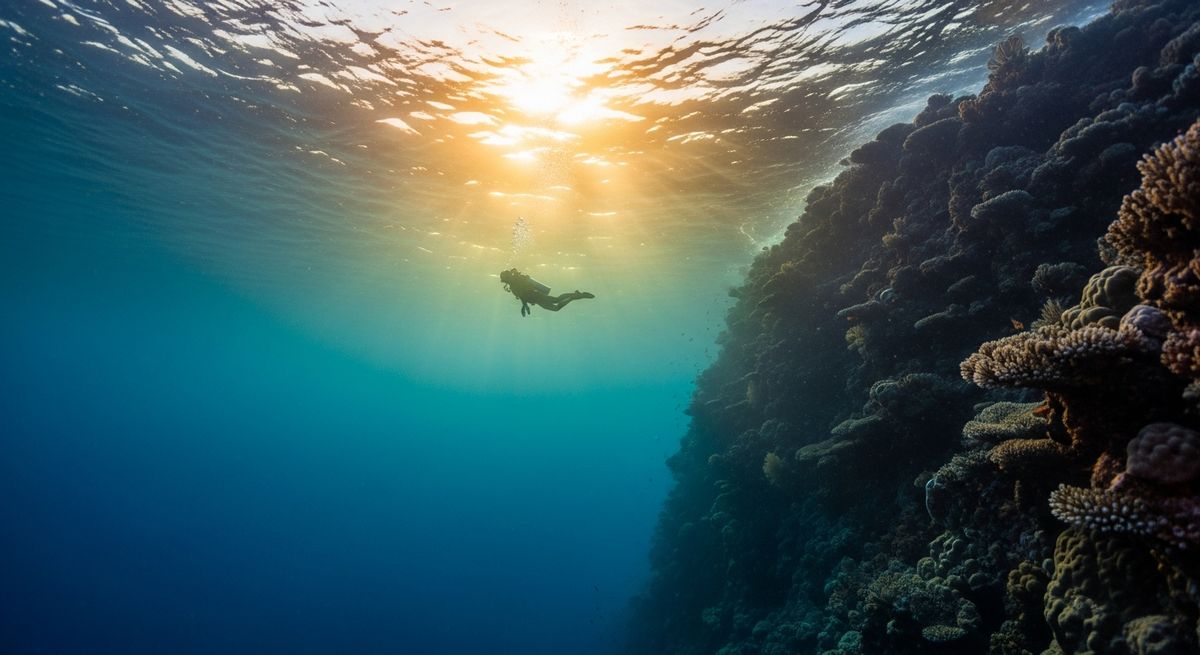
Shag Rock - Poor Knights Islands

We’ll be honest, when we first looked at The Wall, we thought, "Is this it?" Max depth 11m, between two reef crests? Sounds… fine. But boy, were we wrong. This isn't your typical Cozumel rip-roaring drift, but it’s exactly why we love it. It’s all about the turtles here, specifically the green turtles. They graze the seagrass, completely unfazed by divers. You can spend an entire dive just watching them. We’ve seen them surface for air, then dive back down, kicking up little puffs of sand as they munch away. The visibility averages 15m, which is decent for a shallower site, and the light filtering through the water is just gorgeous. Beyond the turtles, keep an eye out for larger schooling fish. We’ve spotted big groups of grunts and yellowtail parrotfish. The coral formations here, while not massive, are healthy, with nice stony corals and sea fans adding texture. It’s a very relaxed dive, perfect for photographers or anyone who wants to slow down and really observe. This site suits newer divers or those who prefer a tranquil experience over a high-adrenaline drift. You might even spot a barracuda lurking in the blue.

Location
Poor Knights Islands, New Zealand, Australasia
Coordinates
-36.268700, 174.795200
Type
wall

Marine Protected Area: Cape Rodney-Okakari Point

Best Time to Dive in Poor Knights Islands

The warmest water temperatures in Poor Knights Islands occur in February, averaging 21.9°C. The coolest conditions are in August at 15.8°C.

Monthly Water Temperatures

  • January: 21.4°C
  • February: 21.9°C
  • March: 21.7°C
  • April: 20.6°C
  • May: 19.1°C
  • June: 17.6°C
  • July: 16.5°C
  • August: 15.8°C
  • September: 15.9°C
  • October: 16.6°C
  • November: 18.2°C
  • December: 19.8°C

Nearby Dive Sites in Poor Knights Islands

Nearest Dive Centres to Shag Rock

Marine Life in Poor Knights Islands

Home to 84 recorded species including 53 reef fish, 11 sharks & rays, 4 whales & dolphins, 4 other, 3 crabs & lobsters, 2 sea urchins.

Notable Species

Recommended Packing List for Shag Rock

Based on average water temperature of 18.8°C, currents 12 cm/s.

  • Wetsuit (3-5mm) - comfortable for 19°C water
  • Mask - essential for every dive
  • Fins
  • BCD - buoyancy compensator
  • Regulator - your most safety-critical piece of gear
  • Dive Computer - tracks depth, time, and NDL
  • Surface Marker Buoy (SMB) - essential for boat pickups
  • Dive Torch - useful for crevices and colour at depth
  • Underwater Camera - capture your diving memories

Frequently Asked Questions

What is the typical depth range for scuba diving at Shag Rock?
The typical depth range for scuba diving at Shag Rock is between 3-5 meters, varying with the tide. Divers can explore sandy pathways and kelp forests within this range, with a maximum depth reaching 8 meters.
What marine life and coral can divers expect to encounter at Shag Rock?
At Shag Rock, divers can expect to encounter a variety of marine life, including snapper, eagle rays, leather jackets, and red moki. While hard corals are not mentioned, the site features vibrant kelp forests providing habitat for these species. For more information on marine species, visit our wildlife database.
Is Shag Rock a suitable dive site for beginner divers, or is it considered more challenging?
Shag Rock is considered an intermediate dive site, making it more challenging than suitable for absolute beginner divers. While the depths are relatively shallow, the 'intermediate' rating suggests it requires a certain level of experience or specific skills. Beginner divers might find other sites in Poor Knights Islands more appropriate.
When is the best time of year to dive Shag Rock for the best conditions and marine sightings?
The provided data for Shag Rock does not specify the best time of year for optimal diving conditions or marine sightings. We recommend checking local dive operators for seasonal insights. For general guidance on planning your dives, explore our When to Dive section.
What diving certifications are needed to dive at Shag Rock?
The specific diving certifications required for Shag Rock are not detailed in the provided information. However, given its 'intermediate' difficulty rating, it is generally recommended that divers hold at least an Advanced Open Water certification or equivalent. Always consult with local dive centers for their specific requirements before planning your dive.
How are the currents, surge, and visibility typically at the Shag Rock dive site?
At Shag Rock, the average visibility is typically around 9 meters, offering clear views of the marine environment. Information regarding typical currents and surge at this specific dive site is not provided in the available data. It's always wise to check current conditions with local dive operators before your dive.