Diving in West Coast
Why dive here
West Coast offers some of Barbados's richest diving, with 376+ marine species recorded in the area - including barracuda, dolphins, humpback whales, octopuses and orcas. Water ranges 27-30°C, warmest August, September, October.
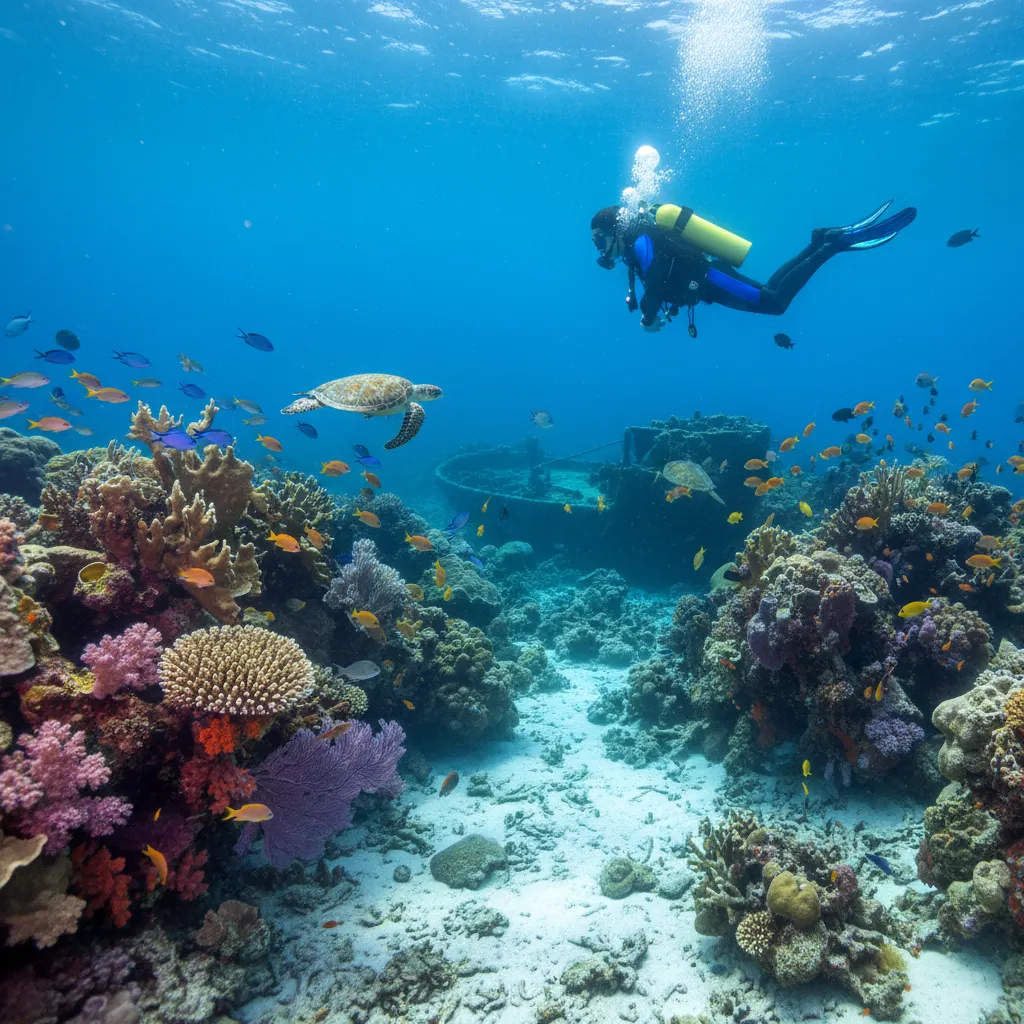
Barbados’ West Coast is where we head when we want easy diving and reliable turtle sightings. The Caribbean side truly lives up to its name for calmness; we’ve rarely encountered anything more than a gentle sway here, making it perfect for longer bottom times. You’ll spend most of your dives drifting gently past low-lying reef structures and a scattering of wrecks, often with a green sea turtle or hawksbill cruising alongside you. Our favourite spots are always the wrecks, especially the Stavronikita. She’s an old freighter, sunk deliberately as an artificial reef, and the way the light filters through her upper decks makes for some striking photography. Look closely in the nooks and crannies for curious little blennies like the Checkered and Longfin, and you’ll often find schools of Atlantic spadefish schooling over the mast. We’ve also had some fantastic encounters with large schools of grunt and drumfish that seem completely unfazed by divers. Visibility stays pretty consistent year-round, usually around 20-25m, so you don’t need to be too picky about when you visit. Just be ready for those turtles, they’re everywhere.
West Coast Dive Site Map
Dive sites and dive centres in West Coast
West Coast Dive Sites
13 dive sites in West Coast
Brightledge
Brightledge is one of those spots on the West Coast where we always feel a little more relaxed. It’s part of the wider Pinnacle reef system, a gentle drift south over a series of coral fingers, each one dropping a few metres deeper than the last. Maxing out around 22m means you get plenty of bottom time, and usually, the current is barely a whisper. Our favourite part has to be the subtle topography changes – one moment you’re hovering over the sandy transition, the next you’re watching a Mottled Flounder melt into the substrate. Keep an eye out for the smaller stuff here; the Bristle Herring shimmer in the distance, and we’ve often spent a good chunk of a dive just watching the Atlantic shrimp gobies tending their burrows. You’ll definitely spot barracuda lurking, and the occasional turtle glides past with a calm indifference. It’s a great site for divers who appreciate a slower pace, those who prefer to really examine the reef rather than rush through a checklist.
Brightledge
Brightledge is one of those spots on the West Coast where we always feel a little more relaxed. It’s part of the wider Pinnacle reef system, a gentle drift south over a series of coral fingers, each one dropping a few metres deeper than the last. Maxing out around 22m means you get plenty of bottom time, and usually, the current is barely a whisper. Our favourite part has to be the subtle topography changes – one moment you’re hovering over the sandy transition, the next you’re watching a Mottled Flounder melt into the substrate. Keep an eye out for the smaller stuff here; the Bristle Herring shimmer in the distance, and we’ve often spent a good chunk of a dive just watching the Atlantic shrimp gobies tending their burrows. You’ll definitely spot barracuda lurking, and the occasional turtle glides past with a calm indifference. It’s a great site for divers who appreciate a slower pace, those who prefer to really examine the reef rather than rush through a checklist.
Bright Ledge
Bright Ledge on Barbados’ west coast is where we go when we want to feel small. This site drops quickly from 25m down to 40m, a true deep reef for advanced divers. The shelf itself is impressive, a massive coral formation dotted with barrel sponges big enough to hide a person. We love drifting along the edge here, keeping an eye out into the blue. It’s a great spot for larger pelagics; we’ve had Caribbean reef sharks cruise by, and schools of jacks often flow past like liquid silver. Down on the ledge itself, the corals host some fantastic macro life if you have the eye for it – look for Spitlure Frogfish tucked away or the curious little Dash Goby peering out from a crevice. It’s a site that rewards patience and good air consumption. If you’re comfortable at depth and keen for a bit more action than the shallower reefs, Bright Ledge delivers. It’s a proper dive, one that reminds you how vast the ocean is.
Cement Plant
We love the Cement Plant for its sheer chaos, in the best possible way. This isn't some pristine, intact wreck sitting pretty. Instead, it’s a sprawling, collapsed pier, a tangle of concrete and rebar that’s become an accidental apartment block for all sorts of critters. At just 10 meters, it's a calm, shallow dive, perfect for just kicking back and letting the world drift by. We’ve spent entire dives here, tracing the outline of the old concrete pilings, now encrusted in sponges and soft corals. It’s the kind of site where you’re guaranteed to find something small and interesting tucked away. Look for puffcheek blennies bobbing their heads in tiny crevices, or a shy octopus trying its best camouflage act amongst the rubble. Our favourite part is the hunt for seahorses. They're here, often clinging to a stray piece of rope or a gorgonian, and spotting one feels like winning a tiny lottery. The schools of small herring and silversides can be immense, often attracting hungry tarpon that cruise through the structure with an easy grace. We’d suggest going early in the morning, before the boat traffic picks up, for the calmest water and the best light filtering through the broken concrete. It’s an easy, rewarding dive, especially if you’ve got a macro lens.
FishPot - Shore Dive
FishPot is one of our go-to chill dives on the West Coast, especially when we want to just roll out of bed and into the water. It’s a shallow affair, maxing out at around 9m, so it’s perfect for a long, relaxed bottom time. The real charm here lies in the sheer number of small, colourful reef fish that flit between the coral ridges. We’ve spent whole dives just watching butterfish and dusky damselfish dart around, occasionally spotting a shy Atlantic shrimp goby peeking out from its burrow. Visibility typically hovers around 10m, which is plenty for this kind of intimate exploration. It’s also a fantastic site for newer divers or those getting back into it after a break; the conditions are usually calm, and there’s no pressure to go deep. Look closely in the nooks and crannies for the tiny blennies – we’ve seen spotcheek and goldline blennies here on multiple occasions. It’s a gentle, unassuming dive that always leaves us feeling refreshed.
Harrison Reefs
Harrison Reefs sits off the West Coast of Barbados, a stretch we know well for its generally calmer conditions. Unlike some of the scattered patch reefs, Harrison feels like a proper, continuous system, something we always appreciate. We’ve logged a good few dives here, and it always delivers a relaxed drift over a bustling coral landscape. You’ll find plenty of brain corals and sea fans, providing cover for a real cast of characters. Keep an eye out for the King Mullet sifting through the sand, and we’ve often spotted Trumpetfish hanging vertically, trying their best impression of a pipe. On a good day, the visibility stretches to 20 metres, letting you see the schools of Cottonwick and Schoolmasters cruising by. It’s a great spot for photographers who like to take their time, focusing on macro life like the tiny blennies and gobies tucked into crevices. This isn't a deep-wreck adrenaline dive; it's a gentle, colourful amble, perfect for unwinding after a day of island exploring.
Maycocks - Sand Channels
Maycocks Sand Channels is a drift diver's playground, even though it's relatively shallow at just 19m. The real show here is the topography: wide, meandering rivers of white sand cut through vibrant coral formations. We love drifting along, letting the current do the work, eyes peeled for what's nestled in those channels. It’s perfect for spotting the smaller, more elusive critters. We’ve found Long-snout Seahorses tucked into the sparse seagrass, and Dusky Smoothhounds cruising the sand flats. Look out for the tiny Smallmouth Goby, a favourite of ours, peeking from its sandy burrows. The current can pick up, making it a proper drift, so a good surface marker buoy is essential. Visibility averages about 12m, but on a good day, it stretches further, making those sand channels glow. It’s a site that rewards slow, careful observation, a real antidote to the hustle of some other west coast spots.
PAMIR
The Pamir, a scuttled motor vessel, lies upright in 15 meters of water off Barbados' west coast. This 48-meter wreck is a good option for newer wreck divers, or those looking for an easy second dive. We’ve found plenty of schooling fish swirling around the superstructure, and the open holds are straightforward to navigate. Keep an eye out for resident barracuda lurking in the deeper shadows of the engine room. It’s an accessible wreck, allowing for a relaxed exploration of its various nooks and crannies.
Pamir, wreck
The Pamir, off Barbados’ west coast, is one of those wrecks we keep coming back to. It’s not a deep dive, maxing out around 16m, but what it lacks in depth it makes up for in character. Dropping down, you first pick out the stern, sitting upright and surprisingly intact. We love exploring the cargo holds, where shafts of light pierce the gloom, illuminating schools of glasseye snapper and the occasional spotted trunkfish peeking from crevices. Our favourite part is the bow, shallower at around 8m, where the deckhouse is still discernibly shaped. Look closely for tiny blackedge triplefins flitting about the decaying metalwork and watch for elusive mushroom scorpionfish camouflaged on the hull. Visibility averages a comfortable 14m, giving you plenty of time to soak in the details. It's an ideal site for newer wreck divers to get a feel for penetration in the open holds, and photographers will find endless compositions. We often combine it with a nearby reef for a solid two-tank day.
Pamir Wreck
The Pamir Wreck, sitting upright at a friendly 5-12m, is one of those sites we always recommend for a relaxed dive. It’s perfect for new divers finding their fins, or anyone just wanting an easy hour underwater without the hassle. We love how accessible it is, and the light penetration is incredible, painting the wreck in shifting blues and greens. What makes the Pamir special, beyond its depth, is the sheer density of small, interesting critters. Sure, it’s not a massive freighter, but the way life has colonised every nook and cranny is fascinating. We’ve spent whole dives just poking around the broken bow and stern sections, finding Broadnose Worm Eels peering from cracks and Dwarf Blennies perched on the metalwork. Keep an eye out for Chain Morays tucked into shadowed corners; they blend in remarkably well. Flounders often settle into the sand nearby, almost invisible until you’re right on top of them. It’s an ideal spot to really slow down, work on your buoyancy, and appreciate the smaller wonders that often get overlooked on flashier dives. For photography, the ambient light is fantastic, especially mid-morning when the sun is high.
STAVRONIKITA
The Stavronikita sits upright at 35 metres, a proper deep dive that Barbados is known for. She was scuttled back in 1978 after a fire, so time has certainly done its work, transforming the old motor vessel into a thriving artificial reef. You’ll find plenty of resident barracuda hovering around the masts, and the open holds are home to schools of snapper and grunt. While it’s not an penetration dive for the casual diver, exploring the deck and superstructure offers a good sense of the ship's scale. We'd suggest this one for advanced divers comfortable with depth and perhaps a bit of current, which can pick up at times.
Stavronikita Wreck
The Stavronikita is a beast of a wreck, a proper freighter sunk deliberately in '78. We love a purposeful sinking, and this one delivers, sitting upright at 42 metres on its port side, though the main deck is closer to 30. It's an intermediate dive for sure, given the depth. You drop down, and this massive silhouette just starts to emerge from the blue, growing clearer with every fin kick. What makes Stavronikita stand out for us isn't just its size, but how you can actually get *inside* it. We've spent dives just exploring the engine room, the hold, even the galley. Sunlight slanting through portholes, illuminating schools of mojarras that dart away as you approach. Keep an eye out for yellowface pikeblennies peeking from crevices and the occasional shortnose batfish doing its slow, deliberate shuffle on the deck. The mast still stands, reaching up into shallower waters around 6-10 metres, covered in fire coral, making a fantastic safety stop. It’s a site that rewards multiple visits, offering something new each time you drop in.
Show all 13 dive sites in West Coast
West Coast Dive Centres
4 dive shops and operators in West Coast
Ocean Wildlife in West Coast
376 species recorded in West Coast
West Coast Daylight & Sunrise/Sunset
Sunrise and sunset times for West Coast, calculated from coordinates
Today - Sunday 11 October
Sunrise
05:49
Sunset
17:43
Daylight
11h 54m
Golden Hour
17:15
First light (dawn) at 05:28 · Last light (dusk) at 18:05
Monthly Averages
| Month | Sunrise | Sunset | Daylight |
|---|---|---|---|
| Jan | 06:26 | 17:51 | 11h 25m |
| Feb | 06:23 | 18:05 | 11h 42m |
| Mar | 06:08 | 18:10 | 12h 2m |
| Apr | 05:47 | 18:12 | 12h 25m |
| May | 05:34 | 18:18 | 12h 44m |
| JunLongest | 05:33 | 18:27 | 12h 54m |
| Jul | 05:40 | 18:30 | 12h 50m |
| Aug | 05:47 | 18:22 | 12h 35m |
| Sep | 05:49 | 18:02 | 12h 13m |
| OctNow | 05:50 | 17:41 | 11h 51m |
| Nov | 05:58 | 17:30 | 11h 32m |
| DecShortest | 06:14 | 17:35 | 11h 21m |
Times are approximate local times based on longitude. Actual times may vary slightly depending on the exact timezone observed in West Coast.
Where to Stay near West Coast
Prices from Booking.com. We may earn a commission at no extra cost to you.
Marine Protected Areas near West Coast
3 protected areas near West Coast - please respect local regulations when diving
Folkstone
Carslisle Bay
Graeme Hall Swamp
Getting to West Coast
Bridgetown
Vieux Fort
Kingstown
Plan & book
Ways to dive West Coast, from day trips to liveaboards.
Day trips & courses
via GetYourGuideGuided dives, courses and snorkel trips with instant booking.
Find dive trips in West CoastPlaces to stay
via Booking.comHotels and dive resorts near West Coast.
Search stays in West CoastDive insurance
Most travel insurance excludes or limits scuba. Check what you need before you go.
Dive insurance explainedPartner links: we may earn a commission if you book, at no extra cost to you. How we make money