CAPTAIN ROKOS (ROCUS)
Protected Area
Virgin Gorda north
Why dive here
With 449+ marine species recorded in the area - including barracuda, blacktip reef sharks, dolphins, dwarf minke whales and eagle rays - CAPTAIN ROKOS (ROCUS) offers some of Virgin Gorda & Anegada's richest wreck diving. Water ranges 27-30°C, warmest August, September, October.
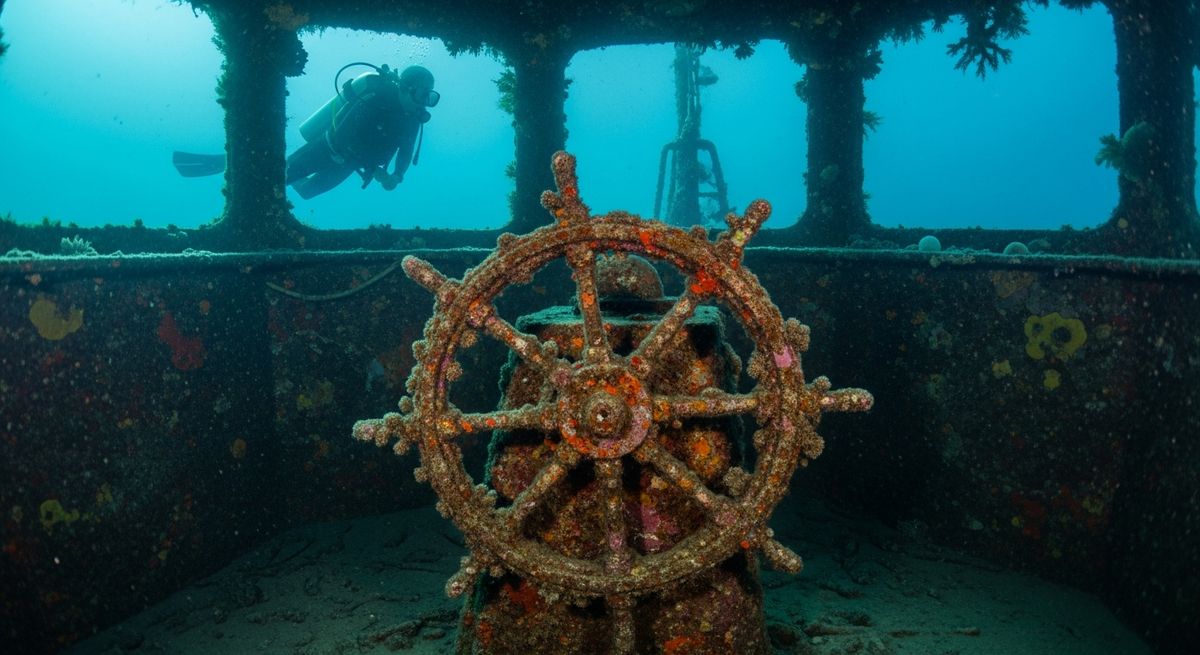
The Captain Rokos is a proper old-school wreck, no mucking about. She was a steamship, went down in 1931, and what’s left of her sits in just 5 metres of water, spread out across the seabed. It’s an easy dive, barely a swim really, but fascinating because you’re looking at history. You can trace the outline of her hull, pick out ribs and plating, and the prop shaft is still visible, which we think is pretty cool. Over the decades, the ocean has taken over. We love spotting the resident parrotfish nibbling algae off the metal, and nurse sharks sometimes snooze under the larger sections. Schools of snapper often hold tight to the superstructure. Because it's so shallow, you get fantastic light penetration, making it a great spot for photographers and really long bottom times. It’s a perfect chill-out dive, especially if you’ve had a few days of deeper, more demanding sites. Our favourite time to visit is mid-morning, before any strong thermals might stir up the sand a bit.
Typical CAPTAIN ROKOS (ROCUS) Dive Profile
Illustrative profile based on site depth and type. Actual dive profiles vary - always follow your dive computer and training.
Safety Notes
Wreck site - avoid penetration without wreck diving certification. Watch for sharp metal and entanglement hazards.
CAPTAIN ROKOS (ROCUS) Wreck History
Year Sunk
1931
Vessel Type
cargo ship
Cause
unknown
The waters between Virgin Gorda and Anegada in the British Virgin Islands are home to the historic remains of the Captain Rokos, a steamship that went down on February 20, 1931. Having rested on the seabed for nearly a century, this wreck is a true time capsule, offering a glimpse into the maritime world of the early 20th century. Its shallow grave at only 5 meters makes it an easily accessible site for divers and snorkelers of all levels.
After so many decades underwater, the Captain Rokos has been thoroughly reclaimed by nature. The ship's original structure is now heavily encrusted with a kaleidoscope of hard and soft corals, transforming the vessel into a spectacular artificial reef. Divers can explore the ship's scattered remains, including its boilers and steam engine components, while being surrounded by the rich marine life that thrives in the BVI's protected waters. It's a dive that beautifully merges history with natural wonder.
Nearest Dive Centres to CAPTAIN ROKOS (ROCUS)
Dive shops near CAPTAIN ROKOS (ROCUS)
View all dive centres in Virgin Gorda & AnegadaReviews for CAPTAIN ROKOS (ROCUS)
Conditions
Ocean conditions, forecast and tides for CAPTAIN ROKOS (ROCUS)
CAPTAIN ROKOS (ROCUS) Ocean Conditions
Monthly averages for CAPTAIN ROKOS (ROCUS), sourced from Open-Meteo marine data - nearest station: Open-Meteo marine grid (18.5, -64.42) (5km away)
October Averages
Sea Temperature
30°C
86°F · Range: 29.1–31.1°C
Air Temperature
28°C
83°F
Wind Speed
7.66 m/s
14.9 knots
Atmospheric Pressure
1013.1 hPa
Based on 4 years of monitoring data · Data sources: Open-Meteo marine data
Plan & book
Ways to dive Virgin Gorda & Anegada, from day trips to liveaboards.
Day trips & courses
via GetYourGuideGuided dives, courses and snorkel trips with instant booking.
Find dive trips in Virgin Gorda & AnegadaPlaces to stay
via Booking.comHotels and dive resorts near Virgin Gorda & Anegada.
Search stays in Virgin Gorda & AnegadaDive insurance
Most travel insurance excludes or limits scuba. Check what you need before you go.
Dive insurance explainedPartner links: we may earn a commission if you book, at no extra cost to you. How we make money
Where to Stay near CAPTAIN ROKOS (ROCUS)
Prices from Booking.com. We may earn a commission at no extra cost to you.