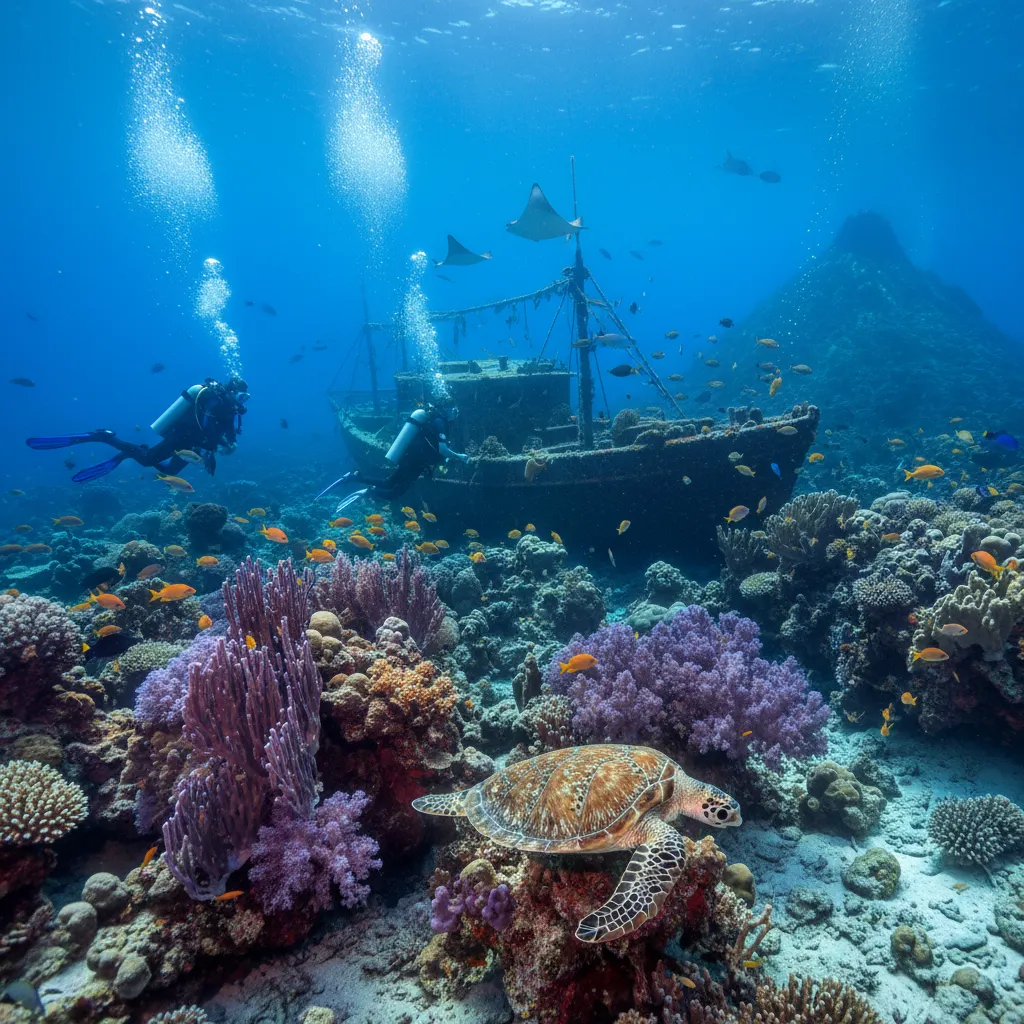
Diving in Carriacou
Why dive here
Carriacou offers some of Grenada's richest diving, with 292+ marine species recorded in the area - including barracuda, dolphins, humpback whales, nurse sharks and orcas. Water ranges 27-30°C, warmest August, September, October.
Carriacou has this laid-back charm, a real contrast to some of the busier Caribbean spots. It’s got that “sister island” vibe, just a short hop from Grenada proper, and the diving really benefits from fewer boats and divers. We love that feeling of having a site almost to ourselves. The reefs here feel wonderfully healthy, loaded with sponges and anemones. Drift dives are our pick, especially along the west coast where the currents gently push you past big schools of fusiliers and snapper. You’ll often spot a Mottled Conger Moray peeking out from a crevice, or an Orangespotted Filefish darting between the coral heads. We’ve had some fantastic encounters with shy Diamond Blennies here, always a treat to watch them flicker in and out of their burrows. The wrecks, like the *Boris*, are pretty accessible for intermediate divers and have become artificial reefs, drawing in plenty of Black-ear Wrasse and curious Hamlets. Visibility is generally excellent, often pushing 30 metres, making it easy to just relax and take it all in. We’d suggest going in the drier months, December to May, for the calmest surface conditions.
Carriacou Dive Site Map
Dive sites and dive centres in Carriacou
Carriacou Dive Sites
33 dive sites in Carriacou
A World Adrift Underwater Sculpture Park
We love a sculpture park, and Carriacou’s ‘A World Adrift’ is a proper standout. Just a five-minute boat ride from Hillsborough Bay, it’s shallow, maxing out at 8m, which makes for long bottom times and great natural light for photography. Jason deCaires Taylor’s sculptures here are inspired by the local boat-building culture, and they truly give you pause – there’s a quiet, reflective feel to drifting through these submerged figures. You’ll spot plenty of marine life making homes in and around the art. We've seen glasseye snapper schooling inside crevices, and the occasional hogfish rooting around the bases. Keep an eye out for the smaller stuff too, like flagfin blennies perched on the textures or tiny gobies darting into the sand. Visibility hovers around 17m, usually, so you get a clear view of the art and the life it now supports. It’s perfect for a relaxed dive, maybe a long snorkel, or just a chance to slow down and really observe.
A World Adrift Underwater Sculpture Park
We love a sculpture park, and Carriacou’s ‘A World Adrift’ is a proper standout. Just a five-minute boat ride from Hillsborough Bay, it’s shallow, maxing out at 8m, which makes for long bottom times and great natural light for photography. Jason deCaires Taylor’s sculptures here are inspired by the local boat-building culture, and they truly give you pause – there’s a quiet, reflective feel to drifting through these submerged figures. You’ll spot plenty of marine life making homes in and around the art. We've seen glasseye snapper schooling inside crevices, and the occasional hogfish rooting around the bases. Keep an eye out for the smaller stuff too, like flagfin blennies perched on the textures or tiny gobies darting into the sand. Visibility hovers around 17m, usually, so you get a clear view of the art and the life it now supports. It’s perfect for a relaxed dive, maybe a long snorkel, or just a chance to slow down and really observe.
Barracuda Point, Carriacou
Barracuda Point, just a short hop from Sisters Rocks, is a site we’ve always enjoyed for its sheer comfort. You’re only 18 meters down, and typically, it’s a gentle drift. We love to just float along, letting the current do the work. The corals here, both hard and soft, are a busy tapestry. Look out into the blue, and you might spot a cruising jack or a round scad. Closer to the reef, we often find a few saddled blennies peeking out, or a curious hamlet hovering near a sponge. For us, the highlight is often spotting one of the sand stargazers, barely visible, just their eyes poking out of the sand. It’s a great dive for anyone looking for a relaxed exploration with consistent reef fish activity.
Barracuda Point, Carriacou
Barracuda Point, just a short hop from Sisters Rocks, is a site we’ve always enjoyed for its sheer comfort. You’re only 18 meters down, and typically, it’s a gentle drift. We love to just float along, letting the current do the work. The corals here, both hard and soft, are a busy tapestry. Look out into the blue, and you might spot a cruising jack or a round scad. Closer to the reef, we often find a few saddled blennies peeking out, or a curious hamlet hovering near a sponge. For us, the highlight is often spotting one of the sand stargazers, barely visible, just their eyes poking out of the sand. It’s a great dive for anyone looking for a relaxed exploration with consistent reef fish activity.
Barrel, Carriacou
The Barrel is one of those spots we always point people towards, especially if they appreciate the quieter, slower side of diving. It's an 11-meter maximum, gentle wander around a series of coral boulders and sandy patches, which means you get a really long bottom time. We love drifting over the sand, keeping an eye out for the unusual. This place is a macro dream. We've found seahorses here tucked into the gorgonian fans, and frogfish camouflaged so perfectly against the sponges it takes a real effort to spot them. Nudibranchs are practically everywhere if you get down close, tiny specks of vibrant colour moving across the coral. Visibility averages around 18 metres, which feels expansive in such a shallow environment. It’s perfect for photographers or anyone who just wants to take their time and truly observe. Forget racing through a site; at the Barrel, you’re encouraged to slow down, breathe, and really look.
Barrel, Carriacou
The Barrel is one of those spots we always point people towards, especially if they appreciate the quieter, slower side of diving. It's an 11-meter maximum, gentle wander around a series of coral boulders and sandy patches, which means you get a really long bottom time. We love drifting over the sand, keeping an eye out for the unusual. This place is a macro dream. We've found seahorses here tucked into the gorgonian fans, and frogfish camouflaged so perfectly against the sponges it takes a real effort to spot them. Nudibranchs are practically everywhere if you get down close, tiny specks of vibrant colour moving across the coral. Visibility averages around 18 metres, which feels expansive in such a shallow environment. It’s perfect for photographers or anyone who just wants to take their time and truly observe. Forget racing through a site; at the Barrel, you’re encouraged to slow down, breathe, and really look.
Black Rocks, Carriacou
Black Rocks on Carriacou is a proper rush, no doubt. The site itself is this dramatic cluster of volcanic rock, thrusting up from the seabed and breaking the surface. It just looks wild, exactly what you want from a Caribbean dive. We’ve found the currents here can really rip, so it’s not one for the timid or brand new divers. We usually drop in and let the water push us along, gliding past the dark rock formations. That current, though, that’s what brings in the action. We've seen big schools of jacks and herring, just holding their position against the flow. Our favourite encounters have been with the resident sharks – nurse sharks tucked into crevices, blacktips cruising the edges, and the occasional Caribbean reef shark patrolling a bit deeper. Keep an eye out for triggerfish, they’re usually around in good numbers too. The coral cover isn't the main event here, it's more about the raw geology and the bigger fish drawn to the currents. For divers who enjoy a drift and the possibility of some serious pelagic encounters, Black Rocks delivers.
Black Rocks, Carriacou
Black Rocks on Carriacou is a proper rush, no doubt. The site itself is this dramatic cluster of volcanic rock, thrusting up from the seabed and breaking the surface. It just looks wild, exactly what you want from a Caribbean dive. We’ve found the currents here can really rip, so it’s not one for the timid or brand new divers. We usually drop in and let the water push us along, gliding past the dark rock formations. That current, though, that’s what brings in the action. We've seen big schools of jacks and herring, just holding their position against the flow. Our favourite encounters have been with the resident sharks – nurse sharks tucked into crevices, blacktips cruising the edges, and the occasional Caribbean reef shark patrolling a bit deeper. Keep an eye out for triggerfish, they’re usually around in good numbers too. The coral cover isn't the main event here, it's more about the raw geology and the bigger fish drawn to the currents. For divers who enjoy a drift and the possibility of some serious pelagic encounters, Black Rocks delivers.
Bogles Ridge
Bogles Ridge starts gently enough, tucked behind Jack-A-Dan island. We drop down onto the top of the reef, maybe 8-10 metres, and then the wall just peels away. It’s not a dramatic, infinite drop, but a lovely, sloping face that hits its deepest around 17 metres. The real draw here is how alive that wall feels. We've often spent an entire dive just tracking Frecklefin Gobies and Roughhead Triplefins in the nooks and crannies, or spotting a well-camouflaged Pacific Spotted Scorpionfish. Look for the Chain Morays and Key Worm Eels tucked into the coral heads – they’re nearly always there if you take your time. You’ll drift past big schools of French Grunts, their yellow fins catching the light. We love the feeling of the current here, usually a gentle push that makes for a relaxed drift along the wall, letting you just soak it all in. This site is perfect for divers who appreciate the smaller, more intricate life on a reef, those who really slow down and observe. It’s a great second dive, especially after something a bit deeper.
Bogles Ridge
Bogles Ridge starts gently enough, tucked behind Jack-A-Dan island. We drop down onto the top of the reef, maybe 8-10 metres, and then the wall just peels away. It’s not a dramatic, infinite drop, but a lovely, sloping face that hits its deepest around 17 metres. The real draw here is how alive that wall feels. We've often spent an entire dive just tracking Frecklefin Gobies and Roughhead Triplefins in the nooks and crannies, or spotting a well-camouflaged Pacific Spotted Scorpionfish. Look for the Chain Morays and Key Worm Eels tucked into the coral heads – they’re nearly always there if you take your time. You’ll drift past big schools of French Grunts, their yellow fins catching the light. We love the feeling of the current here, usually a gentle push that makes for a relaxed drift along the wall, letting you just soak it all in. This site is perfect for divers who appreciate the smaller, more intricate life on a reef, those who really slow down and observe. It’s a great second dive, especially after something a bit deeper.
Coral Nursery, Carriacou
The Coral Nursery on Carriacou’s south side is a quiet dive, maxing out at 12 metres. It’s primarily a restoration project, home to five tables where young elkhorn coral pieces are slowly growing. While the larger reef fish are less common here, we often spot juvenile hamlets darting between the coral fragments, alongside small crabs and tiny shrimps tucked into crevices. Visibility hovers around 17 metres, making it an easy, relaxed dive, particularly good for those who enjoy spotting smaller critters rather than chasing pelagics.
Deep Blue, Carriacou
Deep Blue, off Carriacou’s Sisters Rocks, is one of those sites that just grabs you. We love a good drift, and this one delivers, pulling you around the twin rocks in a lively current. It’s an advanced dive, for sure; you’ll feel the tug, and the landscape rushes by, but that’s precisely its charm. The visibility generally holds around 20 metres, so you get a good, clear view of the action. We've seen schools of black surgeons so dense they cast shadows, weaving through barracudas that seem to hang suspended, just watching. Keep an eye out for green morays tucked into the rocks and those perfectly camouflaged scorpionfish. The maximum depth is 22 metres, which means you have plenty of bottom time to soak it all in. If you’re comfortable with a bit of pace and love feeling like you’re flying through the water, Deep Blue is a top pick.
Show all 33 dive sites in Carriacou
- Jack-A-Dan, Carriacou
- Jack Iron Point, Carriacou
- La Jetée, Carriacou
- Layer Cake, Carriacou
- Lime Kiln, Carriacou
- Mabouya Garden, Carriacou
- Mabouya Whirlpool, Carriacou
- Pagodas Garden, Carriacou
- Point Cistern, Carriacou
- Rock Garden, Carriacou
- Sandy Island Drift, Carriacou
- Seaview, Carriacou
- Sharkies Hideaway Part 1
- Sisters Rocks
- The Channel - Grenada
- Tropical Hill, Carriacou
- Tugboat Boris (Wreck)
- Twin Tugs
- Valan’s Wall, Carriacou
- Westsider Wreck, Carriacou
- White Sand Beach, Carriacou
Carriacou Dive Centres
2 dive shops and operators in Carriacou
Ocean Wildlife in Carriacou
292 species recorded in Carriacou
Carriacou Daylight & Sunrise/Sunset
Sunrise and sunset times for Carriacou, calculated from coordinates
Today - Sunday 11 October
Sunrise
05:56
Sunset
17:51
Daylight
11h 55m
Golden Hour
17:23
First light (dawn) at 05:35 · Last light (dusk) at 18:12
Monthly Averages
| Month | Sunrise | Sunset | Daylight |
|---|---|---|---|
| Jan | 06:32 | 17:59 | 11h 28m |
| Feb | 06:29 | 18:13 | 11h 44m |
| Mar | 06:15 | 18:17 | 12h 2m |
| Apr | 05:55 | 18:19 | 12h 24m |
| May | 05:42 | 18:24 | 12h 41m |
| JunLongest | 05:42 | 18:33 | 12h 51m |
| Jul | 05:49 | 18:36 | 12h 48m |
| Aug | 05:55 | 18:28 | 12h 33m |
| Sep | 05:56 | 18:09 | 12h 13m |
| OctNow | 05:56 | 17:49 | 11h 52m |
| Nov | 06:04 | 17:38 | 11h 34m |
| DecShortest | 06:20 | 17:43 | 11h 24m |
Times are approximate local times based on longitude. Actual times may vary slightly depending on the exact timezone observed in Carriacou.
Where to Stay near Carriacou
Prices from Booking.com. We may earn a commission at no extra cost to you.
Marine Protected Areas near Carriacou
19 protected areas near Carriacou - please respect local regulations when diving
Southern Seascape
Ronde Island Group
South Carricou Islands
Grand Anse
Conference Bay
Levera
Sandy Island-Oyster Bay
Gouyave
Woburn-Clarks-Court Bay
Petite Dominique
Molinier-Beausejour
Molinier-Beausejour
Showing 12 largest of 19
Getting to Carriacou
Union Island
Saint George's
Kingstown
Plan & book
Ways to dive Carriacou, from day trips to liveaboards.
Day trips & courses
via GetYourGuideGuided dives, courses and snorkel trips with instant booking.
Find dive trips in CarriacouPlaces to stay
via Booking.comHotels and dive resorts near Carriacou.
Search stays in CarriacouDive insurance
Most travel insurance excludes or limits scuba. Check what you need before you go.
Dive insurance explainedPartner links: we may earn a commission if you book, at no extra cost to you. How we make money