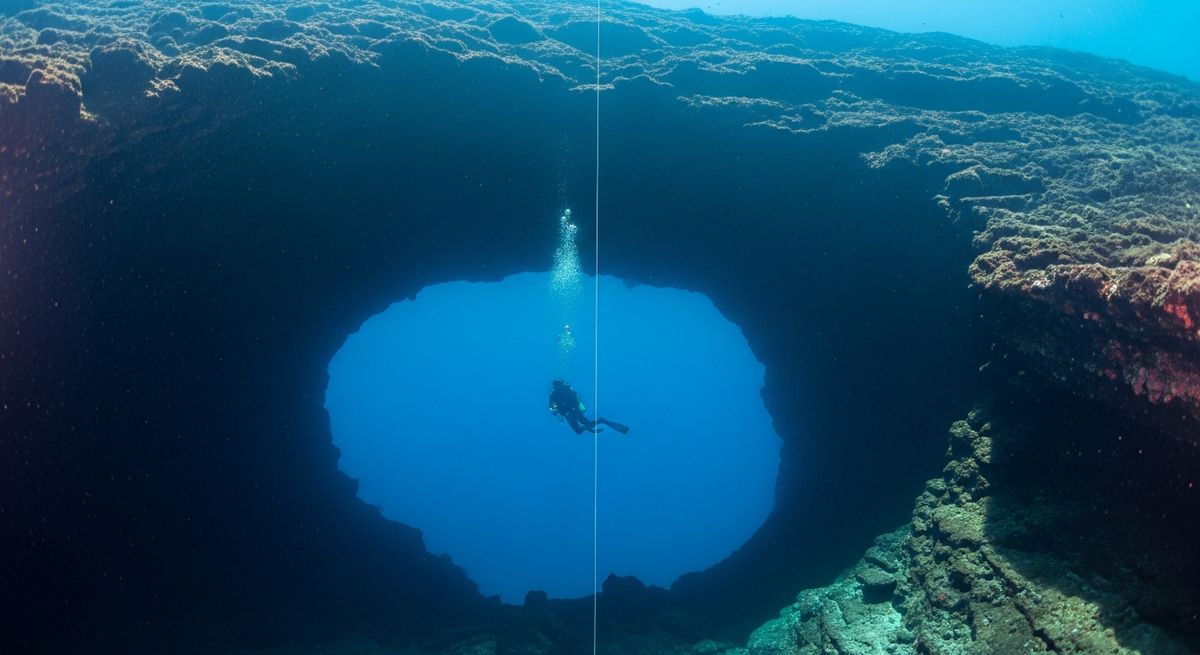
Great Blue Hole
Protected Area
Blue Hole
Why dive here
With 213+ marine species recorded in the area - including barracuda, dolphins, eagle rays, nurse sharks and sea turtles - Great Blue Hole offers some of Lighthouse Reef's richest cave diving. Water ranges 27-30°C, warmest August, September, October.
The Great Blue Hole, smack in the middle of Lighthouse Reef, is one of those places you just have to tick off. We're talking serious bragging rights here, but honestly, it’s more than just a bucket list item. Dropping in, the sheer scale hits you – a perfect circle of deep blue in a sea of turquoise. The real show starts around 40 metres. That’s where you’ll find the giant stalactites, remnants from when this was a dry cave during the last ice age. We love the feeling of swimming amongst these massive ancient formations, they just dwarf you. It’s dark down there, the light fading fast, and it feels genuinely prehistoric. Keep an eye out for the reef sharks that cruise through the deeper sections; they’re often curious, though not overly interested in divers. Visibility is usually good, but the light changes dramatically as you descend, shifting from vibrant blue to a deep, inky indigo. It’s a dive for those who appreciate geology as much as marine life, and it definitely suits divers comfortable with depth and a bit of overhead environment. Our insider tip? Go early in the morning to beat the crowds, and try to time your descent to catch the best light filtering through the opening.
Safety Notes
Overhead environment - never enter without proper cave/cavern training, redundant equipment, and a guideline.
Nearest Dive Centres to Great Blue Hole
Dive shops near Great Blue Hole
View all dive centres in Lighthouse ReefReviews for Great Blue Hole
Conditions
Ocean conditions, forecast and tides for Great Blue Hole
Great Blue Hole Ocean Conditions
Monthly averages for Great Blue Hole, sourced from Open-Meteo marine data + Copernicus Marine (EU) - nearest station: Open-Meteo marine grid (17.22, -87.61) (6km away)
October Averages
Sea Temperature
30°C
86°F · Range: 29.1–31.7°C
Current Speed
11.66 cm/s
Direction: NW (301°)
Chlorophyll-a
0.074 mg/m³
Very clear (oligotrophic)
Salinity
35.96 PSU
Based on 4 years of monitoring data · Data sources: Open-Meteo marine data + Copernicus Marine (EU)
Plan & book
Ways to dive Lighthouse Reef, from day trips to liveaboards.
Day trips & courses
via GetYourGuideGuided dives, courses and snorkel trips with instant booking.
Find dive trips in Lighthouse ReefPlaces to stay
via Booking.comHotels and dive resorts near Lighthouse Reef.
Search stays in Lighthouse ReefDive insurance
Most travel insurance excludes or limits scuba. Check what you need before you go.
Dive insurance explainedPartner links: we may earn a commission if you book, at no extra cost to you. How we make money
Where to Stay near Great Blue Hole
Prices from Booking.com. We may earn a commission at no extra cost to you.